Fortress
Muralla de Santiago de Compostela
🇪🇸 Spain · 11th century
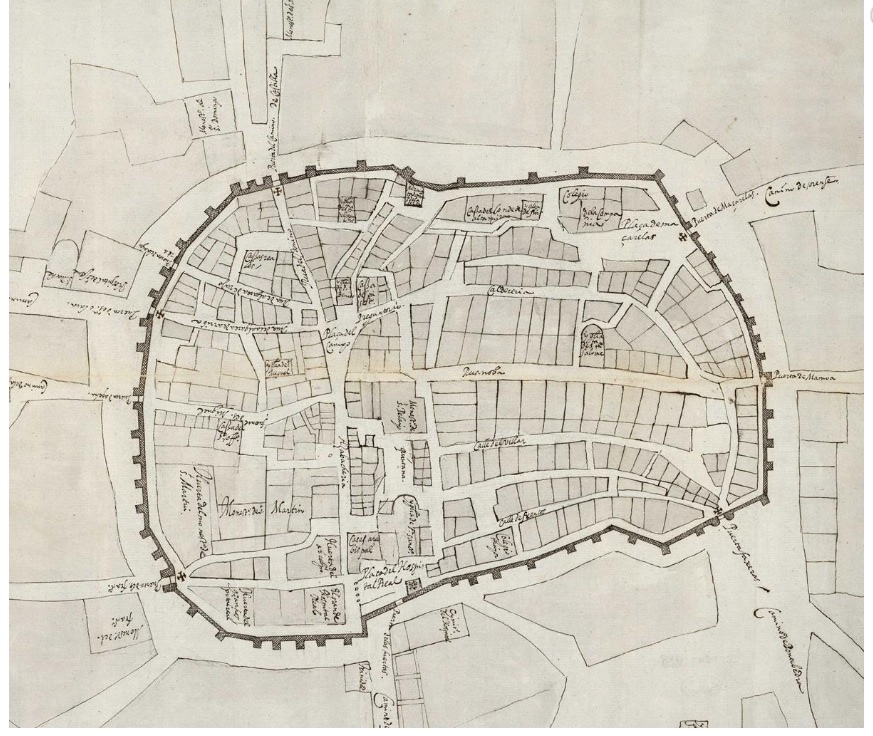
The Santiago de Compostela Wall was a medieval defensive wall in Santiago de Compostela, Galicia, Spain. It was mostly demolished towards the end of the 19th century, although some fragments remain today, the largest being the Mazarelos arch.
In the year 968 Sisenando II walled the area around the church built before the current cathedral, forming the nucleus known as Locus Sancti Iacobi. This space is now occupied by the cathedral, the Quintana Square and the Monastery of Saint Pelagius of Antealtares, with a few adjacent streets. This wall, which was complemented by a second ring made up of moats and palisades, was almost completely destroyed by the Almanzor expedition in 997.
In the middle of the 11th century, given the rise of the city, which was beginning to be a flourishing place of pilgrimage, together with the fear of a Norman or Muslim incursion, bishop Cresconius built a new, much larger wall over the ring of moats and palisades. This new wall, which was about 2 km in circumference and covered a space of 30 hectares, is essentially the one that remained until the 19th century and protected the new suburbs that were forming around the cathedral.
Of the first wall, which disappeared very soon under the new buildings, there are only a few vestiges that have been found in the Azabachería area. In 2009, during the remodeling works of the old Bank of Spain building to accommodate the new Museum of Pilgrimage, a section of this first fortification was found in fairly good condition.
Text adapted from “Walls of Santiago de Compostela” on Wikipedia, CC BY-SA 4.0.
Muralla de Santiago de Compostela ranks #6,324 of 8,134 worldwide in the atlas's castle fame ranking, and #336 of the 602 mapped in Spain. Founded c. 1100, it is older than 86% of the atlas's dated landmarks — one of 325 atlas entries founded in the 11th century. 4 more atlas landmarks stand within 25 km. See how Spain compares in the castle statistics.
View on the interactive castle map →Frequently asked questions
Where is Muralla de Santiago de Compostela?
Muralla de Santiago de Compostela stands in Spain, at 42.88083°, -8.54444°.
When was Muralla de Santiago de Compostela built?
The atlas dates its founding to c. 1100. Earlier structures may have stood on the site; this is the earliest documented founding year.
How famous is Muralla de Santiago de Compostela?
In this atlas's fame ranking: #6,324 of 8,134 worldwide, and #336 in Spain. Fame here combines how many Wikipedia language editions cover a landmark with how many people read them.
What is the nearest castle to Muralla de Santiago de Compostela?
Palacio de Rajoy, about 1 km away.
More castles in Spain
- Castro of Porto de Baixo Spain
- Castro of A Cidá Spain
- Marbella city walls Spain · 10th century
- Torre de Fornells Spain · 19th century
More fortresses
- Torre de Paraires Spain · 13th century
- Torre Picada Spain · 17th century
- Portal de Graells Spain · 15th century
- Puerta de Santiago Spain