Ruin
Namioka Castle
🇯🇵 Japan · 14th century
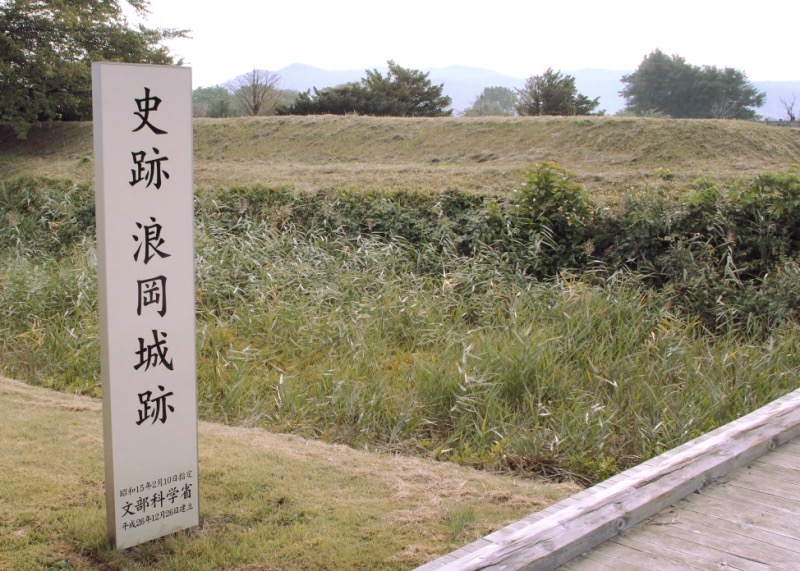
Namioka Castle (浪岡城, Namioka jō) was a Muromachi period Japanese castle located in what is now the city of Aomori, Aomori Prefecture, in the Tōhoku region of far northern Japan. The ruins were designated a National Historic Site in 1940 by the Japanese government.
Namioka Castle is located on a fluvial terrace of the Namioka River, in former Namioka town, south of the center of Aomori city. The location is roughly long and narrow diamond which commands a central location to cover the entry to the Tsugaru Plain from the east.
The castle consisted of eight motte-and-bailey enclosures, approximately 800 meters long by 800 meters wide. The Kitayakata (North Residence) served as the inner bailey, and did not contain a tenshu. The outer enclosures included the Nishiyakata (West Residence), Higashiyakata (East Residence), Uchiyakata (Inner Residence), Shinyakata (New Residence), etc.
As was typical for the time, each enclosure had its own fortifications, which consisted primarily of wooden palisades and earthen ramparts, guarded by a double moat directly connected to the Namioka River. The moats were 20 meters wide by 5 meter deep. The jōkamachi contained streets built in a grid pattern similar to that of Kyoto
Namioka Castle was constructed around 1373, during the early Nanboku-chō period, by the Namioka-Kitabatake clan. During the struggles between Emperor Go-Daigo and Ashikaga Takauji, Kitabatake Akiie, who had been sent to rule northern Japan from Taga Castle was appointed Chinjufu-shōgun. In December 1335, Kitabatake Akiie and his father Kitabatake Chikafusa drove Ashikaga Takauji from Kyoto to Kyushu. However, Takauji was able to raise a new army the following year, and after defeating Emperor Go-Daigo at the Battle of Minatogawa, was able to drive him into exile in Yoshino. Kitabatake Akiie was subsequently defeated by the forces of Kō no Moronao at the Battle of Ishizu in 1338.
His younger brother, Kitabatake Akinobu was also unable to hold Taga Castle and other strongholds against the victorious Ashikaga forces and fled to the far north of Honshū, seeking the protection of the Nanbu clan based at Sannohe Castle and the Andō clan who controlled Tosaminato on the Sea of Japan and changed his family name to “Namioka”.
Text adapted from “Namioka Castle” on Wikipedia, CC BY-SA 4.0.
Namioka Castle ranks #5,552 of 8,134 worldwide in the atlas's castle fame ranking, and #269 of the 297 mapped in Japan. Founded 1373, it is older than 56% of the atlas's dated landmarks — one of 604 atlas entries founded in the 14th century. Its Wikipedia articles were opened 1,460 times in the last 60 days, more than 59% of the atlas. 1 more atlas landmarks stand within 25 km. See how Japan compares in the castle statistics.
View on the interactive castle map →Frequently asked questions
Where is Namioka Castle?
Namioka Castle stands in Japan, at 40.71694°, 140.60444°.
When was Namioka Castle built?
The atlas dates its founding to 1373. Earlier structures may have stood on the site; this is the earliest documented founding year.
How famous is Namioka Castle?
In this atlas's fame ranking: #5,552 of 8,134 worldwide, and #269 in Japan. Fame here combines how many Wikipedia language editions cover a landmark with how many people read them.
What is the nearest castle to Namioka Castle?
Hirosaki Castle, about 17 km away.
More castles in Japan
- Furumiya Castle Japan · 16th century
- Komakiyama Castle Japan · 16th century
- Hiketa Castle Japan
- Niitakayama Castle Japan · 16th century
More ruins
- Liman Castle Turkey
- Fort Elize Carthago Ghana · 18th century
- Petra Mlakou Castle Algeria
- Fortress of São João Brazil