 Poland · 18th century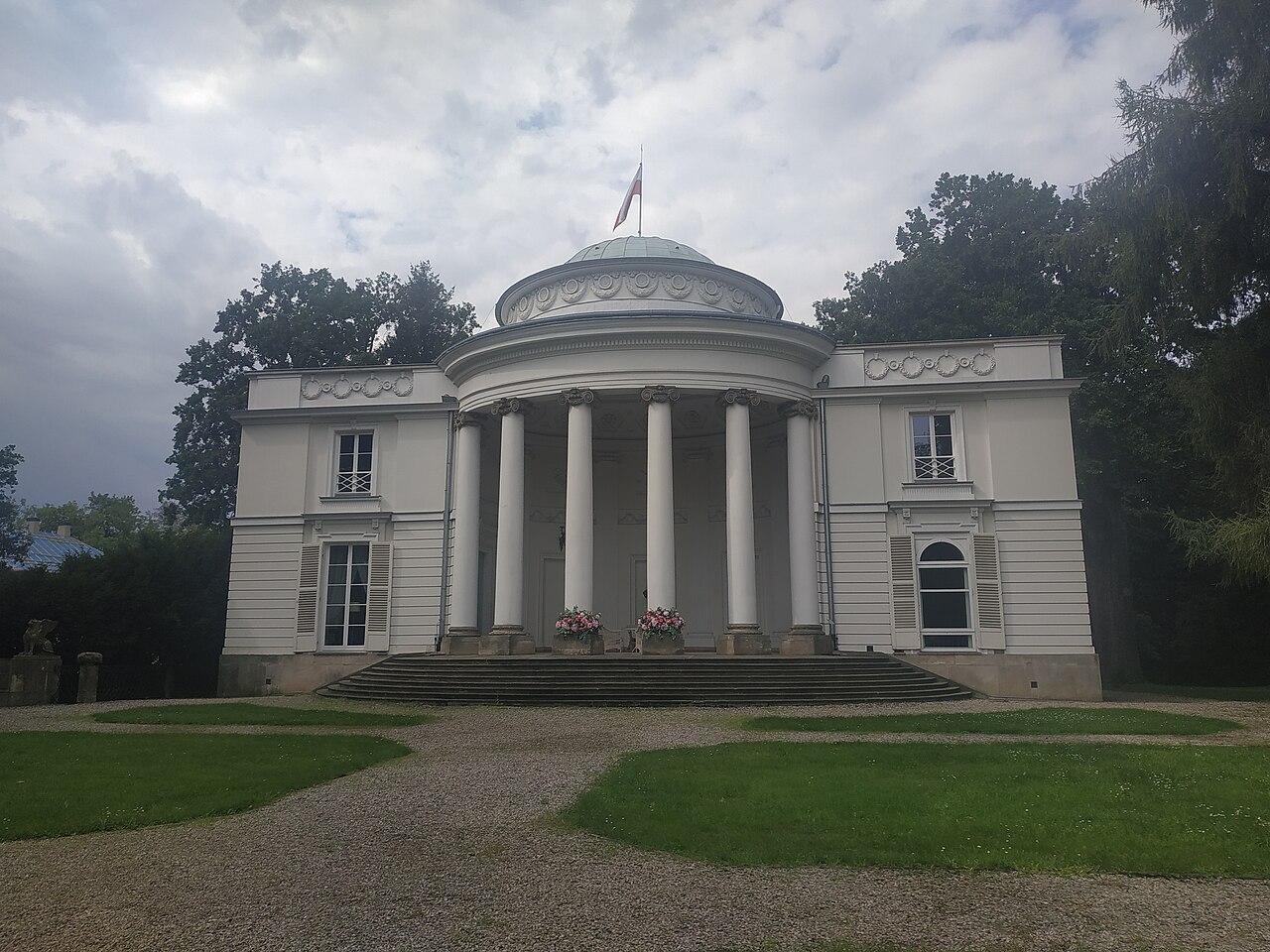
The Natolin Palace and Park Complex (Polish: Zespół pałacowo-parkowy w Natolinie), also known as the Natolin Park (Polish: Park Natoliński) is a historic park and nature reserve (1.2 km2) on the southern edge of Warsaw, Poland, in the Natolin residential neighborhood. It contains the Potocki Palace.
At the end of the 17th century, the King of Poland John III Sobieski started the construction of a royal zoological garden in the village of Natolin. It was a part of his royal residence of Wilanów and also served as a hunting lodge. In the early 1730s, Sobieski's successor King August II the Strong reformed the garden into a pheasant breeding and hunting area. The place was thus called Bażantarnia – Pheasantry. With time, the former royal grounds were passed to the Czartoryski family. In 1780 Prince August Czartoryski built on the spot his new summer residence. Located in dense forests on the escarpment of the Vistula River, the new classicist palace was designed by a renowned contemporary architect Szymon Bogumił Zug while the internal design was prepared by Vincenzo Brenna. The palace featured a distinctive half-open salon, with a view on the forest below the escarpment.
In late 18th century the Wilanów estate, including the grounds around the Pheasantry, passed on to son-in-law of Izabela Lubomirska, Stanisław Kostka Potocki. After the Partitions of Poland, in 1806, Potocki started an extensive modernization of the palace and the park. The Pheasantry was also renamed to its modern name of Natolin in honor of Potocki's granddaughter, Natalia Potocka (born 1807). The palace's reconstruction included rebuilding of the facade and the courtyard elevation, as well as notable changes in the internal design and decorations. The new design was created by another of Poland's notable architects of the epoch, Chrystian Piotr Aigner, though some of the changes are attributed to Potocki himself.
The paintings inside the palace were replaced with stuccos by Wirgiliusz Bauman. Significant changes were applied to the surrounding park, which was converted from a typical classicist French park into a picturesque and then-popular landscape park. The park was also extended to include some romantic buildings and sculptures such as the Holendernia built between 1812 and 1814 by Aigner or two guard houses, modelled after medieval castles, built in 1832.
Text adapted from “Natolin Palace and Park Complex” on Wikipedia, CC BY-SA 4.0.
Natolin Palace ranks #2,710 of 9,035 worldwide in the atlas's castle fame ranking, and #95 of the 397 mapped in Poland. Founded 1780, it is older than 13% of the atlas's dated landmarks, one of 685 atlas entries founded in the 18th century. Its Wikipedia articles were opened 1,445 times in the last 60 days, more than 61% of the atlas. 44 more atlas landmarks stand within 25 km. The nearest day-trip guide is Warsaw, 11 km away. See how Poland compares in the castle statistics.
View on the interactive castle map →