 Italy · 17th century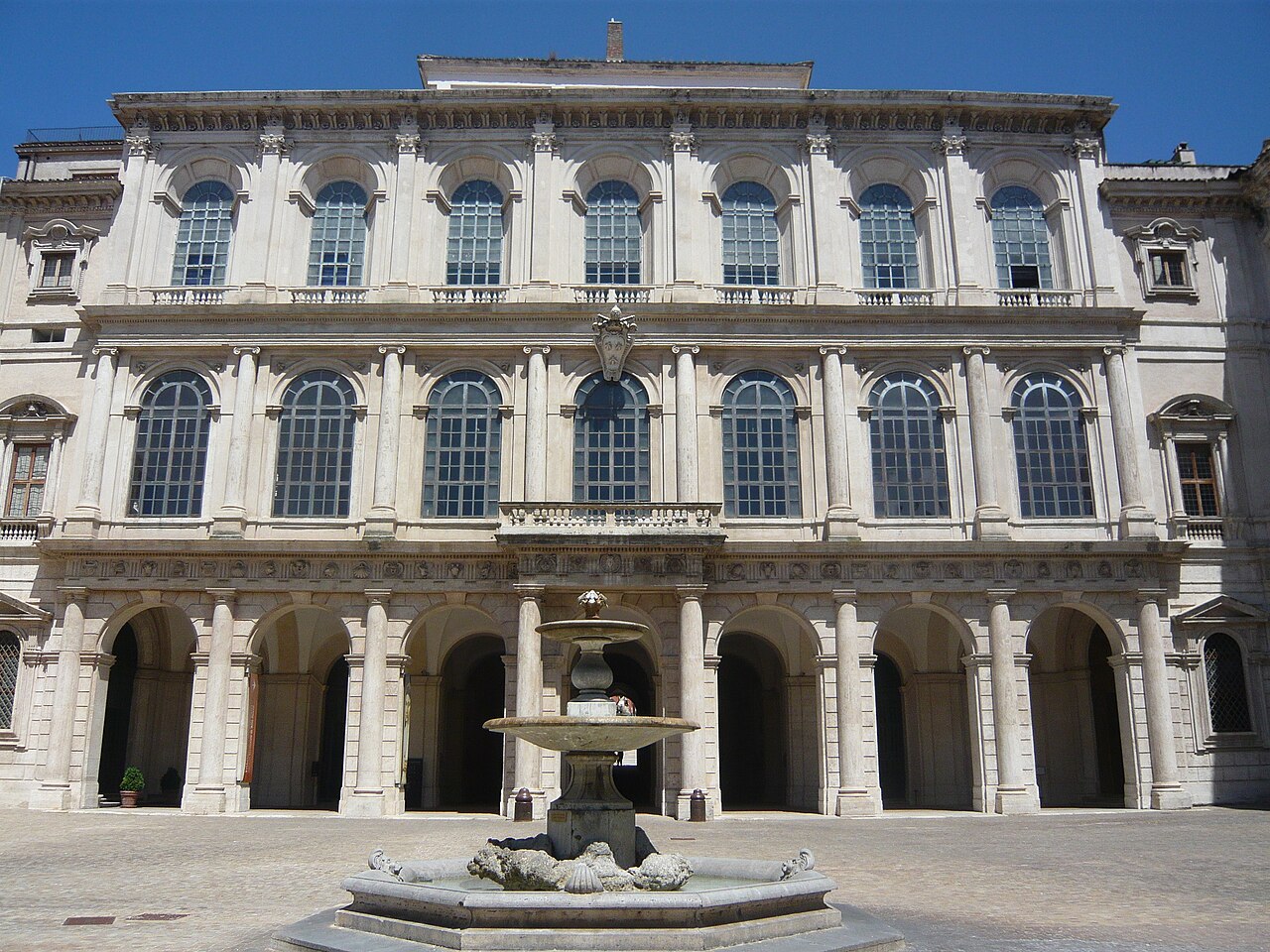
The Palazzo Barberini (English: Barberini Palace) is a 17th-century palace in Rome, facing the Piazza Barberini in Rione Trevi. Today, it houses the Galleria Nazionale d'Arte Antica, the main national collection of older paintings in Rome.
Around 1549 Cardinal Alessandro Sforza came into possession of the garden/vineyard of Cardinal Rodolfo Pio da Carpi on the Quirinal Hill, where the Sforza family had a palazzetto built. The sloping, semi-urban site was purchased in 1625 from Alessandro Sforza, Duca di Segni, by Maffeo Barberini, of the Barberini family, who became Pope Urban VIII.
Three great architects worked to create the Palazzo, each contributing his own style and character to the building. Carlo Maderno, then at work extending the nave of St Peter's, was commissioned to enclose the Villa Sforza within a vast Renaissance block along the lines of Palazzo Farnese; however, the design quickly evolved into a precedent-setting combination of an urban seat of princely power combined with a garden front that had the nature of a suburban villa with a semi-enclosed garden.
Maderno began in 1627, assisted by his nephew Francesco Borromini. When Maderno died in 1629, Borromini was passed over and the commission to oversee construction was awarded to Bernini, a young prodigy then better known as a sculptor. Borromini stayed on regardless and the two architects worked together, albeit briefly, on this project and at the Palazzo Spada. Works were completed by Bernini in 1633.
The palace was inhabited mainly by Pope Urban VIII’s two nephews Francesco and Taddeo, with Taddeo and his family living in one wing and Francesco in the other. Francesco established there the Arazzia Barberini or Barberini Tapestry works, which operated from 1627 until 1679.
In February 1634, a revised version of Il Sant'Alessio was performed at the Teatro delle Quattro Fontane, the Cardinal's private opera theater in the Palazzo. The Cardinal had written the libretto and Stefano Landi the music. Cardinal Francesco's other contributions to the Palazzo were a small natural science museum and botanical garden and a library which included ancient Greek and Roman manuscripts. His collections attested to his interests in ancient sculpture, numismatics and inscriptions. In 1902, the large Biblioteca Barberina was purchased by Pope Leo XIII and became part of the Vatican holdings.
Text adapted from “Palazzo Barberini” on Wikipedia, CC BY-SA 4.0.
Palazzo Barberini ranks #245 of 9,079 worldwide in the atlas's castle fame ranking, and #17 of the 560 mapped in Italy. Founded 1627, it is older than 28% of the atlas's dated landmarks — one of 721 atlas entries founded in the 17th century. Its Wikipedia articles were opened 13,808 times in the last 60 days, more than 96% of the atlas. 65 more atlas landmarks stand within 25 km. The nearest day-trip guide is Rome, 1 km away. See how Italy compares in the castle statistics.
View on the interactive castle map →