 Italy · 16th century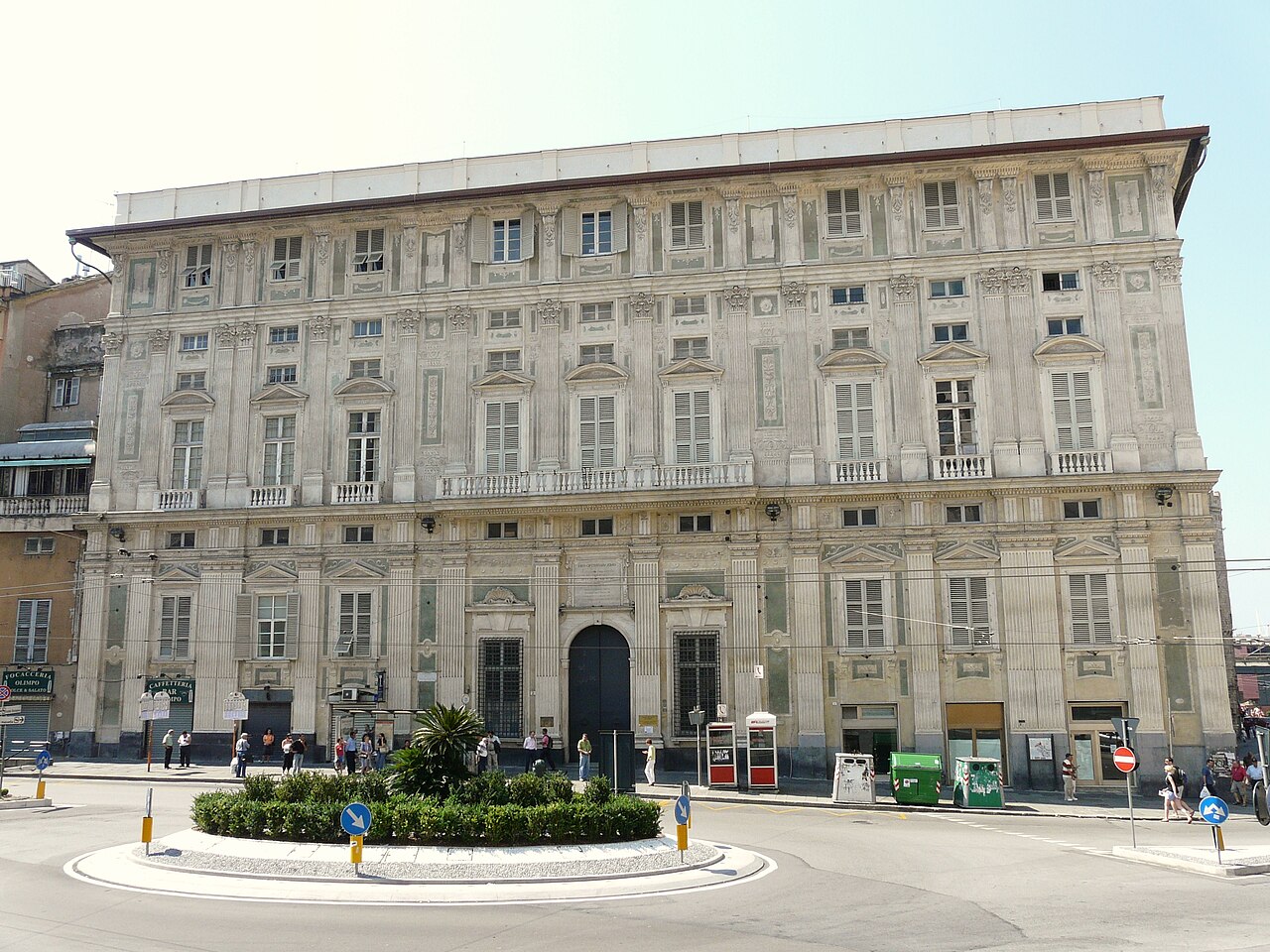
The palazzo Belimbau, also known as palazzo Antoniotto Cattaneo or Palazzo Francesco De Ferrari, is a building in Piazza della Nunziata at number 2 in Genoa, included on 13 July 2006 in the list of the 42 palaces inscribed in the Rolli di Genova that became World Heritage by UNESCO on that date.
The palace was initially built by Antoniotto Cattaneo, a member of the old Genoese nobility, who completed the construction of the building in 1594.
The residence then became the property of Francesco De Ferrari, who with his wife Delia Giustiniani, between 1604 and 1611, probably entrusting the work to the architect Ceresola known as Andrea Vannone, renovated it and united it with another of his adjoining residences, thus giving the building its present architectural and volumetric consistency.
In the first decade of the 17th century, the family commissioned Lazzaro Tavarone (Genoa 1556–1641), a pupil of Luca Cambiaso, to decorate the palace with a vast pictorial cycle with a historical-celebratory theme, which would be deployed on the walls and vault (architecture) of the vestibule, the grand staircase and various rooms on the piano nobile. The frescoes decorating the entrance vestibule, which gives access to the monumental staircase, are dedicated to the life of Cleopatra. In the centre of the vault, the main panel depicts the queen of Egypt sailing in the waters of the Cnidus river, on the grandiose ship with a golden stern and silver oars, as narrated by Plutarch in his Vieces.
All around it within painted mock architectures are fanciful grotesque decorations of a still late Mannerist taste, interspersed with full-length portraits of condottieri. The cycle dedicated to Cleopatra continues on the monumental staircase, where The Meeting of Antony and Cleopatra.
At the end of the staircase, an entrance vestibule leads to the monumental hall facing the balcony overlooking Piazza dell’Annunziata, entirely covered with frescoes dedicated by Tavarone to the Imprese di Cristoforo Colombo Christopher Columbus's exploits. The characters and events depicted are taken from the Historie della vita e dei fatti di Cristoforo Colombo Historie della vita e dei fatti di Cristoforo Colombo by Fernando Colombo, second son of the famous navigator, published in Venice in 1571.
Text adapted from “Palazzo Belimbau” on Wikipedia, CC BY-SA 4.0.
Palazzo Belimbau ranks #6,327 of 9,035 worldwide in the atlas's castle fame ranking, and #446 of the 555 mapped in Italy. Founded 1594, it is older than 32% of the atlas's dated landmarks, one of 886 atlas entries founded in the 16th century. 20 more atlas landmarks stand within 25 km. See how Italy compares in the castle statistics.
View on the interactive castle map →