 Italy · 16th century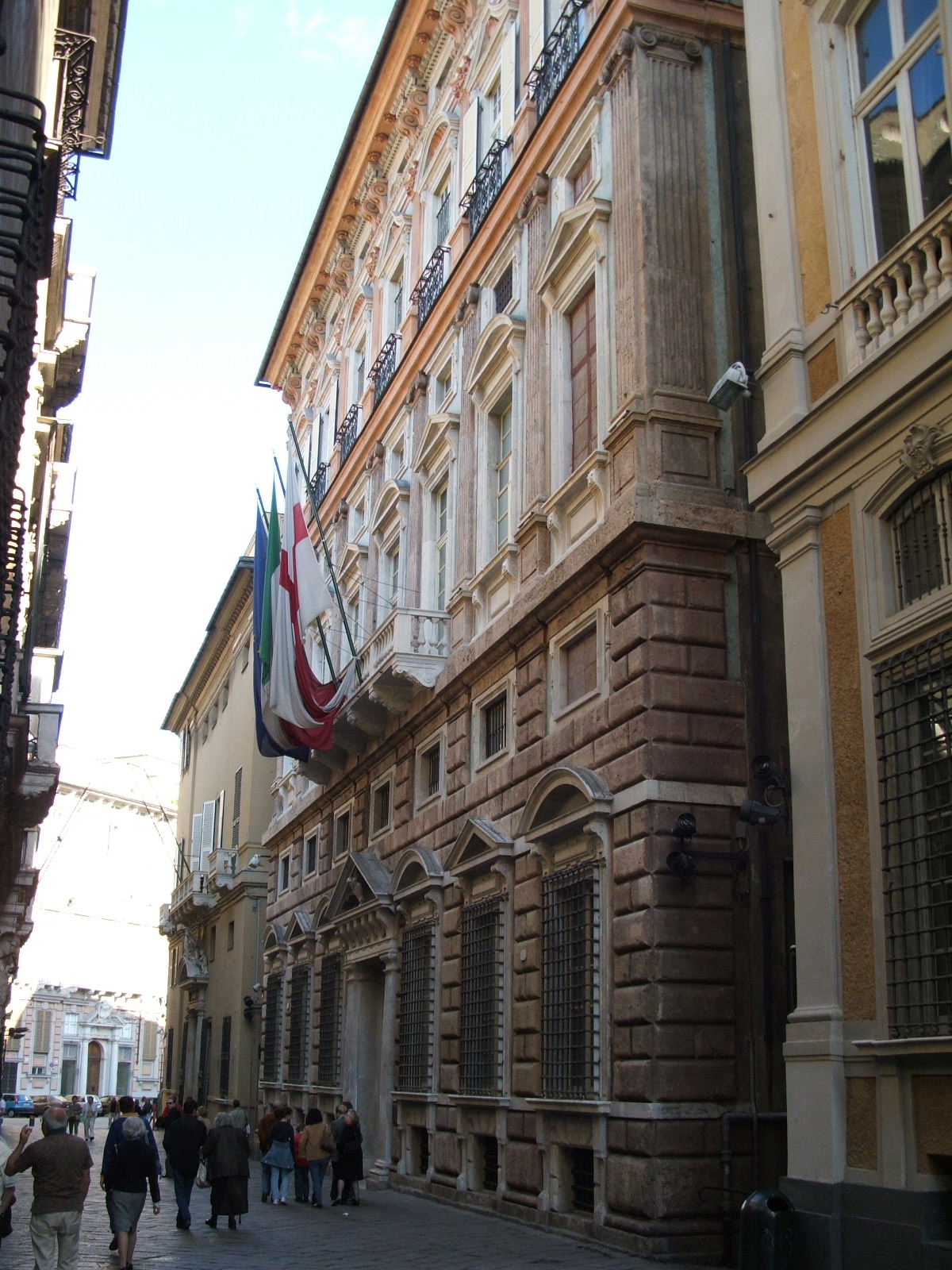
The Palazzo Carrega-Cataldi or Palazzo Tobia Pallavicino is a building located in via Garibaldi (Genoa) at number 4 in the historic centre of Genoa, included on 13 July 2006 in the list of the 42 palaces inscribed in the Rolli di Genova that became World Heritage by UNESCO on that date. The building is now the headquarters of Genoa's Chamber of Commerce.
The palace was built between 1558 and 1561 for Tobia Pallavicino by Giovan Battista Castello «il Bergamasco» with the collaboration of Bartolomeo Riccio, Domenico Solari and Antonio Roderio. This is the first known work executed in Genoa by the Bergamasco, on which he worked at the same time as the decoration of the suburban villa of Pallavicino himself, designed a few years earlier by Galeazzo Alessi, known as Villa Pallavicino delle Peschiere. Tobia Pallavicino, a wealthy alum merchant, was a descendant of one of the city's oldest noble families and held numerous positions for the Genoese republic. He was among the first to purchase a large area for the construction of the family palace overlooking the Strada Nuova designed a few years earlier by Cantoni, with a garden, which disappeared during the 18th-century extensions, opening onto the Piazza del Ferro behind it.
In the construction of the palazzo, Bergamasco, already active in his home town as a decorator and fresco painter, proceeded simultaneously and coherently with the decoration of the external and internal surfaces. The clarity of the façade is Renaissance and of clear Alessian influence, with ashlar cladding in final stone on the ground floor, and pilasters of Ionic order on the first floor that harmoniously mark the façade.
The 16th century construction consisted of a cubic block of two floors plus two mezzanines. The building did not undergo any major alterations until the beginning of the 18th century, when it passed into the ownership of the Carrega family and was raised by one storey and considerably enlarged: two perpendicular arms and the rear body were built, delimited towards Piazza del Ferro by a simple facade with plasterwork.
The interior decoration reflects the two phases of construction: in particular, the two vestibules on the ground and main floors, completely covered in late Renaissance decoration, have survived intact.
Text adapted from “Palazzo Carrega-Cataldi” on Wikipedia, CC BY-SA 4.0.
Palazzo Carrega-Cataldi ranks #5,673 of 9,035 worldwide in the atlas's castle fame ranking, and #405 of the 555 mapped in Italy. Founded 1558, it is older than 36% of the atlas's dated landmarks, one of 886 atlas entries founded in the 16th century. 21 more atlas landmarks stand within 25 km. See how Italy compares in the castle statistics.
View on the interactive castle map →