 Czech Republic · 14th century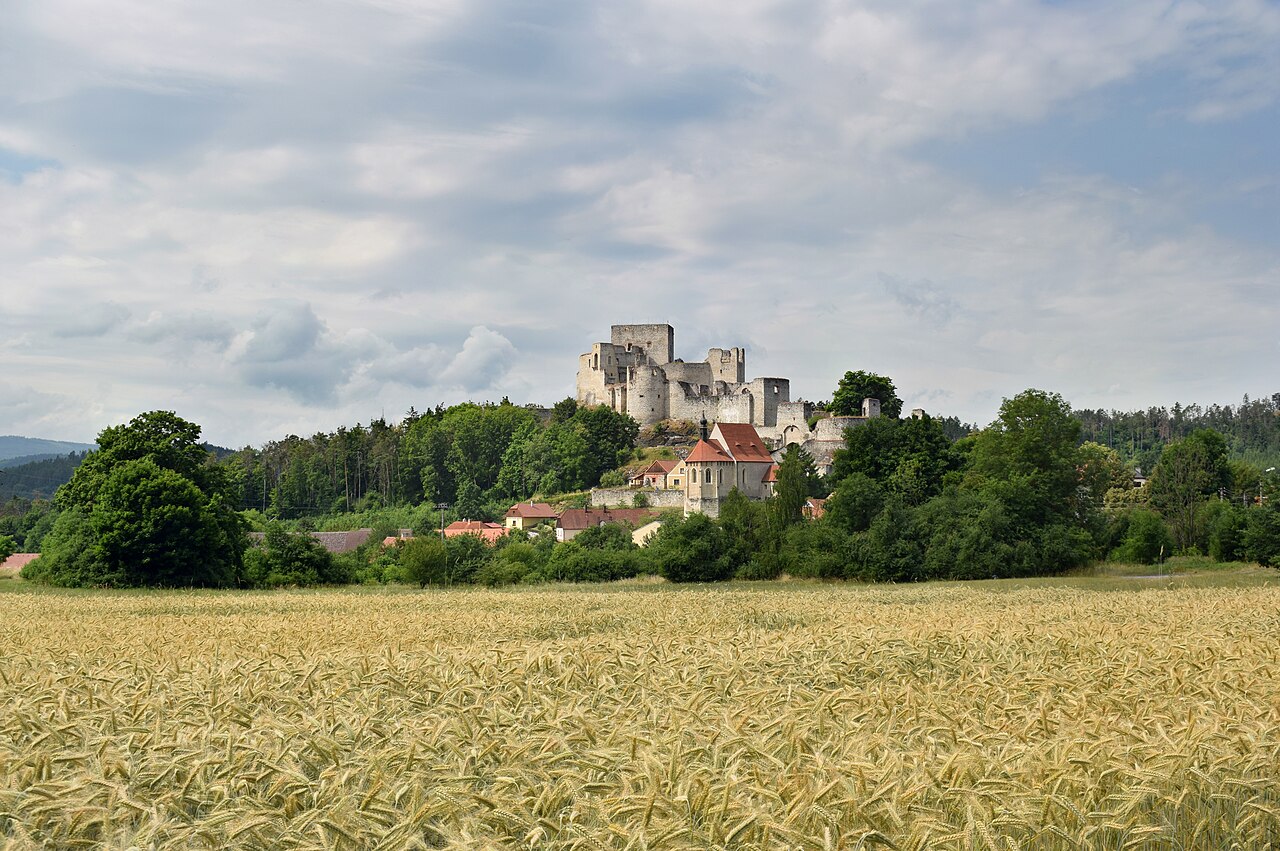
Rabí or Rábí is a ruined castle in the Plzeň Region of the Czech Republic. It is the largest castle (in terms of area) in the country.
Rabí Castle was proclaimed a national cultural monument in 1978.
The name of the castle might derive from the German word raben ("raven"), or it could be mangled Czech name vrab(č)í vrch ("sparrow's peak").
Rabí is located on a prominent hill by the central course of the Otava River, in the foothills of Bohemian Forest Foothills, 130 kilometres (81 mi) southwest of Prague.
The first mention of Rabí Castle dates from 1380, although it is not known exactly when it was founded. It is likely that the Lords of Velhartice established it after 1300 to protect trade routes along the Otava and also to inspect gold-bearing deposits in it. They built a strong palace, ramparts and a keep. Subsequent owners, the Švihovský of Rýzmburk family, continued the building work and built the outer ward and two square towers.
At the start of the Hussite rebellions, the Švihovský family searched for havens of supporters of the Catholic side in the district and for their treasures, at Rabí. In 1420–1421, the Hussites conquered the castle twice, and legend has it that during the second siege, an arrow shot from a crossbow hit the trunk of a pear tree and a splinter from the tree hit Jan Žižka in his only good eye. In 1479, the provincial governor Půta Švihovský of Rýzmberk became the owner of the estate and began with a thoughtful remodelling of the castle under the guidance of famous master Benedict Rejt. New living quarters and service buildings were constructed, the castle was enlarged and the fortifications heightened.
Rabí Castle was, from the very start, envisioned as a donjon-type castle. It was built in the form of three separate sections, constructed in tiers above each other. The ramparts were up to 6 metres (20 ft) wide, and had bastions, vallum fortifications and moats. However, building activity exhausted the Švihovský family's finances and the fortifications remained incomplete.
Many alchemical experiences took place during Půta's time as well; a German alchemist who failed to transform lead into gold was then imprisoned in the castle's massive prismatic tower. Půta had three nannies walled in alive for turning his wife against his brothers. His son later sold the estate in 1549, but the new owners did not invest in the castle.
Text adapted from “Rabí Castle” on Wikipedia, CC BY-SA 4.0.
Rabí Castle ranks #2,485 of 9,079 worldwide in the atlas's castle fame ranking, and #64 of the 243 mapped in Czech Republic. Founded c. 1400, it is older than 50% of the atlas's dated landmarks — one of 755 atlas entries founded in the 14th century. Its Wikipedia articles were opened 3,190 times in the last 60 days, more than 79% of the atlas. Wikidata records about 55,000 visitors in 2022. 6 more atlas landmarks stand within 25 km. The nearest day-trip guide is Plzeň, 54 km away. It is one of the 189 landmarks on the atlas's regional map of Bohemia. It is stop 22 of 28 on the Bohemian castle route, Prague to Český Krumlov. See how Czech Republic compares in the castle statistics.
View on the interactive castle map →