 Spain · 11th century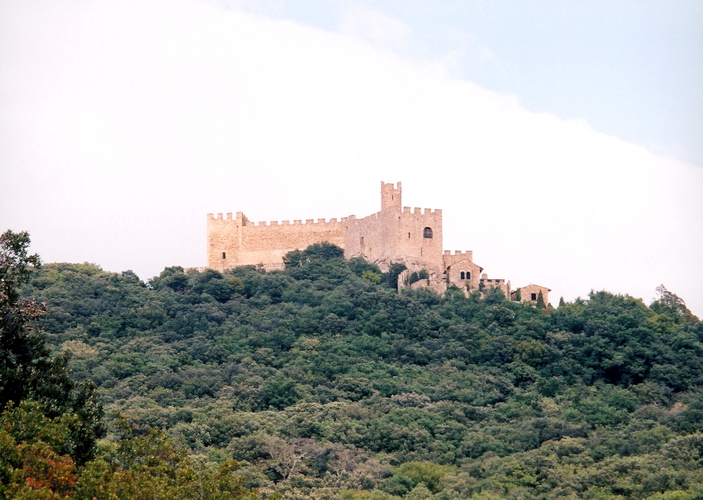
Requesens Castle is situated on a hill overlooking the southern valleys of Mount Neulós, approximately 7 km east of the Requesens neighbourhood. For centuries, it has controlled the passage into Spain and corresponds to the ancient village of Requesens, a settlement in La Jonquera.
The castle is referenced in a grievance memorial (rancures) from Count Ponç I of Empúries to his cousin, Count Gausfred II of Roussillon, and his son, Giselbert (circa 1040-1071). Ponç I protested the recent construction of the castle (“castrum de recoser”) by the latter on allodial land entrusted to them within the territory of the County of Empúries.
The construction of this first documented castle in Requesens was part of the disputes between the two counties following their separation at the end of the 10th century. The Counts of Roussillon retained control within the County of Empúries until their extinction. The lordship of Requesens (dominicaturam de Rechesen) was confirmed to them in a 1075 agreement between the respective counts, and control over the castle (castrum Rechosindo) was reaffirmed in agreements of 1085 and 1121. The Roussillon counts or their vassals had a “castlà” (lord of the castle), who, during the first half of the 12th century, was a member of the same count family, indicating their ongoing interest.
These individuals owed allegiance to the Count of Empúries and also to the Viscount of Peralada, within whose territories the fortress was located. During the 12th century, conflicts arose due to the alliance between the Rocabertí, viscounts of Peralada, and the Counts of Roussillon, making Requesens Castle a significant factor in these disputes. One such conflict, known as the “war of Requesens” (1047-1072), began with the capture of the castle by Count Ponç II of Empúries. This count was troubled by the isolation of his domains, surrounded by the lands of a single lord, the Count of Barcelona, who seized the county in 1172. To pacify the region, the new lord of Roussillon, King Alfonso II, renounced his rights to Requesens in favour of the Count of Empúries, thereby securing full control.
Very few remnants of the castle from these events remain, primarily located in the area of the upper enclosure, which, in the 13th century, when a new outer enclosure was built, was known as the greater or upper fortress.
Text adapted from “Requesens Castle” on Wikipedia, CC BY-SA 4.0.
Requesens Castle ranks #2,602 of 9,035 worldwide in the atlas's castle fame ranking, and #95 of the 606 mapped in Spain. Founded c. 1055, it is older than 89% of the atlas's dated landmarks, one of 439 atlas entries founded in the 11th century. Its Wikipedia articles were opened 1,936 times in the last 60 days, more than 69% of the atlas. 10 more atlas landmarks stand within 25 km. The nearest day-trip guide is Perpignan, 28 km away. See how Spain compares in the castle statistics.
View on the interactive castle map →