 Poland · 14th century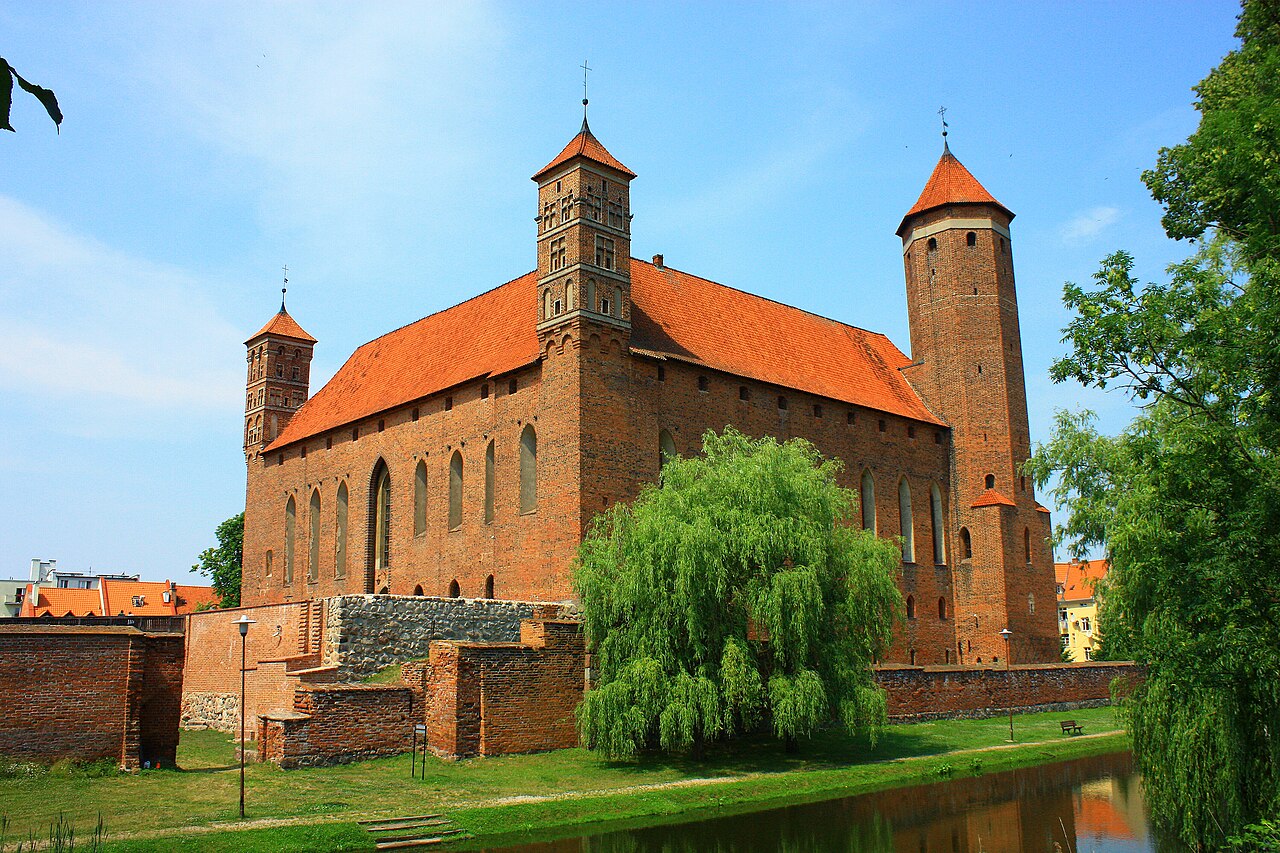
The Lidzbark Castle (Polish: Zamek w Lidzbarku, German: Burg Heilsberg), officially known as Lidzbark Bishops' Castle, is a fortified castle and palace from the 14th century located in the town of Lidzbark Warmiński, Warmian-Masurian Voivodeship, in northern Poland. It is one of the most precious Gothic structures in the country and a popular destination for holidaymakers.
The palatial stronghold in Lidzbark Warmiński, which for centuries was the largest town in Warmia, is located by the estuary of the river Symsarna with the river Łyna. The stronghold is encircled by a defensive moat. An additional "dry moat" encircled the local living quarters located close to the stronghold – all of the defensive structures survive except the northern-moat, where the castle's windmill was once located.
The castle was built on a plan of a square formation, with 48,5 metre long walls. A fourteen level tower is located in the north-east wing of the castle. The lower part of the tower, built in a square structure has posterns – while the upper part of the tower is octagonal. The other four corners of the castle have small square decorational towers, whose design changed throughout the centuries.
The castle courtyard is made up of two levels – both with cloisters; these are the only historical cloisters in Poland which have not architecturally changed. The stronghold has aspects relating to the Teutonic Order, whose architectural style can be both seen in the castle's courtyard but also traced in the representative level of the castle in: the chapel; the small and big refectory; in the capitulary; common hall; and in the bishops' chambers.
The castle serves as one of the main attractions of the town and regularly hosts cabaret events in the Autumn months.
The castle was built between 1350 and 1401 as the seat of the Warmian bishops, later going into the hands of the Teutonic Order. The Teutonic Knights lost the castle in 1466, after the Second Peace of Toruń – the fortress was part of the Polish–Lithuanian Commonwealth up until 1795 (after the Third Partition of Poland; where behind the castle walls artistic life thrived. In 1794, Ignacy Krasicki, the last residing bishop, left the castle. His successors – bishops Karol and Józef Hohenzollern – moved to Oliwa. In 1963, the castle became the premises of the Branch of the Museum of Warmia and Masuria in Olsztyn.
Text adapted from “Lidzbark Castle” on Wikipedia, CC BY-SA 4.0.
Castle of Warmian Bishops in Lidzbark Warmiński ranks #2,234 of 9,035 worldwide in the atlas's castle fame ranking, and #76 of the 397 mapped in Poland. Founded 1350, it is older than 54% of the atlas's dated landmarks, one of 757 atlas entries founded in the 14th century. Its Wikipedia articles were opened 2,986 times in the last 60 days, more than 78% of the atlas. 1 more atlas landmarks stand within 25 km. The nearest day-trip guide is Kaliningrad, 66 km away. It is one of the 25 landmarks on the atlas's regional map of Warmia and Masuria. It is stop 8 of 9 on the Teutonic castle road, Toruń to Malbork. See how Poland compares in the castle statistics.
View on the interactive castle map →