 Bhutan · 17th century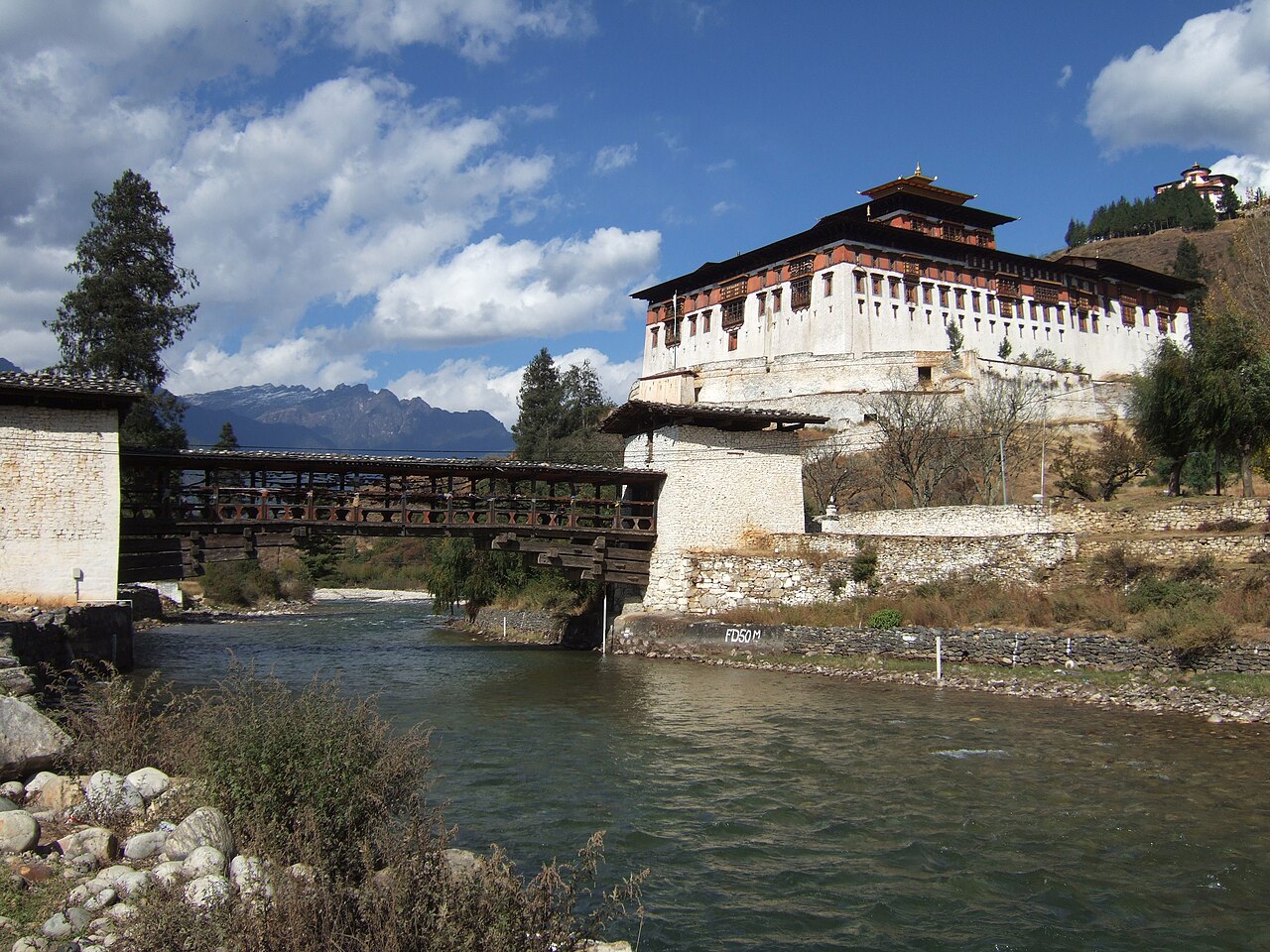
Rinpung Dzong, sometimes referred to as Paro Dzong, is a large dzong - Buddhist monastery and fortress - of the Drukpa Lineage of the Kagyu school in Paro District, Bhutan. It houses the district Monastic Body as well as government administrative offices of Paro Dzongkhag. It is listed as a tentative site in Bhutan's Tentative List for UNESCO inclusion.
According to historical accounts of Paro Dzong, the rock face below the site was named Ringpung by Guru Rinpoche in the 8th century. When the dzong was later constructed at this location, it came to be known as Ringpung Dzong.
In the 15th century, the local community offered the crag of Hungrel at Paro to Lama Drung Drung Gyal, a descendant of Phajo Drugom Zhigpo. Drung Drung Gyal constructed a small temple and later a five-storey fortress known as Hungrel Dzong.
By the 17th century, his descendants, known as the Lords of Hungrel, offered this fortress to the Zhabdrung Ngawang Namgyal, founder of the unified Bhutanese state and head of the Drukpa Lineage, in recognition of his religious and political authority. In 1644, the Zhabdrung dismantled the old structure and laid the foundations for a new dzong. The new fortress was consecrated in 1646 and established as the administrative and monastic centre of western Bhutan, thereafter becoming known as Rinpung Dzong.
During the tenure of the 23rd Penlop, Dawa Penjor, the dzong was severely damaged by fire, prior to the enthronement of the first king, Gongsa Ugyen Wangchuck. Most of the relics and statues were destroyed, with the exception of the 20-metre-wide Thongdrel. Devotees believe that paying homage to the Thongdrel brings spiritual merit and the potential for liberation.
The dzong has also appeared in popular culture; several scenes from the 1993 film Little Buddha were filmed at Paro Rinpung Dzong.
Kungarwa Monks' assembly hall Sandalwood Stupa Protector's shrine Temple of the Guru's Eight Manifistations (Dzongkha: གུ་རུ་མཚན་རྒྱད་ལྷ་ཁང) Chapel of the head lama Chapel of Amitayus The Clear Crystal Shrine Chapel of the Eleven-faced Avalokiteśvara Apartments of the Abbot Chapel of Akshobhya Temple of the Treasure Revealer Apartments of the King (Gyalpo'i Zimchung) Temple of the Bursar Outside the main dzong is the Deyangkha Temple.
Text adapted from “Rinpung Dzong” on Wikipedia, CC BY-SA 4.0.
Rinpung Dzong ranks #2,111 of 9,035 worldwide in the atlas's castle fame ranking, and #4 of the 14 mapped in Bhutan. Founded 1645, it is older than 26% of the atlas's dated landmarks, one of 708 atlas entries founded in the 17th century. Its Wikipedia articles were opened 1,431 times in the last 60 days, more than 60% of the atlas. 4 more atlas landmarks stand within 25 km. The nearest day-trip guide is Thimphu, 21 km away. See how Bhutan compares in the castle statistics.
View on the interactive castle map →