 Bhutan · 13th century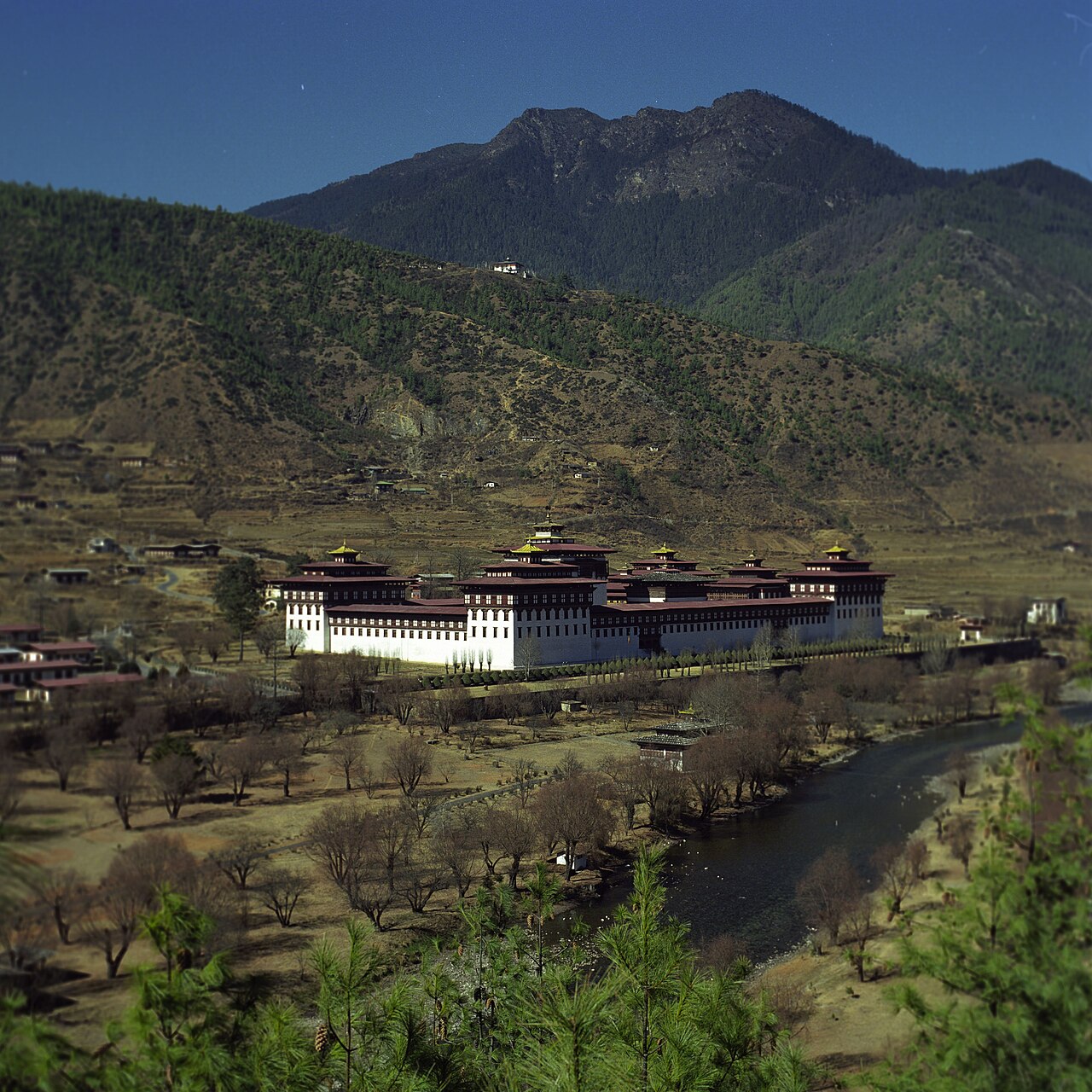
Tashichho Dzong (Dzongkha: བཀྲ་ཤིས་ཆོས་རྫོང) is a Buddhist monastery and fortress on the northern edge of the city of Thimphu in Bhutan, on the western bank of the Wang Chu. It has traditionally been the seat of the Druk Desi (or "Deb Raja"), the head of Bhutan's civil government, an office which has been combined with the kingship since the creation of the monarchy in 1907, and summer capital of the country. In old British documents, it is known as Tassisudon. According to a 1922 traveller:
It was built by the first Dharma Raja, who also founded the Lho-drukpa sect of Buddhism, which has remained the distinctive sect of Bhutan. The correct transliteration of the vernacular name—Bkrashis-chhos-rdzong, meaning "the fortress of auspicious doctrine"—is, according to Graham Sandberg, Tashichhoidzong.
The main structure of the whitewashed building is two-storied with three-storied towers at each of the four corners topped by triple-tiered golden roofs. There is also a large central tower or utse.
Text adapted from “Tashichho Dzong” on Wikipedia, CC BY-SA 4.0.
Tashichho Dzong ranks #1,188 of 9,079 worldwide in the atlas's castle fame ranking, and #1 of the 14 mapped in Bhutan. Founded c. 1250, it is older than 67% of the atlas's dated landmarks — one of 1080 atlas entries founded in the 13th century. Its Wikipedia articles were opened 3,358 times in the last 60 days, more than 80% of the atlas. 5 more atlas landmarks stand within 25 km. The nearest day-trip guide is Thimphu, 2 km away. See how Bhutan compares in the castle statistics.
View on the interactive castle map →