 Italy · 12th century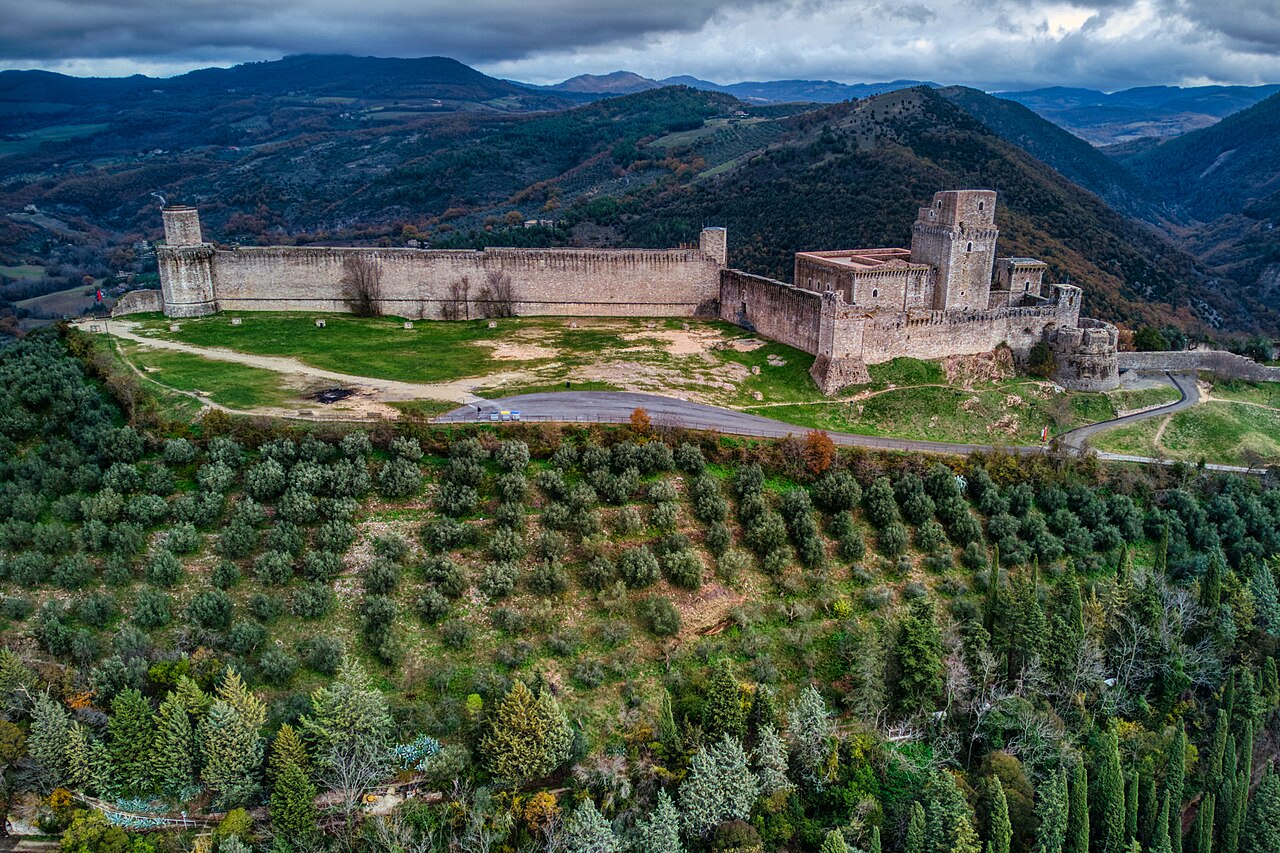
The Rocca Maggiore is a castle that served as the principal defensive fortification of the city of Assisi and the Tescio valley, dominating the area for more than eight hundred years.
The current structure of Rocca Maggiore was built in 1316 and consists of two fortresses: the Major and the Minor.
The first documented reference to the fortress dates back to 1173, when the German diplomat and Catholic archbishop Christian of Mainz (1130–1183), chancellor of Germany under Emperor Frederick I Barbarossa, occupied Assisi on behalf of the emperor, who stayed there for a short period.
The young future King of Sicily and Holy Roman Emperor, Frederick II, also resided in the fortress. He had been entrusted by his mother, Costanza d'Altavilla, to the Duchess of Urslingen, the wife of Corrado, Duke of Spoleto and comes Assisi, a close confidant of the Swabian monarch.
Empress Constance later returned to Sicily, but came back to Assisi accompanied by her husband, Henry VI of Swabia. Their son was baptized at the Cathedral of San Rufino and was given the auspicious name Frederick Roger, in honor of his two grandfathers.
In 1198, the city came under the control of the Guelphs loyal to Pope Innocent III. The local population, in opposition to imperial rule, expelled the imperial legate and the young Frederick — who was only four years old — and inflicted extensive damage on the fortress. That same year, Francis of Assisi was sixteen years old.
The fortress was reconstructed in 1356 on the initiative of Cardinal Gil Álvarez Carrillo de Albornoz (1310–1367), who had been commissioned by Pope Innocent VI during the Avignon Papacy to strengthen the fortifications of the Papal States.
In 1458, the captain of Perugia and Lord of Assisi, Jacopo Piccinino (1423–1465), built the polygonal northwestern tower, which was later completed by Pope Pius II. It was connected to the rest of the fortress by a fortified, defensible corridor.
The complex consists of fortress walls built with the pink limestone of Mount Subasio. The walls are trapezoidal in shape, with towers at each corner. Among these is a square formwork structure, renovated in 1478 by Pope Sixtus V, on which the keep now stands.
Text adapted from “Rocca Maggiore” on Wikipedia, CC BY-SA 4.0.
Rocca Maggiore ranks #1,922 of 9,079 worldwide in the atlas's castle fame ranking, and #140 of the 560 mapped in Italy. Founded 1173, it is older than 79% of the atlas's dated landmarks — one of 756 atlas entries founded in the 12th century. Its Wikipedia articles were opened 2,744 times in the last 60 days, more than 76% of the atlas. Wikidata records about 8,961 visitors in 2021. 2 more atlas landmarks stand within 25 km. The nearest day-trip guide is Terni, 57 km away. See how Italy compares in the castle statistics.
View on the interactive castle map →