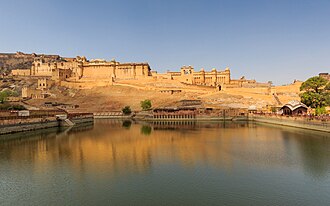
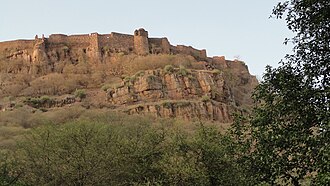
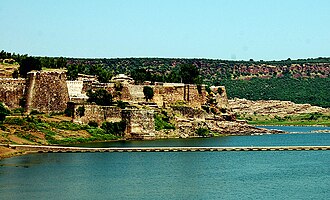
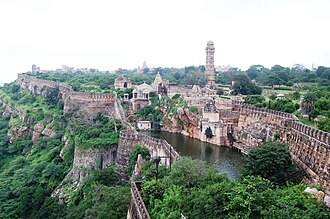
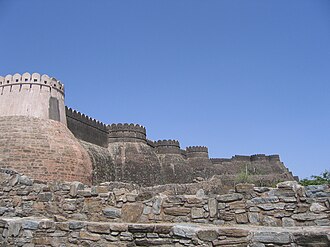
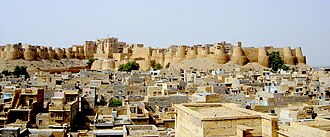
UNESCO inscribed six Rajput hill forts as one World Heritage Site in 2013, on the grounds that together they show what a Rajput kingdom was: a fortified hill enclosing not just a garrison but a whole town, with palaces, temples, tanks and bazaars inside the walls. Kumbhalgarh’s perimeter wall runs 36 kilometres, one of the longest continuous walls in the world; Jaisalmer’s fort is still lived in, by about a quarter of the old town’s population.
What this atlas maps on the Rajasthan hill forts
Every stop is named in the route itself rather than chosen by a radius, spanning 10th century to 16th century.
The best known is Amber Fort, ranked 118 of the 9,035 landmarks in the atlas by Wikipedia presence and real readership. The oldest is Ranthambore Fort, founded c. 950.
The route runs through India. The same ground, without the itinerary: Castles in Rajasthan.
Travelling it
The six are spread across the state and the distances are long: Jaisalmer sits out in the Thar Desert, 575 kilometres west of Jaipur. Ranthambore is inside a tiger reserve.
Day-trip guides for the towns and cities along it: Jaipur.
See the route on the map →