Fortress
Royal Walls
🇪🇸 Spain · 10th century
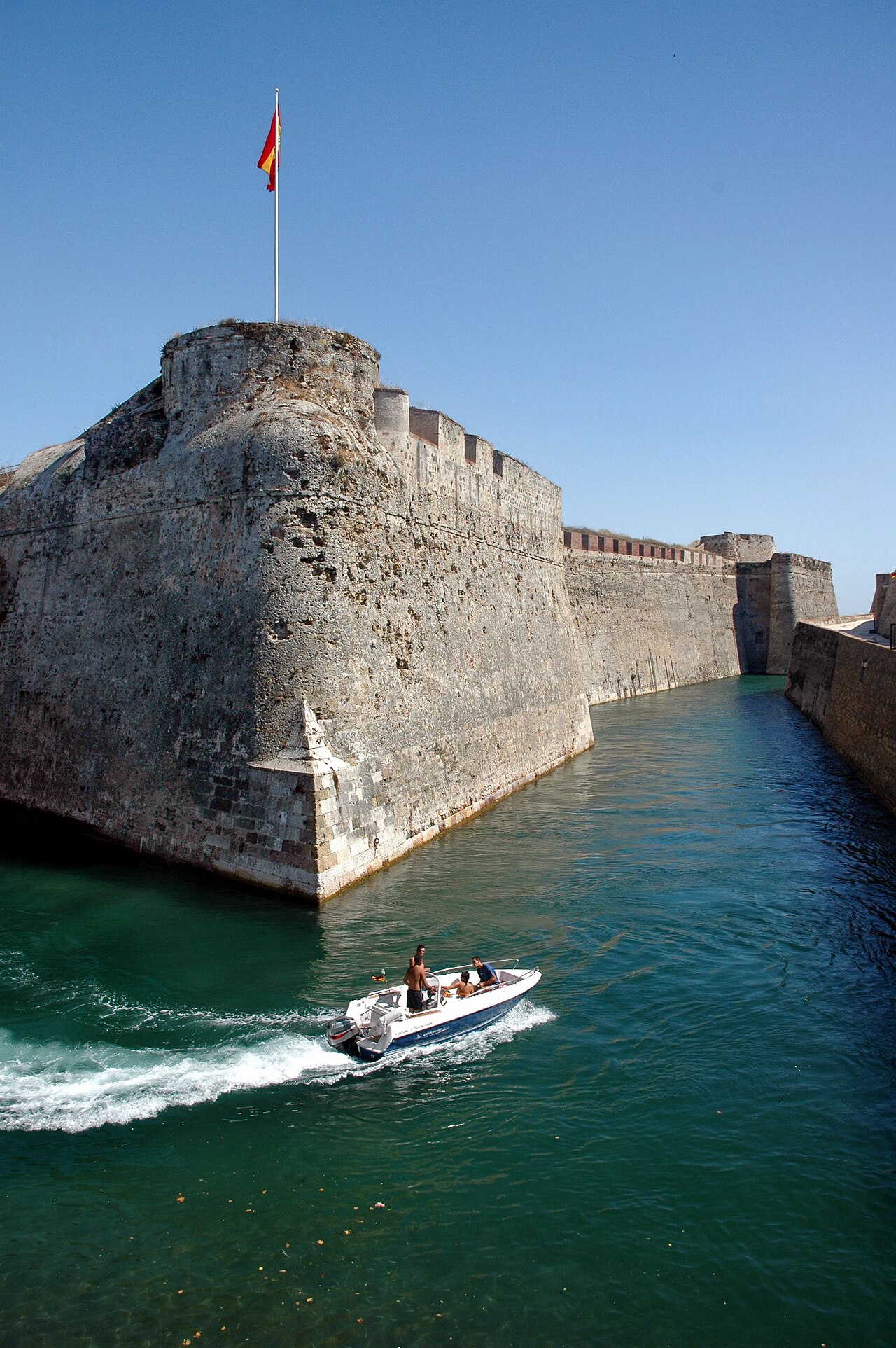
The Royal Walls of Ceuta (Spanish: Murallas Reales de Ceuta) are a line of fortification in Ceuta, an autonomous Spanish city in north Africa. The walls date to 962 in its oldest part and the most modern parts to the 18th century. They remain largely intact, with the exception of some outworks, and are listed as a Spanish Property of Cultural Interest.
Ceuta had been a naval base since Carthaginian and Roman times, and had some form of fortification since at least the 5th century. The city was captured by the Portuguese during the Conquest of Ceuta in 1415, who began to strengthen the defences in the 1540s by building the Royal Walls including bastions, a navigable moat and a drawbridge. Some of these bastions are still standing, like the bastions of Coraza Alta, Bandera and Mallorquines.
In 1669, Ceuta became part of the Kingdom of Spain following the dissolution of the Iberian Union. The walls at the southern end of the city were severely damaged in a storm in 1674, but were quickly repaired. Some outworks were subsequently added to reinforce the Royal Walls.
The Royal Walls played a significant role in the Sieges of Ceuta, which began in 1694. Whenever there was an interval in the fighting, the Spanish added more outworks. The siege was broken in 1720 after the arrival of a relief force, and the outworks were completely rebuilt at this stage. Ceuta was besieged again in 1721, but by now the fortifications were much stronger and the last Moorish attempt to take the city ended in 1734.
Further modifications to the fortifications were made in the 1730s. Another Moorish siege occurred between 1790 and 1791, but the attack was repelled. During the Napoleonic Wars, the city was garrisoned by British troops allied with Spain. The walls were eventually decommissioned when they became obsolete in the 19th century.
Parts of the walls, especially the outworks, were demolished to make way for urban development. However, the Royal Walls, their ditch, and the first line of outworks remain intact, and have been restored in recent years. On 3 July 1985 they were declared a Spanish heritage site. The walls were one of 100 candidates for the 12 Treasures of Spain in 2007 and the only one of those in Ceuta. Parts of the walls are open to the public.
The Royal Walls are a land front running across the isthmus separating Ceuta from the rest of North Africa.
Text adapted from “Royal Walls of Ceuta” on Wikipedia, CC BY-SA 4.0.
Royal Walls ranks #1,279 of 8,134 worldwide in the atlas's castle fame ranking, and #45 of the 602 mapped in Spain. Founded 962, it is older than 93% of the atlas's dated landmarks — one of 138 atlas entries founded in the 10th century. Its Wikipedia articles were opened 9,258 times in the last 60 days, more than 92% of the atlas. The nearest day-trip guide is Algeciras, 29 km away. See how Spain compares in the castle statistics.
View on the interactive castle map →Frequently asked questions
Where is Royal Walls?
Royal Walls stands in Spain, at 35.88861°, -5.31889°.
When was Royal Walls built?
The atlas dates its founding to 962. Earlier structures may have stood on the site; this is the earliest documented founding year.
How famous is Royal Walls?
In this atlas's fame ranking: #1,279 of 8,134 worldwide, and #45 in Spain. Fame here combines how many Wikipedia language editions cover a landmark with how many people read them.
What is the nearest castle to Royal Walls?
Charles V Wall, about 27 km away.
More castles in Spain
- Castle of Lorca Spain · 9th century
- Alcazaba of Badajoz Spain · 9th century
- Castle of Xàtiva Spain
- Roman Theatre of Cádiz Spain · 1st century BC
More fortresses
- Biertan fortified church Romania · 16th century
- Fortifications of Rhodes Greece
- Theresienstadt Small Fortress Czech Republic · 18th century
- Qala-i-Jangi Afghanistan · 19th century