 Latvia · 12th century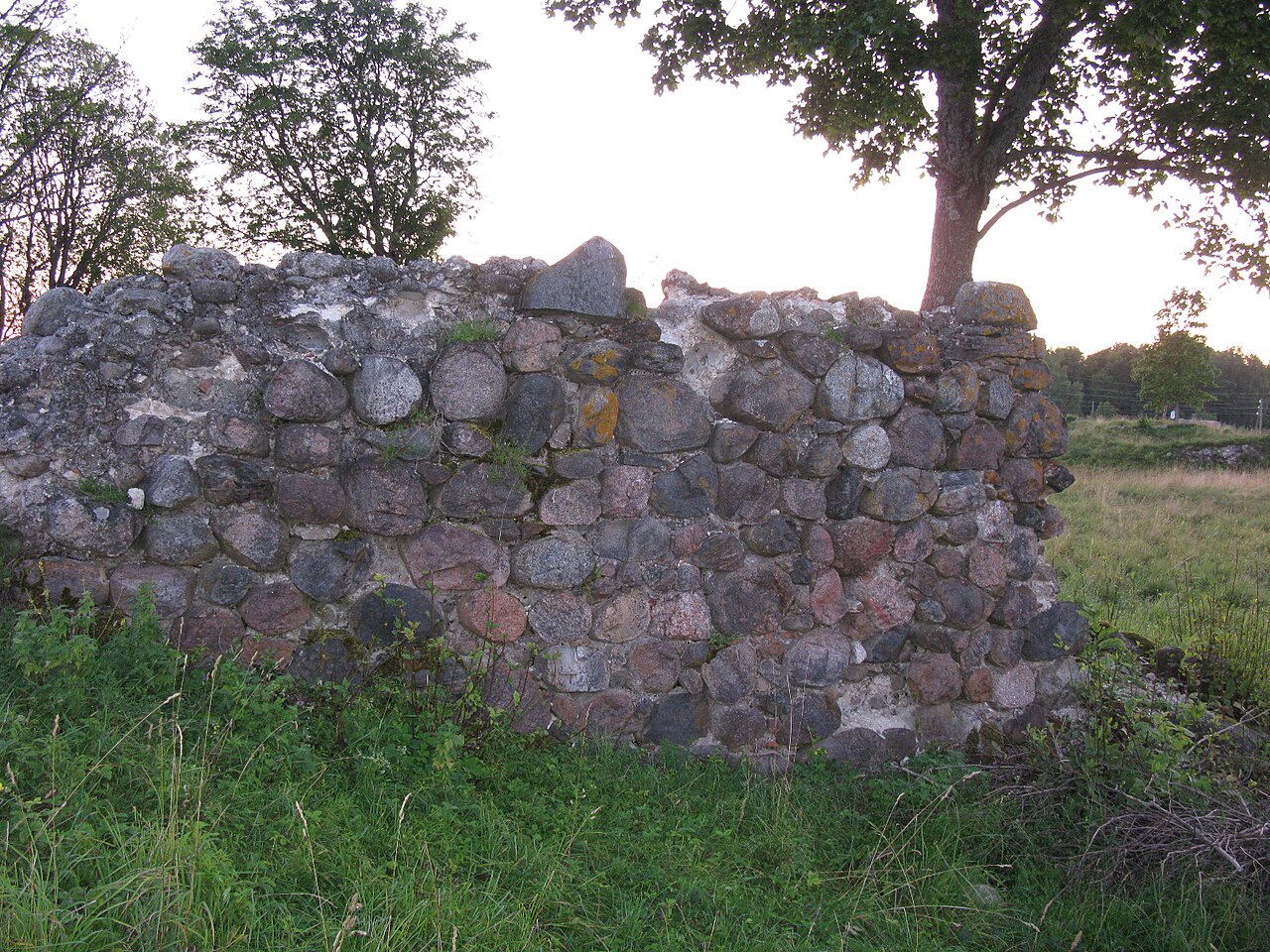
The ruins of the Latvian hill castle Rujiena Castle are located on the edge of the present-day village of Rūjiena in Valmiera Municipality in the Vidzeme region, on the right bank of the Rūja river.
Historic chronicles dating from 1125 tell of the wooden Livonian Castle, Metsepole, located on the right bank of the Rūja River, about 3 km (1.9 mi) from the current centre of the town, and how it was destroyed by invading forces from Saaremaa. The region submitted to the Livonian Brothers of the Sword after the Battle of St. Matthew's Day.
The wooden Livonian castle was replaced with a castle built by Landmeister of the Teutonic Order Burchard von Hornhausen in 1263. A substantial settlement was established around the castle and named Rūjiena. Rūjiena Castle guarded the border between the Teutonic Order and the dominion of the Archbishopric of Riga.
The castle as an order castle of the Livonian Order was first mentioned in 1499. Their castle area not only included the parish of Rūjiena, but also the part of the parish of Salisburg on the right bank of the Salis. Rūjiena shared a bailiff with Karkus and Heimat. The Rūjiena crochet mill was called oppidum in 1555.
During the reign of Ivan III of Russia, Rūjiena Castle was repeatedly attacked by Russian troops and destroyed in 1481. It did not suffer major damage and Rūjiena quickly recovered. In 1526 Walter von Plettenberg, Master of the Teutonic Order, called a provincial assembly to try Archbishop Johannes VII Blankenfeld for his relationship with Russia. Rūjiena's importance grew and the castle was raised to the rank of commandery. Heinrich von Galen was its only commander. He died in 1557 and so did not see its destruction by the Russians in 1560. During the Livonian War in 1560, the castle was occupied, looted and burned by the Lithuanian nobility, but was then restored. In September 1560, the Russian army under Ivan the Terrible destroyed Rūjiena Castle and the town.
After Vidzeme was partitioned to Poland in 1562, the Polish king Sigismund August presented Rūjiena to his brother-in-law, Swedish prince John.
The occupation of the castle surrendered in 1575 King Magnus, but in the autumn of 1575 the Germans managed to take them back. Rūjiena was still called a castle in 1554 but it military value was slighted in 1582.
Text adapted from “Rujiena Castle” on Wikipedia, CC BY-SA 4.0.
Rūjiena Fortress ranks #7,543 of 9,079 worldwide in the atlas's castle fame ranking, and #44 of the 47 mapped in Latvia. Founded 1125, it is older than 84% of the atlas's dated landmarks — one of 756 atlas entries founded in the 12th century. 2 more atlas landmarks stand within 25 km. See how Latvia compares in the castle statistics.
View on the interactive castle map →