 Germany · 12th century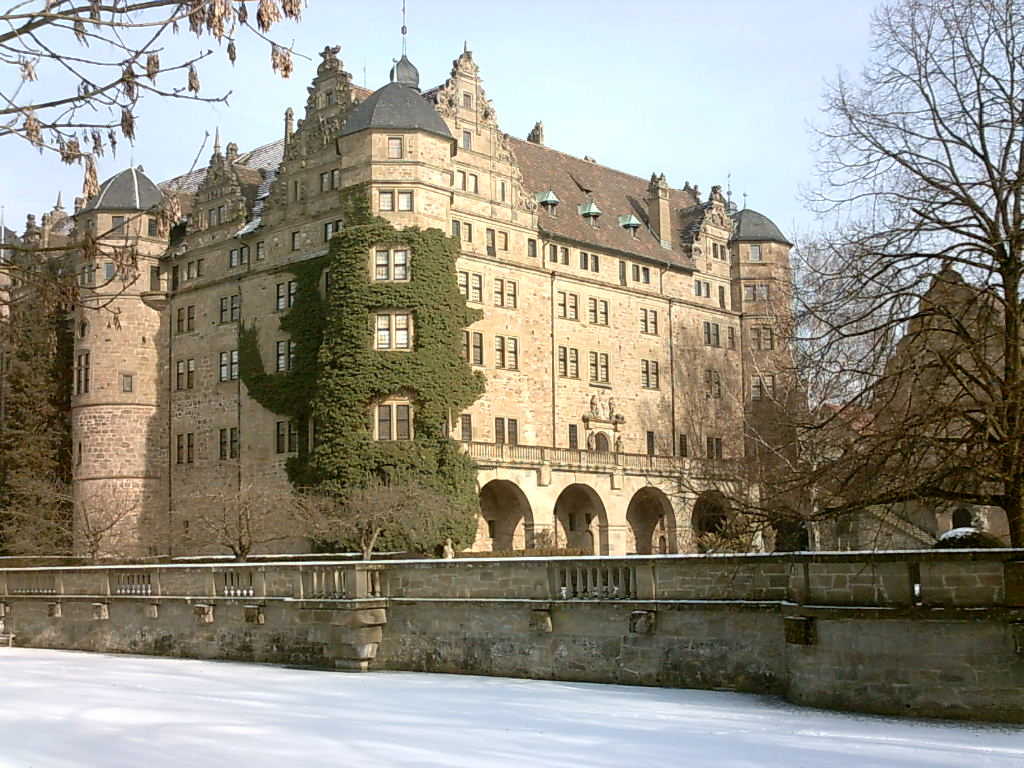
Neuenstein Castle (German: Schloss Neuenstein) is a castle in the middle of the town of Neuenstein. Built as the seat of the Hohenlohe-Neuenstein noble family, it now houses a castle museum and, with the Neuenstein Hohenlohe Central Archives, the shared house archive of the House of Hohenlohe, which is looked after by the State of Baden-Württemberg.
The origins of the present castle can be found in a Hohenstaufen moated castle from the early 13th century. It stood on a sandbank in a swampy area near an old long-distance trade route that led from the Rhine via Wimpfen east to the Danube.
Around 1230, the complex was owned by the Lords of Stein, whose descendants later called themselves "von Neuenstein". Around 1300, the Neuenstein estate came to the House of Hohenlohe, which still owns the castle today. Gottfried von Hohenlohe, who lived at Weikersheim Castle, was a follower of Emperor Frederick II and tutor to his son Conrad IV. He allegedly survived a murder plot in Regensburg in 1250, the mastermind of which was Albert I, the Bishop of Regensburg. King Konrad gave Gottfried fiefdoms in Regensburg in gratitude for his help. This also included the bailiwick of the canons' monastery of Öhringen, founded in 1037, as well as the castles and manors in Neuenstein and Waldenburg.
The different castles were divided many times between the respective generations. Louis Casimir, Count of Hohenlohe-Neuenstein (1517–1568) founded the Neuenstein line (with the possessions of Langenburg, Ingelfingen, Öhringen and Kirchberg), one of the two main lines of the House of Hohenlohe that still exist today; the other (the Waldenburg line) was founded by his half-brother Eberhard, Count of Hohenlohe-Waldenburg (1535–1570) (with Waldenburg, Bartenstein and Schillingsfürst) in the main state division of 1551. After the complex had already been expanded in the 15th century, Count Louis Casimir had the castle redesigned into a castle in the Renaissance style by the Heilbronn master builder Balthasar Wolff. The expansion lasted until the beginning of the 17th century.
After Wolfgang Julius von Hohenlohe-Neuenstein died in 1698, the family moved their residence to Öhringen to the former canons' monastery, which was renovated in baroque style in keeping with contemporary taste. Neuenstein Castle subsequently stood empty and rapidly fell into disrepair.
Text adapted from “Neuenstein Castle” on Wikipedia, CC BY-SA 4.0.
Schloss Neuenstein ranks #3,205 of 9,035 worldwide in the atlas's castle fame ranking, and #260 of the 709 mapped in Germany. Founded 1200, it is older than 75% of the atlas's dated landmarks, one of 763 atlas entries founded in the 12th century. Its Wikipedia articles were opened 1,524 times in the last 60 days, more than 62% of the atlas. 1 more atlas landmarks stand within 25 km. The nearest day-trip guide is Stuttgart, 56 km away. See how Germany compares in the castle statistics.
View on the interactive castle map →