 Sri Lanka · 5th century
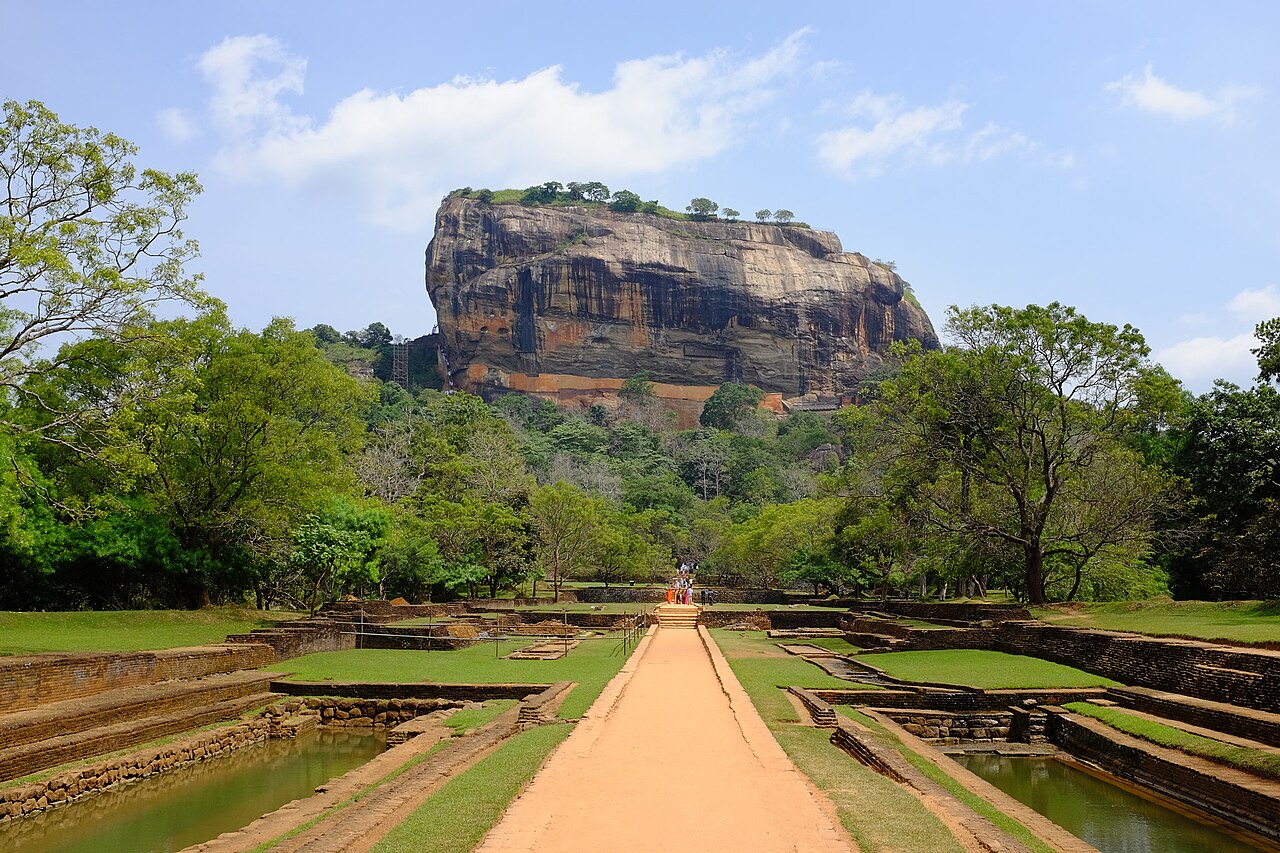
Sigiriya or Sinhagiri (Lion Rock Sinhala: සීගිරිය, Tamil: சிகிரியா/சிங்ககிரி) is an ancient rock fortress located in the northern Matale District near the town of Dambulla in the Central Province, Sri Lanka. It is a site of historical and archaeological significance that is dominated by a massive column of granite approximately 180 m (590 ft) high.
According to the ancient Sri Lankan chronicle the Cūḷavaṃsa, this area was a large forest, then after storms and landslides it became a hill and was selected by King Kashyapa (CE 477–495) for his new capital. He built his palace on top of this rock and decorated its sides with colourful frescoes. On a small plateau about halfway up the side of this rock he built a gateway in the form of an enormous lion. The name of this place is derived from this structure; Sinhagiri, the Lion Rock.
The capital and the royal palace were abandoned after the king's death. It was used as a Buddhist monastery until the 14th century. Sigiriya today is a UNESCO listed World Heritage Site. It is one of the best preserved examples of ancient urban planning.
Text adapted from “Sigiriya” on Wikipedia, CC BY-SA 4.0.
Sigiriya ranks #24 of 9,035 worldwide in the atlas's castle fame ranking, and #1 of the 15 mapped in Sri Lanka. Founded c. 477, it is older than 97% of the atlas's dated landmarks, one of 37 atlas entries founded in the 5th century. Its Wikipedia articles were opened 60,506 times in the last 60 days, more than 99% of the atlas. See how Sri Lanka compares in the castle statistics.
View on the interactive castle map →