 Slovenia · 13th century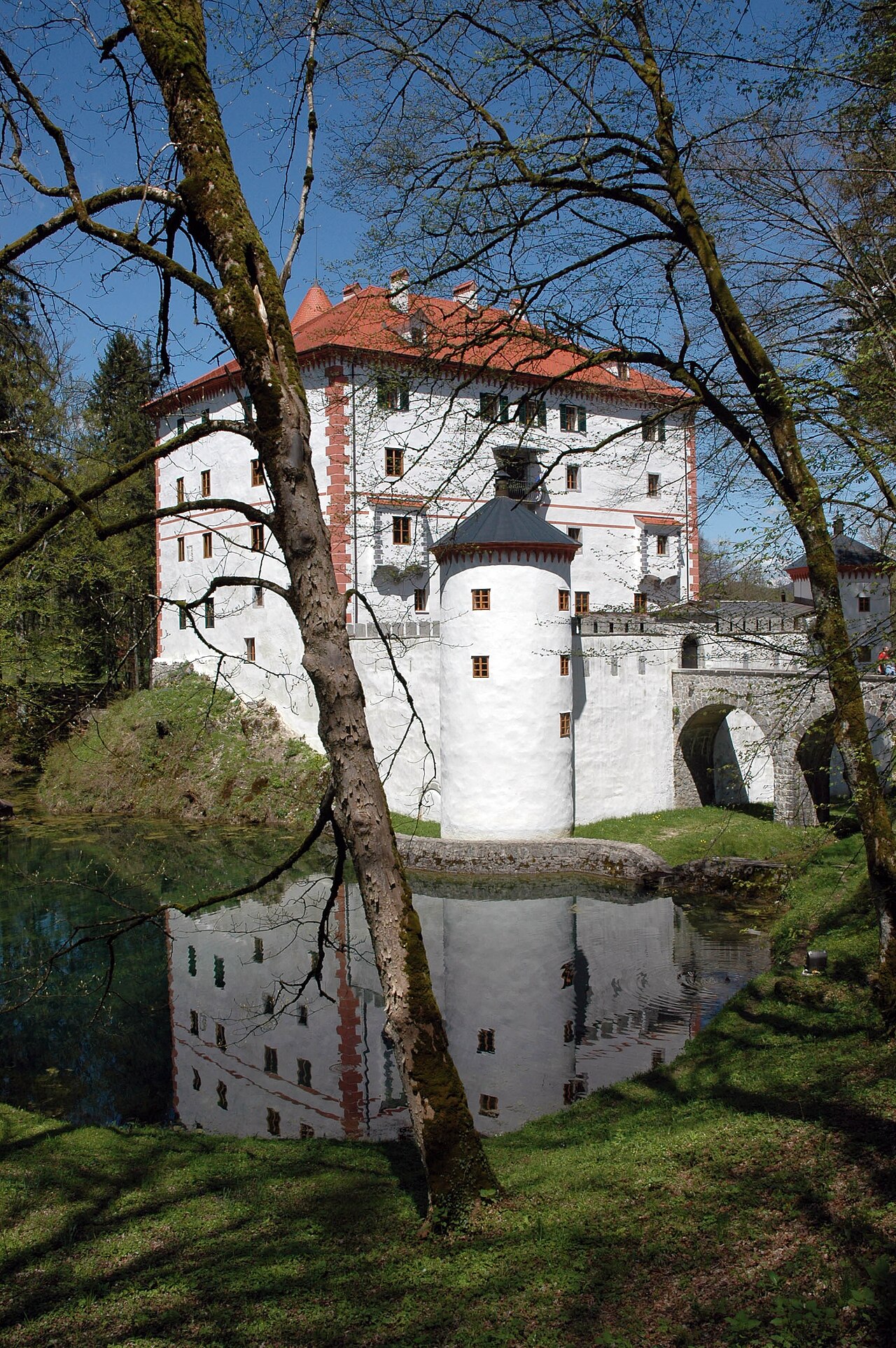
Snežnik Castle (Slovene: Grad Snežnik, German: Schloß Schneeberg) is a 13th-century castle in the municipality of Loška Dolina, Slovenia. It is located in the southwest part of the Lož Valley, near the settlement of Kozarišče.
The castle's name is coincidentally identical to a univerbation based on the Slovene word sneg ('snow'), but is actually a Slovenized form of the name of the noble house of Schneberg, whose possession it initially was.
The date of the castle's construction is unclear; its existence is first attested in 1269, by way of mention of its owner Meinhard von Schneberg (Slovene: Majnhard Snežniški, Latin: Meynardus de Sneperch); at the time it was a possession of the Patriarchate of Aquileia, with the Schnebergs as their ministeriales. The family fractured the estate through multiple heirs; by the late 14th century the castle had several co-owners. In 1393, a quarter-share of it and several neighboring farms was purchased by William II von Lamberg, a relative of the Schnebergs; his descendants increased their share through the 15th century until they owned the entire estate, giving the castle its more-or-less current renaissance appearance as well.
The Lambergs were followed by the houses of Eggenberg, Lichtenberg, and Schönburg-Waldenburg. By marriages, the castle passed to the Scheyer family, followed by the Pranckhs and, in the first third of the 17th century, the barons Rambschissl, who sold it to the Imperial governor of Carniola, prince Eggenberg. Along with Snežnik, the prince bought the lordship of Lož, moving its administrative center from the uncomfortable, hilltop Lož Castle to the more amiable and better-accessible manor at Snežnik. In 1669, Janez Žiga Eggenberg sold the Loš-Snežnik lordship to prince Janez Vajkard Auersperg, the count of Gottschee (Kočevje).
in 1707 the estate was taken over by count Jurij Gotfrid Lichtenberg, who in 1718 permanently joined the Lož and Snežnik lordships. The house of Lichtenberg held the estate for 140 years, a period marked by the centralist policies of the Habsburg monarchy, in particular the constant diminution of the rights of the nobility. By the early 19th century, the Lichtenberg had been forced deep into hock; a court-ordered appraisal occurred in 1816. In 1832 the family was forced to accept a lottery loan; the main prize was the entire Snežnik estate, or 250,000 florins.
Text adapted from “Snežnik Castle” on Wikipedia, CC BY-SA 4.0.
Snežnik Castle ranks #2,789 of 9,079 worldwide in the atlas's castle fame ranking, and #8 of the 50 mapped in Slovenia. Founded 1269, it is older than 66% of the atlas's dated landmarks — one of 1080 atlas entries founded in the 13th century. Its Wikipedia articles were opened 1,373 times in the last 60 days, more than 59% of the atlas. 1 more atlas landmarks stand within 25 km. The nearest day-trip guide is Rijeka, 39 km away. See how Slovenia compares in the castle statistics.
View on the interactive castle map →