 Germany · 13th century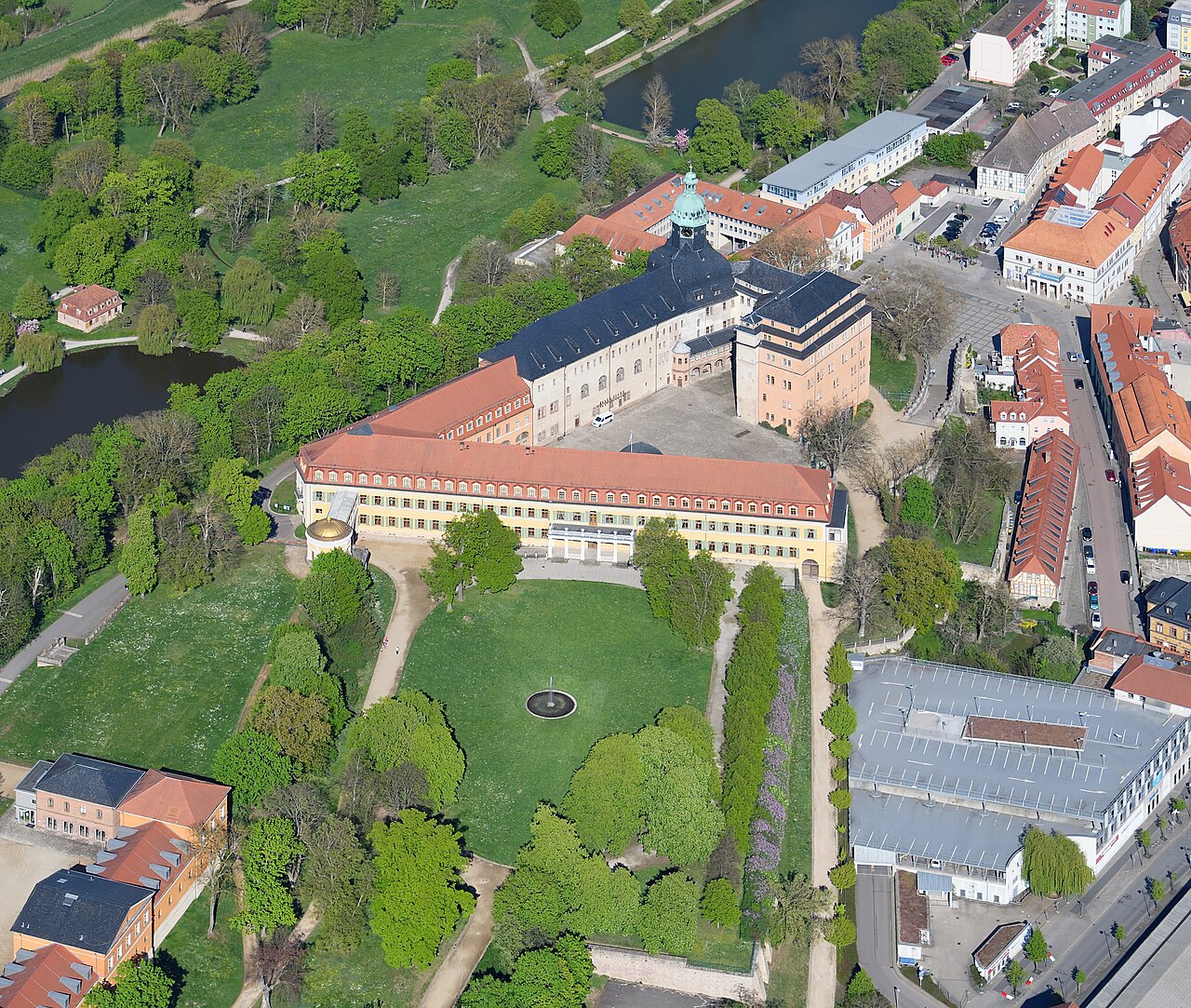
From an architectural and art historical point of view Sondershausen Palace can be considered one of the most important palace complexes in Thuringia. It is an irregular four-wing complex. With its imposing silhouette the former Schwarzburg residence dominates today's district town of Sondershausen in the Kyffhäuserkreis district.
There is evidence that some of the oldest building fabric of the castle dating from the end of the 13th century can be attributed to the Counts of Hohnstein.
The remaining tower was integrated under Count Günther XL of Schwarzburg when the Renaissance palace, consisting of the south, east and old north wings, was built between the 1530s and the 1550s.
Under Prince Christian William I of Schwarzburg-Sondershausen, who reigned between 1666 and 1720, a busy building activity started in the 1680s. The three Renaissance wings of the palace were altered and enlarged in the Baroque style.
In 1764, during the reign of Prince Christian Günther III of Schwarzburg-Sondershausen, the new west and north rococo wings were started under supervision of the Quedlinburg architect Johann Heinrich Breit and the former architect from Brunswick, Martin Peltier. At that time the palace received its final architectural layout of an irregular four-wing complex.
When Prince Günther Friedrich Carl II, who reigned from 1835 to 1880, engaged Carl Scheppig, a pupil of Karl Friedrich Schinkel, in 1836, his aim was to give most parts of the entire palace complex a completely new appearance. Financial constraints, however, limited this project to redesigning the eastern place area towards the market (palace terrace, guard house and stairs between 1837 and 1839), to rebuilding the rococo wings in the neo-classical style (1846–1851) and to erecting the new stables (1847–1849).
As the last architectural undertaking, a two-storey gallery, connecting the tower and the east and south wings, was erected between 1914 and 1915.
Opened in 1760 by Prince Christian Günther, the hall in the Rococo style extends over the two upper storeys and has galleries on both long sides. The dominant colors are blue and white; they reflect the state colors of Schwarzburg-Sondershausen. In this hall there are traces of traditional Baroque tectonics as well as transitional elements from Baroque to Neoclassicism and finally Rococo ornaments typical of the time.
Text adapted from “Sondershausen Palace” on Wikipedia, CC BY-SA 4.0.
Sondershausen Palace ranks #3,479 of 9,079 worldwide in the atlas's castle fame ranking, and #285 of the 711 mapped in Germany. Founded c. 1275, it is older than 65% of the atlas's dated landmarks — one of 1080 atlas entries founded in the 13th century. Its Wikipedia articles were opened 1,266 times in the last 60 days, more than 57% of the atlas. 3 more atlas landmarks stand within 25 km. See how Germany compares in the castle statistics.
View on the interactive castle map →