Ruin
Miyazu Castle
🇯🇵 Japan · 16th century
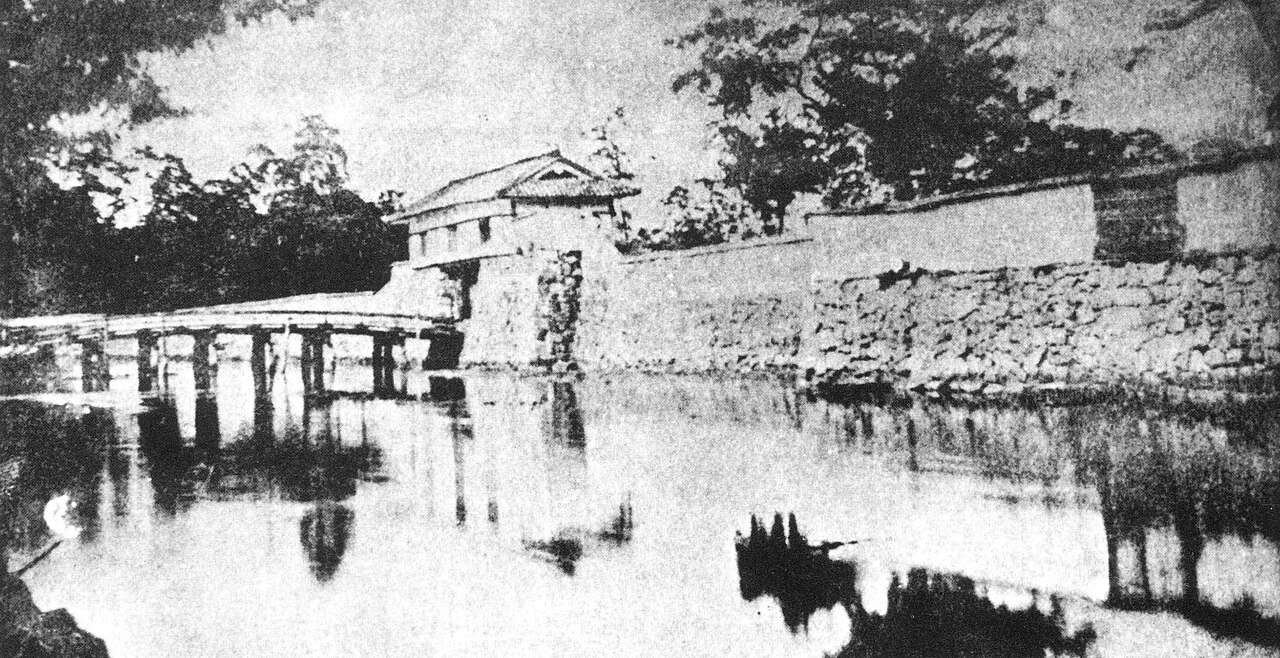
Miyazu Castle (宮津城, Miyazu-jō) is a flatland-style Japanese castle located in Miyazu, northern Kyoto Prefecture, Japan. At the end of the Edo period, Miyazu Castle was home to a branch of the Honjō-Matsudaira, daimyō of Miyazu Domain.
The Miyazu area was the center of ancient Tango Province and the location of its provincial capital. From the Muromachi period, the area was ruled by the Isshiki clan who served as shugo. However, in the Sengoku period, the area came under the control of the Hosokawa clan. Hosokawa Fujitaka (1564–1610) built the first Miyazu Castle at the end of Miyazu Bay in 1580. After the Honnō-ji Incident, Fujitaka retreated to Tanabe Castle, while his son, Hosokawa Tadaoki remained lord of Miyazu Castle. During the Battle of Sekigahara, Tadaoki was en route to the Kantō region with his troops in support of Tokugawa Ieyasu while Fujitaka was attacked by forces of the Western Army local to Ishida Mitsunari.
Fujitaka set fire to Miyazu Castle and entrenched himself in Tanabe Castle, which he successfully defended at the Siege of Tanabe. The Tokugawa shogunate awarded the Hosokawa clan within transfer to Buzen Province, and Kyōgoku Takatomo was placed in charge of the newly-created Miyazu Domain, whose 123,000 kokudaka encompassed the entire province. In 1621, he divided his domain into three parts, with his heir, Kyōgoku Takahiro, receiving Miyazu. Kyōgoku Takahiro extensively reconstructed the castle into the current layout. However, his son Kyōgoku Takakuni was disposed by the shogunate in 1666 due to poor administration.
The Nagai, Abe, Okudaira and Aoyama clans followed as lords of the castle, until finally Honjō-Matsudaira Sukemasa was assigned the domain in 1758. The Honjō-Matsudaira then remained until the Meiji Restoration in 1868, after which the castle fell into complete disrepair.
Miyazu Castle makes extensive use of the Ōte River to the west as its outer moat. The complex consists of the inner bailey (Honmaru), a second bailey (Ninomaru) to the east and south, separated by a moat, and the third bailey (Sannomaru), also protected by a moat and stone walls. The castle never had a tenshu, but instead relied on eight two-story yagura watchtowers located at strategic points along the fortifications.
At present, all of the moats have been filled in and the castle site itself has largely disappeared under urban encroachment.
Text adapted from “Miyazu Castle” on Wikipedia, CC BY-SA 4.0.
Miyazu Castle ranks #4,500 of 8,134 worldwide in the atlas's castle fame ranking, and #224 of the 297 mapped in Japan. Founded 1580, it is older than 36% of the atlas's dated landmarks — one of 755 atlas entries founded in the 16th century. Its Wikipedia articles were opened 1,925 times in the last 60 days, more than 66% of the atlas. 1 more atlas landmarks stand within 25 km. The nearest day-trip guide is Kyoto, 78 km away. It is one of the 71 landmarks on the atlas's regional map of Kansai. See how Japan compares in the castle statistics.
View on the interactive castle map →Frequently asked questions
Where is Miyazu Castle?
Miyazu Castle stands in Japan, at 35.53656°, 135.19831°.
When was Miyazu Castle built?
The atlas dates its founding to 1580. Earlier structures may have stood on the site; this is the earliest documented founding year.
How famous is Miyazu Castle?
In this atlas's fame ranking: #4,500 of 8,134 worldwide, and #224 in Japan. Fame here combines how many Wikipedia language editions cover a landmark with how many people read them.
What is the nearest castle to Miyazu Castle?
Tanabe Castle, about 16 km away.
More castles in Japan
- Yodo Castle Japan
- Karasuyama Castle Japan · 15th century
- Nagashima Castle Japan · 13th century
- Tachibana Castle Japan · 14th century
More ruins
- Manegg Castle Switzerland · 14th century
- Kalich Czech Republic · 15th century
- Reichenštejn Czech Republic · 14th century
- Bobrowniki Castle Poland