Palace & château
Tiradentes Palace
🇧🇷 Brazil · 20th century
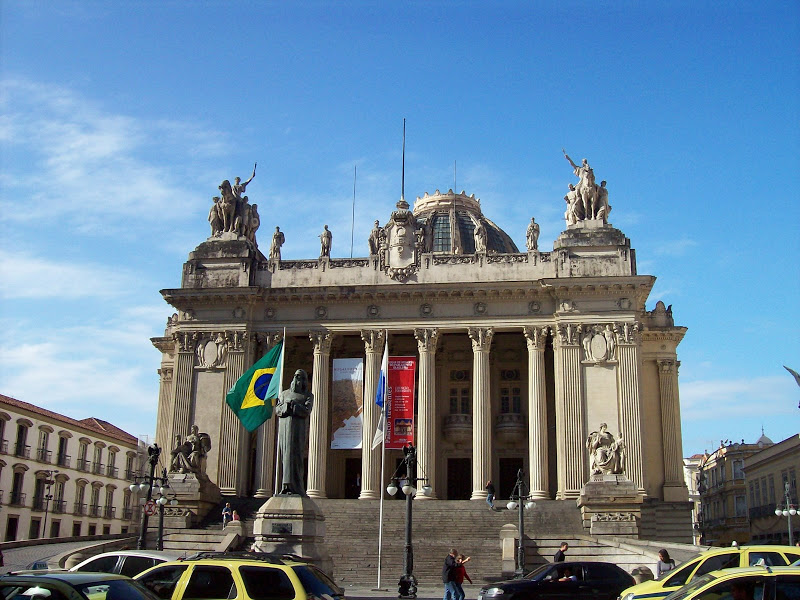
The Tiradentes Palace (Portuguese: Palácio Tiradentes) is an eclectic government building located in the Centro neighborhood (bairro), next to the Paço Imperial in Rio de Janeiro, Brazil. It was inaugurated on 6 May 1926 and was the former seat of the Chamber of Deputies of Brazil, between 1926 and 1960, and is the current seat of the Legislative Assembly of the State of Rio de Janeiro.
The Tiradentes Palace replaced another building that once occupied the same spot. The construction of the first building, called Casa de Câmara e Cadeia (literally: House of Chamber and Jail), was requested by the local government of Rio de Janeiro in 1631. It was built in 1640 and housed the three aldermans of Rio de Janeiro and a jail. They were elected by indirect vote, for a one year term, and took care of the city's finances. The aldermans worked on the upper floor while the jail functioned on the lower one. As time passed the building became known as Cadeia Velha (Old Jail). It was in this jail that one of the leading figures of the Minas Gerais Conspiracy, Joaquim José da Silva Xavier, known as Tiradentes, was imprisoned. Tiradentes was imprisoned there for three years, until his execution by hanging on 21 April 1792.
The upper floor served as the seat of the Chamber of Deputies and later the Senate, until 1808, when it was then used to house the Portuguese royal family's servants after the transfer of the Portuguese court to Brazil. At the time of Brazil's Independence in 1822, Rio de Janeiro was the country's capital and the building became the seat of the General Constituent Assembly, tasked with creating Brazil's first constitution, in 1823.
It later became the seat of the General Assembly of the Empire of Brazil, the lower house of the country's legislative branch (the Senate being the upper one). From 1825 onwards, the street to the right of the building, then known as Rua da Cadeia, became known as Rua da Assembleia, a name it retains to this day. It was in that building, at that time serving as the General Assembly, that the Golden Law that abolished slavery in Brazil was voted and approved in 1888.
After the proclamation of the republic, in 1889, the building became the seat of the Chamber of Deputies until 1914, at which point it already had serious structural problems due to its old age; the Chamber of Deputies was then transferred to the Monroe Palace.
Text adapted from “Tiradentes Palace” on Wikipedia, CC BY-SA 4.0.
Tiradentes Palace ranks #2,695 of 8,134 worldwide in the atlas's castle fame ranking, and #9 of the 80 mapped in Brazil. Founded 1926 — one of 169 atlas entries founded in the 20th century. Its Wikipedia articles were opened 1,916 times in the last 60 days, more than 66% of the atlas. 17 more atlas landmarks stand within 25 km. The nearest day-trip guide is Rio de Janeiro, 3 km away. See how Brazil compares in the castle statistics.
View on the interactive castle map →Frequently asked questions
Where is Tiradentes Palace?
Tiradentes Palace stands in Brazil, at -22.90387°, -43.17388°.
When was Tiradentes Palace built?
The atlas dates its founding to 1926. Earlier structures may have stood on the site; this is the earliest documented founding year.
How famous is Tiradentes Palace?
In this atlas's fame ranking: #2,695 of 8,134 worldwide, and #9 in Brazil. Fame here combines how many Wikipedia language editions cover a landmark with how many people read them.
What is the nearest castle to Tiradentes Palace?
Paço Imperial, about 1 km away.
More castles in Brazil
- Catete Palace Brazil · 19th century
- Guanabara Palace Brazil · 19th century
- São Marcelo Fort Brazil
- Rio Branco Palace Brazil · 16th century
More palaces & châteaux
- Prinzessinnenpalais Germany · 18th century
- Palazzo Altieri Italy
- Palazzo Magnani Italy · 16th century
- Gosford Castle Northern Ireland · 19th century