Castle
Tynnelsö Castle
🇸🇪 Sweden · 13th century
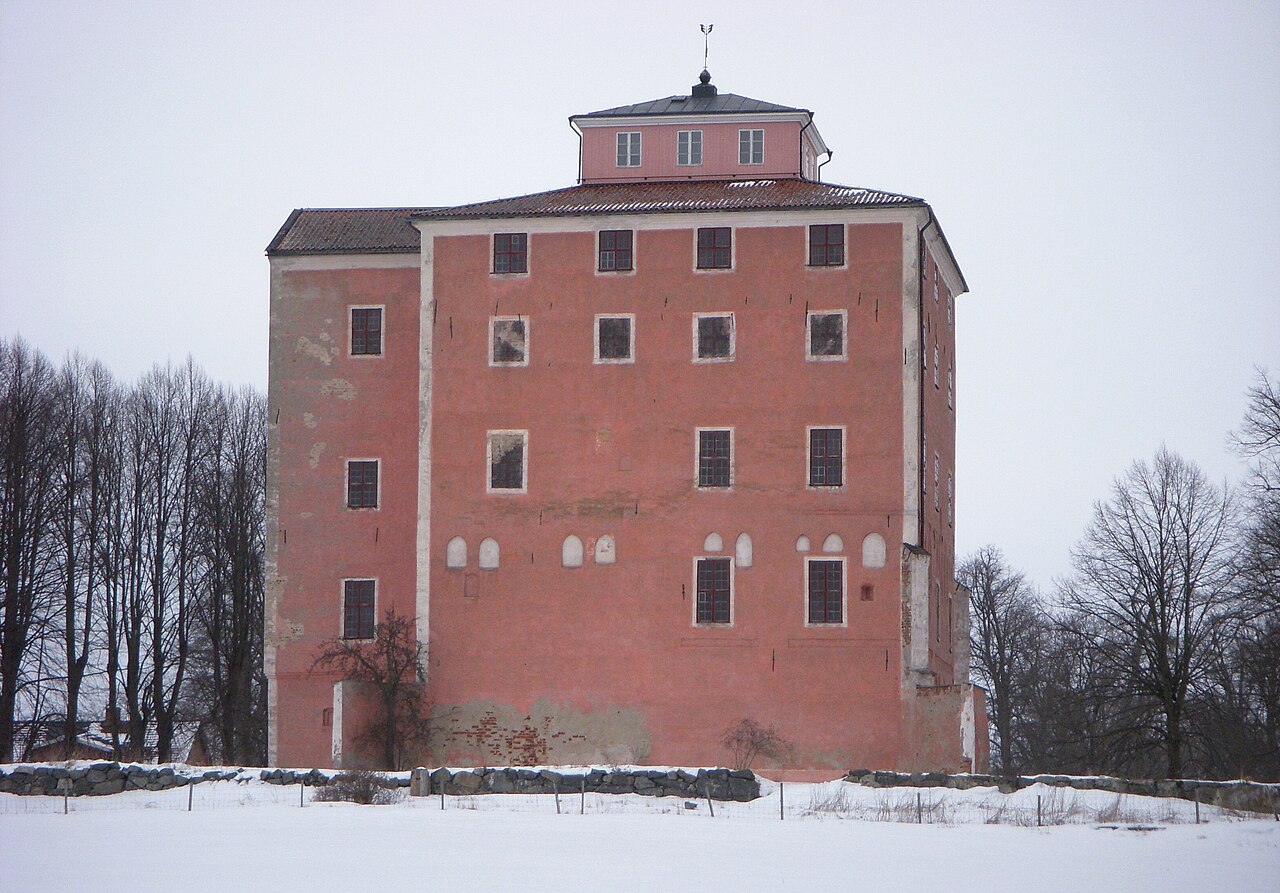
Tynnelsö Castle (Swedish: Tynnelsö slott) is a castle in Sweden. It is on Tynnelsö island in Lake Mälaren, a few kilometres north-east of Strängnäs. The castle was built during the Middle Ages by the bishops of Strängnäs.
The oldest parts of Tynnelsö Castle probably date from the 13th century. The castle is mentioned in written sources for the first time in 1282. From 1306, the estate belonged to the Diocese of Strängnäs and the castle was the property of the bishop. The castle was continuously expanded during the Middle Ages. During the time of bishop Thomas Simonsson, the castle is mentioned as one of the strongest in Sweden. A preserved list of inventories from 1443 lists the weapons housed in the castle at the time: 24 firearms, including several cannon, 52 crossbows, a barrel of crossbow bolts and 150 cannonballs. In the time of bishop Sigge (1449–63), the castle had a garrison of 100 men.
The castle saw action during the Swedish War of Liberation. It was besieged and conquered by the troops of Gustav Vasa and later used by his army as an arsenal during the siege of Stockholm. In 1527, it was confiscated by the crown of Sweden and turned into a crown estate. Gustav Vasa spent time there on several occasions, and his wife Margareta Leijonhufvud died at Tynnelsö Castle in 1551.
After the death of Gustav Vasa, the castle passed to his widow Katarina Stenbock and then to Duke Charles of Södermanland, the future Charles IX of Sweden, who started transforming it from a medieval castle to a Renaissance palace. He gave the castle as a gift to his first wife, the Maria of Simmern and, after her death, likewise to his second wife Christina of Holstein-Gottorp. Eventually it passed to his son Charles Philip, Duke of Södermanland. It was then inherited by his daughter Elizabeth Carlsdotter Gyllenhielm. It stayed in her family until the late 17th century, when it became the property of queen Hedvig Eleonora of Holstein-Gottorp.
In 1725, it was given to a Polish noblewoman, Anna Woynarowska née Mirowicz, who was niece-in-law of Ivan Mazepa, as payment for a debt that king Charles XII had to her husband. Anna Woynarowska however left Sweden in 1748, after which the castle was sold to the brothers Fredrik Willhelm and Carl Edward, Princes von Hessenstein, sons of Frederick I of Sweden and Hedvig Taube.
Text adapted from “Tynnelsö Castle” on Wikipedia, CC BY-SA 4.0.
Tynnelsö Castle ranks #5,406 of 8,134 worldwide in the atlas's castle fame ranking, and #157 of the 206 mapped in Sweden. Founded c. 1300, it is older than 63% of the atlas's dated landmarks — one of 861 atlas entries founded in the 13th century. 4 more atlas landmarks stand within 25 km. The nearest day-trip guide is Västerås, 39 km away. See how Sweden compares in the castle statistics.
View on the interactive castle map →Frequently asked questions
Where is Tynnelsö Castle?
Tynnelsö Castle stands in Sweden, at 59.41222°, 17.10028°.
When was Tynnelsö Castle built?
The atlas dates its founding to c. 1300. Earlier structures may have stood on the site; this is the earliest documented founding year.
How famous is Tynnelsö Castle?
In this atlas's fame ranking: #5,406 of 8,134 worldwide, and #157 in Sweden. Fame here combines how many Wikipedia language editions cover a landmark with how many people read them.
What is the nearest castle to Tynnelsö Castle?
Gripsholm Castle, about 19 km away.
More castles in Sweden
- Gripenberg Castle Sweden · 17th century
- Öster-Malma Castle Sweden · 17th century
- Östanå Castle Sweden · 18th century
- Dagsnäs Castle Sweden
More castles
- Krustpils Castle Latvia
- Vao Castle Estonia
- Wintrange Castle Luxembourg · 17th century
- Enniscorthy Castle Ireland · 12th century