 Indonesia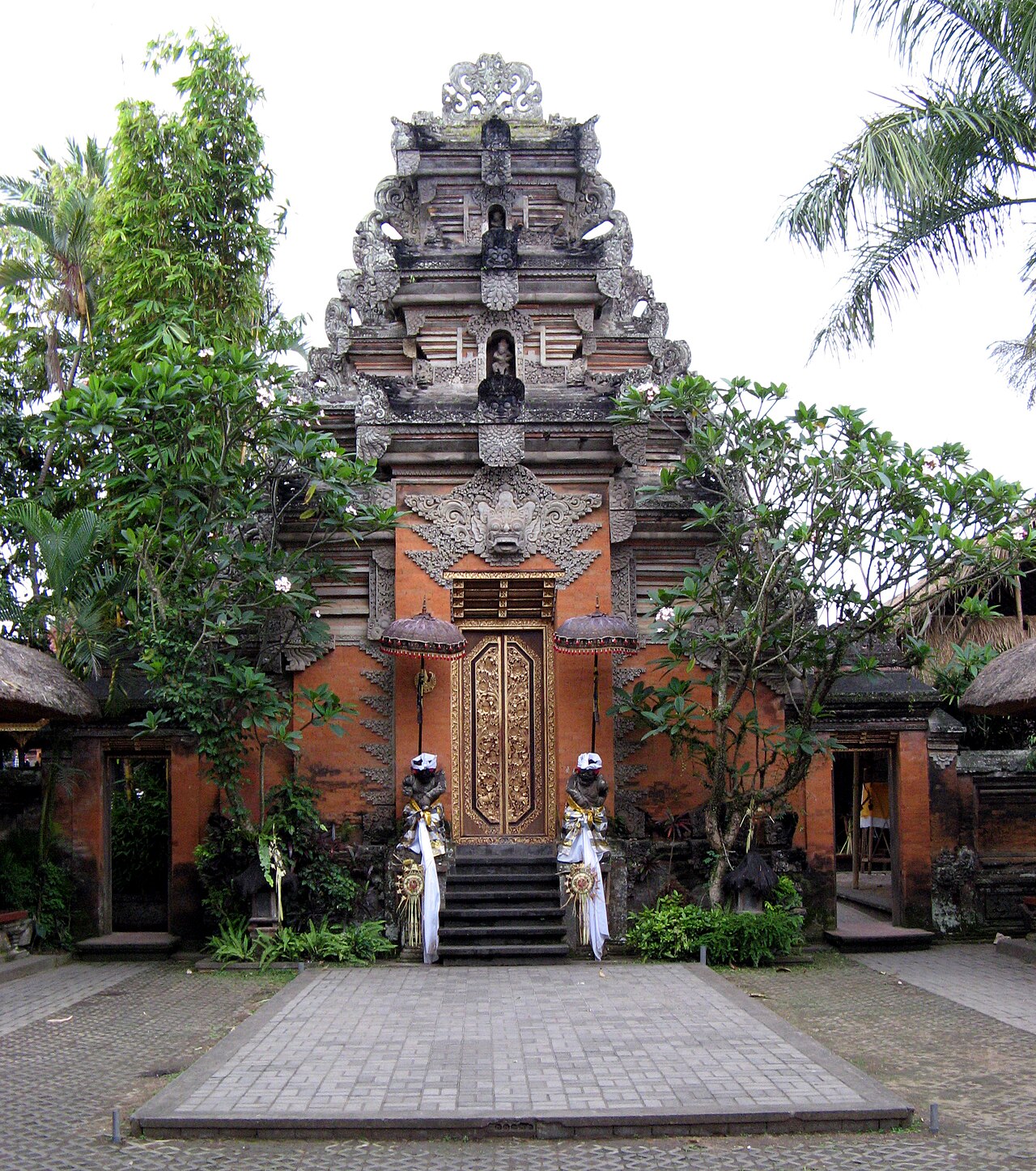
The Ubud Palace, officially Puri Saren Agung, is a historical building complex situated in Ubud, Gianyar Regency of Bali, Indonesia.
The palace was the official residence of the royal family of Ubud.
During his travels, Rsi Markandya received a divine revelation that he was to bury five precious metals on a mountain slope in Bali, where the Mother Temple of Besakih now stands. With a group of followers, Rsi Markandya was magnetically attracted to a destination located in the central foothills of the island that radiated light and energy. This place was Campuhan in Ubud, at a confluence in the Wos River and it was here that he felt compelled to build a temple, Pura Gunung Lebah.
On subsequent expeditions around Bali, Rsi Markandya built a number of other significant temples and created a shared irrigation system for the terraced landscape that is still practiced by farmers today. The formation of the banjar, which is a village council responsible for community and religious affairs, was also inspired by Rsi Markandya. In essence, it can be said that Rsi Markandya is responsible for the foundation of Balinese Hinduism in its purest form referred to as Agama Tirtha or the religion of holy water.
Since its settlement in the 8th century, the area of Campuhan has always been highly regarded by Balinese for its immense spiritual powers. Even the term Ubud is derived from the term ubad, meaning "medicine", in reference to the traditional healing properties of the various plants that grew in the area. Generations of Hindu worshippers have made special pilgrimages to the confluence in the Wos River to mediate, bathe and collect holy water for temple ceremonies and cleansing rituals.
There had always been ties between Java and Bali, but it was the disintegration of the once mighty Majapahit Empire in the 15th century that saw a mass exodus of nobles to Bali. A new kingdom on the island's east coast called Gelgel was consequently established and gave sanctuary to many important ruling families. They brought with them an artistic legacy and the principles of the caste system.
By the 17th century, Bali invariably experienced a rapid emergence of new kingdoms, including the founding of several royal houses in Ubud. However, this period also saw clans battle for supremacy.
Text adapted from “Ubud Palace” on Wikipedia, CC BY-SA 4.0.
Ubud Palace ranks #1,555 of 9,079 worldwide in the atlas's castle fame ranking, and #6 of the 43 mapped in Indonesia. Its Wikipedia articles were opened 4,695 times in the last 60 days, more than 85% of the atlas. 1 more atlas landmarks stand within 25 km. See how Indonesia compares in the castle statistics.
View on the interactive castle map →