 Italy · 10th century
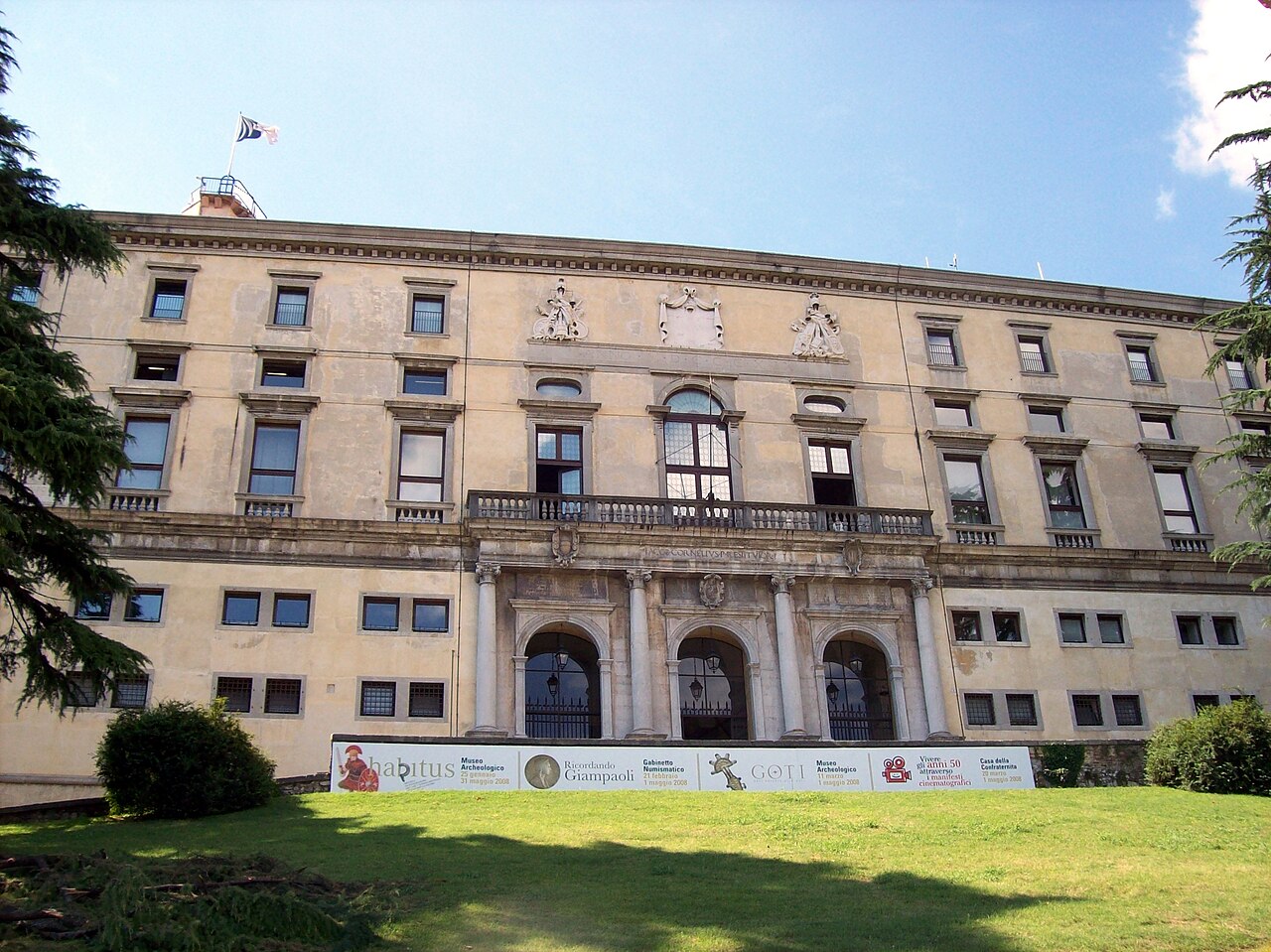
Udine Castle ranks #3,739 of 9,040 worldwide in the atlas's castle fame ranking, and #284 of the 555 mapped in Italy. Founded 983, it is older than 92% of the atlas's dated landmarks, one of 192 atlas entries founded in the 10th century. Its Wikipedia articles were opened 2,064 times in the last 60 days, more than 70% of the atlas. 1 more atlas landmarks stand within 25 km. The nearest day-trip guide is Udine, 1 km away. See how Italy compares in the castle statistics.
The Udine Castle (Italian: Castello di Udine) is a historical building in Udine, Northern Italy, built on a hill in the historical center of the city (138 meters above sea level).
Castle Hill was long believed to be made of drift accumulating during centuries. However, a legend about its origin says that when Attila the Hun (also called the Scourge of God) plundered Aquileia (one of the biggest cities of the Roman Empire at that time) in the year 452, he asked his soldiers to build a hill to see Aquileia burning. This was made by filling the helmet of each soldier with soil.
Recent scientific studies showed that the hill is artificial, but much older than the legend presupposes.
In fact, the origins of the hill are in the Bronze Age, and it might date to a period between 3000 and 3500 years ago, comparable in age to the slightly higher Silbury Hill in Wiltshire, England, dating from c. 2300 BC. However the castle Hill in Udine is bigger by volume, making it the biggest prehistoric mound in Europe.
The first official statement of the existence of a building on the hill dates back to 983: the Holy Roman Emperor Otto II donated to Rodoaldo, Patriarch of Aquileia a castrum or military building.
The present building has the form of a palace and it was built on the ruins of a fortress destroyed in the year 1511 Idrija earthquake. The construction had started in 1517 and the works had lasted for 50 years. The external decoration of the palace and the paintings in the Parliament Hall are due to Giovanni da Udine, one of the pupils of Raphael.
The council of the Patria del Friuli was one of the first parliaments in the world, and it was suppressed after the French occupation in 1797.
Today the castle hosts the History and Art Museum of the City of Udine.
Text adapted from “Udine Castle” on Wikipedia, CC BY-SA 4.0.
View on the interactive castle map →