 Czech Republic · 13th century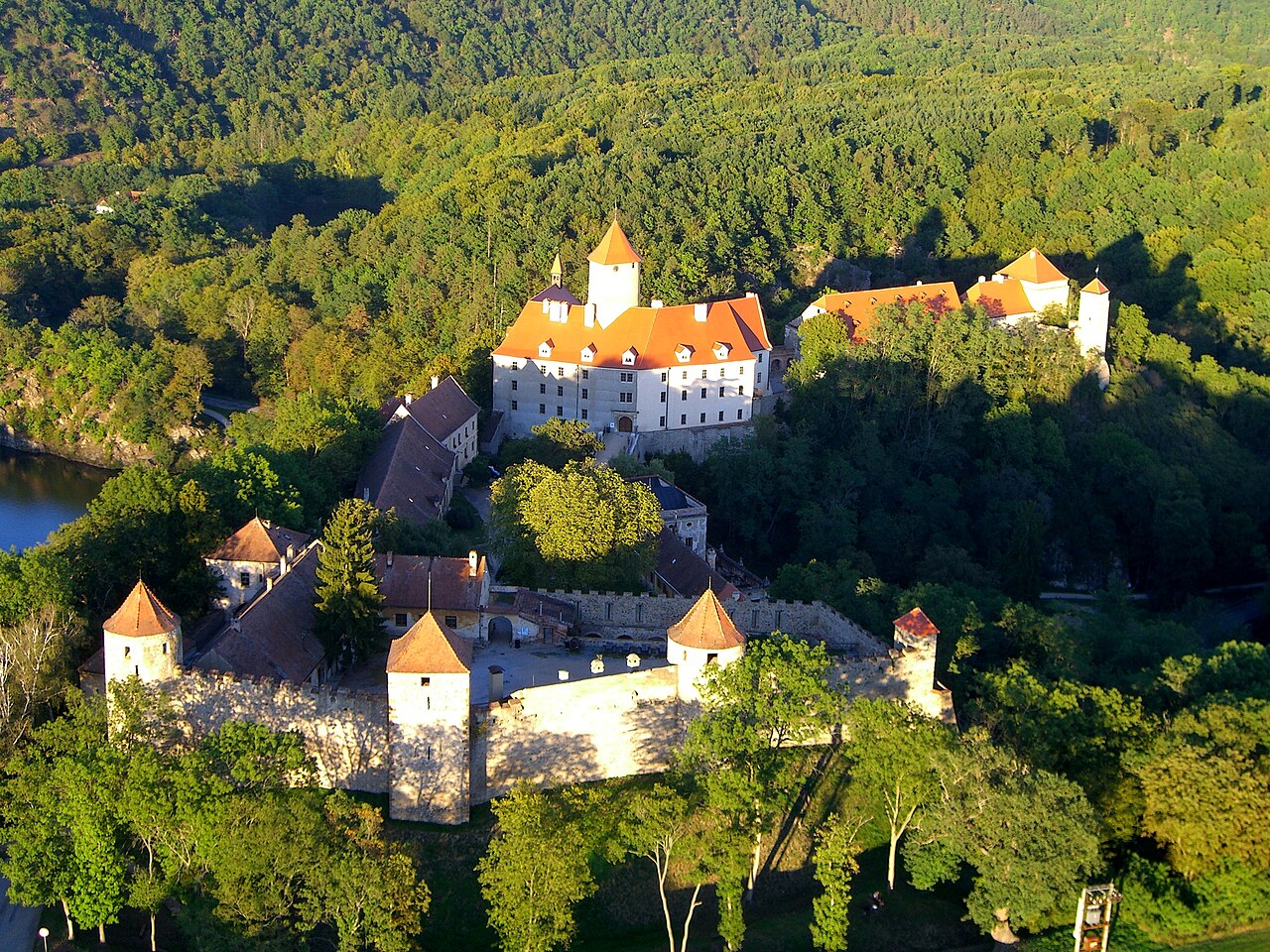
Veveří (Czech: hrad Veveří, German: Eichhorn) is an originally ducal and royal castle in Brno in the Czech Republic. It is located about 12 kilometres (7 mi) northwest of Brno city centre on the Svratka River.
According to legend, the castle Veveří (literally "squirrel's" in Czech) was founded by Přemyslid Duke Conrad of Brno in the middle of the 11th century, as a hunting lodge. Nevertheless, the first credible recorded mention about the castle is from the years 1213 and 1222, when King Ottokar I of Bohemia used the fortified castle as a prison for rebellious peers. Initially, it was apparently a wooden or masonry residence situated near the Romanesque church of the Assumption of the Virgin Mary west of the present compound. In the 1220s, a stone castle on the extremity of the rocky promontory behind a deep moat cut out of the rock started to grow. The so-called keep is the only structure which has remained well-preserved from this oldest building stage.
King John of Bohemia pledged the castle to nobleman Jan of Vartemberk in 1311, but his son, Margrave of Moravia Charles (later Holy Roman Emperor Charles IV), received the property as a debt settlement in 1335. Charles' younger brother, Margrave John Henry, then took a fancy to Veveří Castle. He was responsible for the building of its rear part with two towers and an outer ward. In the central area around the keep, he developed the main palace, which included a large hall and the Chapel of St. Procopius (later Chapel of St. Wenceslaus). The present appearance of the compound is the result of these building activities, giving the castle its basic silhouette of a medieval fortress.
The castle was a military-civic centre around a manor until the Hussite Wars. During the Hussite wars, Emperor Sigismund positioned mercenary forces of his son-in-law, Albrecht of Austria, around the castle, but he later pledged it to local nobleman Petr Kutěj in 1424. The Hussites besieged the castle in vain during the years 1428–32. During the second half of the 15th century, the castle was rented by Przemyslaus II of Těšín, who decided to reinforce the castle with the construction of surrounding walls. In 1468, King of Hungary and antiking of Bohemia Matthias Corvinus started his occupation of the castle.
Text adapted from “Veveří Castle” on Wikipedia, CC BY-SA 4.0.
Veveří Castle ranks #1,266 of 9,079 worldwide in the atlas's castle fame ranking, and #31 of the 243 mapped in Czech Republic. Founded c. 1300, it is older than 61% of the atlas's dated landmarks — one of 1080 atlas entries founded in the 13th century. Its Wikipedia articles were opened 3,823 times in the last 60 days, more than 82% of the atlas. Wikidata records about 90,000 visitors in 2022. 4 more atlas landmarks stand within 25 km. The nearest day-trip guide is Brno, 13 km away. See how Czech Republic compares in the castle statistics.
View on the interactive castle map →