 Denmark · 16th century
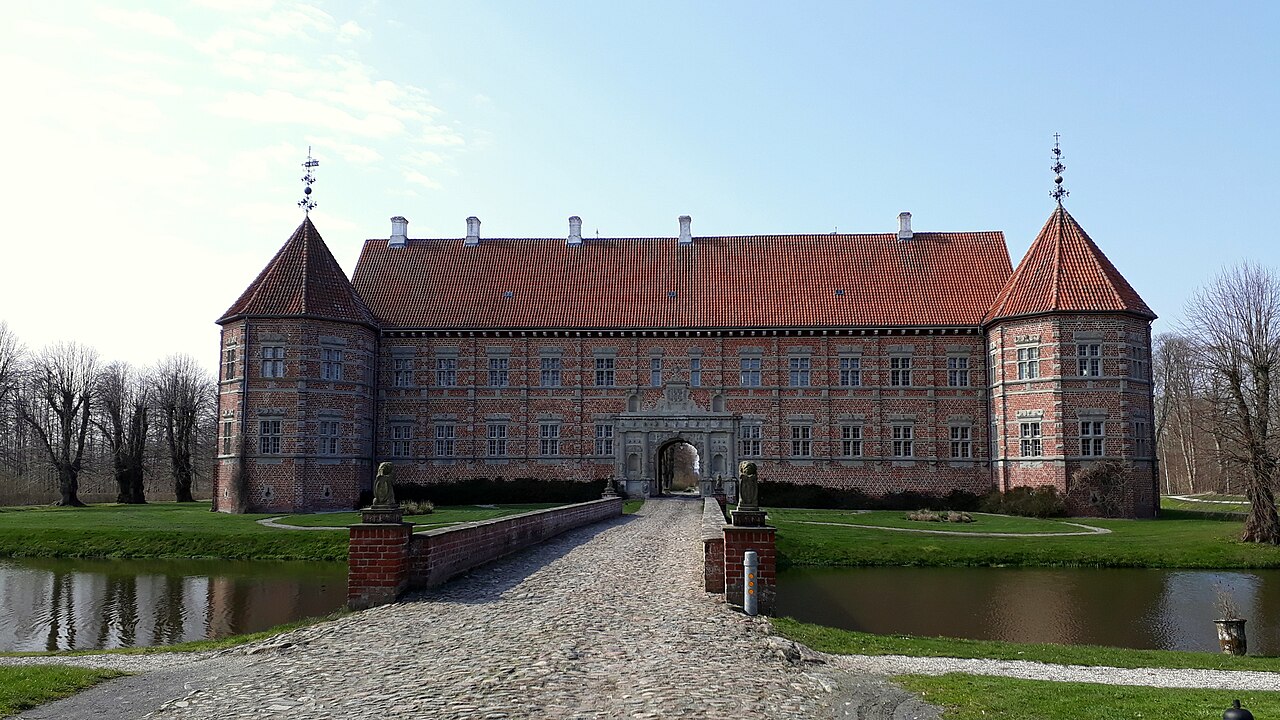
Voergaard Castle ranks #3,197 of 9,040 worldwide in the atlas's castle fame ranking, and #41 of the 59 mapped in Denmark. Founded 1588, it is older than 33% of the atlas's dated landmarks, one of 887 atlas entries founded in the 16th century. Its Wikipedia articles were opened 2,158 times in the last 60 days, more than 71% of the atlas. 1 more atlas landmarks stand within 25 km. See how Denmark compares in the castle statistics.
Voergaard Castle (Danish: Voergaard Slot) is a moated Renaissance manor house located 10 km north of Dronninglund on the North Jutland peninsula in north-western Denmark. It is open to the public and houses a significant art collection.
Voergaard's recorded history goes back to 1481. At the outbreak of the Count's Feud it was owned by Stygge Krumpen, Bishop of Børglum, taken by Skipper Clement's army of peasants and then, after the Reformation, confiscated by the Crown in 1536.
In 1578, King Frederick II ceded the property to Karen Krabbe in exchange for Nygaard, an estate located between Vejle and Kolding. Krabbe's daughter, Ingeborg Skeel, took over the property from her mother and carried out an expansion which was completed in 1588.
Over the following two centuries, Voergaard changed hands many times. Much of the land was sold.
In 1872 it was purchased by Peder Brønnum Scavenius, a politician and land owner, who re-acquired much of the land which had previously been sold. At the time of his death in 1914, the estate covered 1,944.4 ha of land, making it one of the largest in Denmark at the time. The next owner was his son, Erik Scavenius, Danish Prime Minister during World War II, who owned Voergaard from 1914 to 1945.
In 1955 Voergaard was acquired by Ejnar Oberbech-Clausen, a Dane who had lived in France since 1906 where he had become a count through his marriage with Marie Henriette Chenu-Lafitte, the widow of his former employer, and an Imperial Count in the Holy Roman Empire. Chenu-Lafitte was the daughter of Jules-Émile Péan, one of the great French surgeons of the 19th century, and owned an extensive art collection which originated both from her father and deceased husband.
The couple owned several châteaus in the area around Bordeaux but after his wife's death, in an air raid in 1941, Oberbech-Clausen moved to Paris and later decided to return to his native Denmark. He acquired Voergaard and, with approval from the French state, brought 12 train cars of art with him back to Denmark. He undertook a comprehensive and costly restoration of the castle which went on for several years. After his death in 1963, the castle and collections were passed to a foundation and opened to the public.
Voergaard is a two-winged, L-shaped castle built in red brick in the Renaissance style.
Text adapted from “Voergaard Castle” on Wikipedia, CC BY-SA 4.0.
View on the interactive castle map →