 Germany · 14th century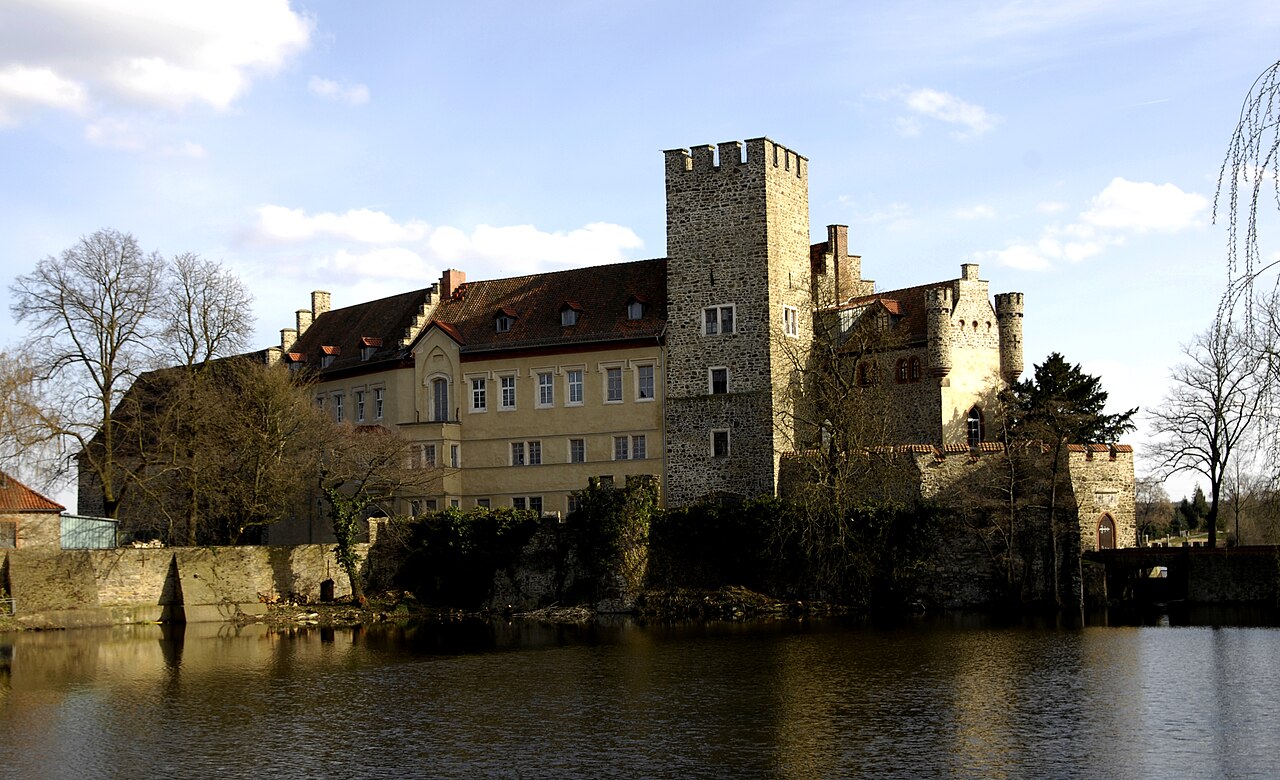
The Flechtingen water castle or Flechtingen moated castle (German: Wasserschloss Flechtingen or Wasserburg Flechtingen) is a largely well-preserved castle complex in the centre of the municipality of Flechtingen in the district of Börde in Saxony-Anhalt, Germany.
The castle is located in the centre of the village of Flechtingen, in the northern area of the Schloßteich Flechtingen castle pond, which is drained to the north by a river, the Spetze. The main tributary is the Große Renne in the south of the lake. There is an old watermill, the castle mill (de: Schlossmühle) Flechtingen, right next to the drain. Flechtingen is located in the middle of the Magdeburg Börde in today's Börde district in Saxony-Anhalt, Germany.
The history of the moated castle began in the first decade of the 14th century. Heinrich von Schenck, who was initially called Heinrich von Dövenstedt, Schenck, whereby Schenck is derived from the court office of Schenk, received Flechtingen as a fief from Herman, Margrave of Brandenburg-Salzwedel for his services. As early as 1307, he and his brother Alverich called themselves Schencken von Dönstedt and Lords of Flechtingen Castle. This was also the first written mention of the facility. So it must have been built before that date. The castle was built on a rocky base in a swampy lowland. The bergfried, the foundation walls of the main castle and the buildings of the outer bailey can be dated to the time when the complex was built.
It is assumed that the master builder was the same one who designed or built the castle in nearby Bahrdorf. Contractually Louiss II, Elector of Brandenburg. In 1359, he stipulated in the feudal letter that the castle had to be available to him and his descendants as a place of refuge in times of war. Similar agreements existed with the Duchy of Brunswick and the Archdiocese of Magdeburg, so the castle was often used as a place of refuge.
At the beginning of the 15th century, the moated castle was structurally modified and used as a hunting castle or hunting lodge. The readiness to defend no longer played the central role. Further modifications followed. The outer walls of what later became the castle garden in the south of the complex were built later in their current form after embankments had gained appropriate space. The old castle walls ran closer to the buildings.
Text adapted from “Flechtingen water castle” on Wikipedia, CC BY-SA 4.0.
Wasserburg Flechtingen ranks #7,442 of 9,079 worldwide in the atlas's castle fame ranking, and #665 of the 711 mapped in Germany. Founded c. 1350, it is older than 55% of the atlas's dated landmarks — one of 755 atlas entries founded in the 14th century. 2 more atlas landmarks stand within 25 km. See how Germany compares in the castle statistics.
View on the interactive castle map →