 Germany · 11th century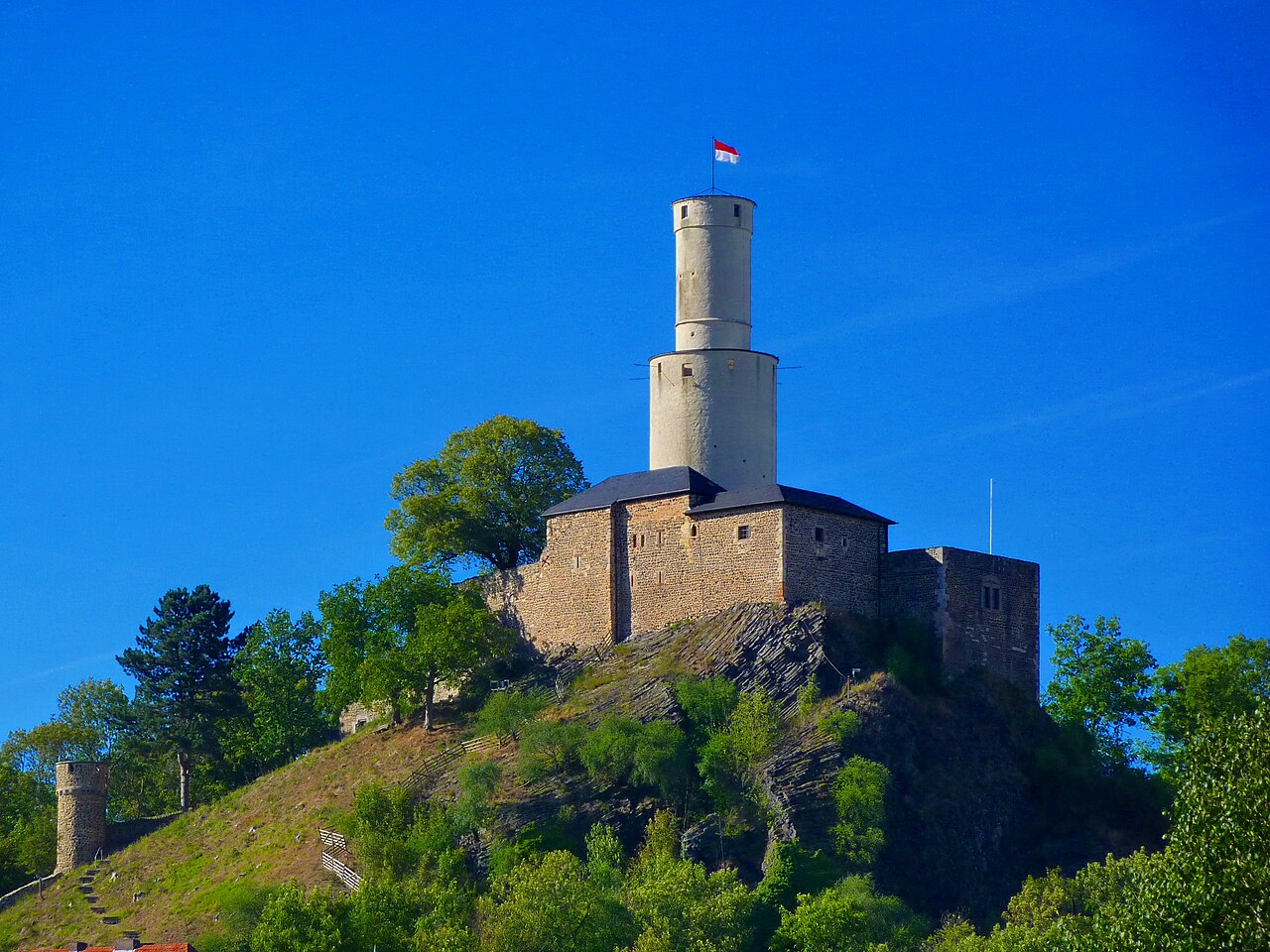
Felsburg is a partial ruin of a hill castle situated in Felsberg on the Eder River in the Schwalm-Eder district of North Hesse, Germany.
The steep basalt cone, which rises about 40 meters above the Eder Valley in the center of the present-day town, was likely fortified with a wooden defensive structure as early as Chatti times (300–600 AD). From this vantage point, the Eder Valley could be controlled, particularly protecting the old salt trade route that ran from Bad Sooden-Allendorf on the Werra River to the Ruhr region, crossing the Eder via a ford.
The castle and the (vice-)counts residing there were first mentioned in documents in 1060 under the name Velisberc. The surrounding town was documented shortly after, in 1090. The ruling family belonged to the so-called Megin lineage and resided in the castle from at least 1090 until 1253. During this period, the construction of Heiligenberg Castle took place within sight of Felsburg as a direct counterfort. The Archbishop and Elector of Mainz sought to assert his claim against the Landgraves of Thuringia and later Hesse, resulting in a prolonged conflict that lasted until 1427, in which Felsburg played a crucial strategic role.
The rulers of Felsberg gradually withdrew from the Eder Valley, ceding the castle and town to the Landgraviate of Thuringia in 1238. In 1253, Berthold of Felsberg donated most of his estates to Breitenau Monastery, and after 1286, the Felsberg vice-counts focused exclusively on their holdings around Hessisch Lichtenau. The family soon became extinct.
Following the division of Hesse and Thuringia after the death of Henry Raspe, Felsburg came under the control of the Landgraviate of Hesse. The castle then became the seat of various Hessian landgravial officials. In 1367, Hessian knights under the leadership of Knight Konrad Spiegel zum Desenberg defeated an army of the Hersfeld Abbot Berthold II of Völkershausen in the Eder Valley near the nearby Altenburg. In 1375, the landgravial ministerialis and Landvogt of Lower Hesse, Friedrich von Felsberg, resided in the castle; as early as 1373, the Landgrave had pledged him the tax revenues of the town of Felsberg. Beginning in 1333, Landgrave Henry II, "the Iron" expanded the Felsburg, and its defenses were further reinforced in 1387, 1388, and 1392.
Text adapted from “Felsburg” on Wikipedia, CC BY-SA 4.0.
Felsburg ranks #7,877 of 9,079 worldwide in the atlas's castle fame ranking, and #694 of the 711 mapped in Germany. Founded 1060, it is older than 88% of the atlas's dated landmarks — one of 436 atlas entries founded in the 11th century. 4 more atlas landmarks stand within 25 km. See how Germany compares in the castle statistics.
View on the interactive castle map →