 Thailand
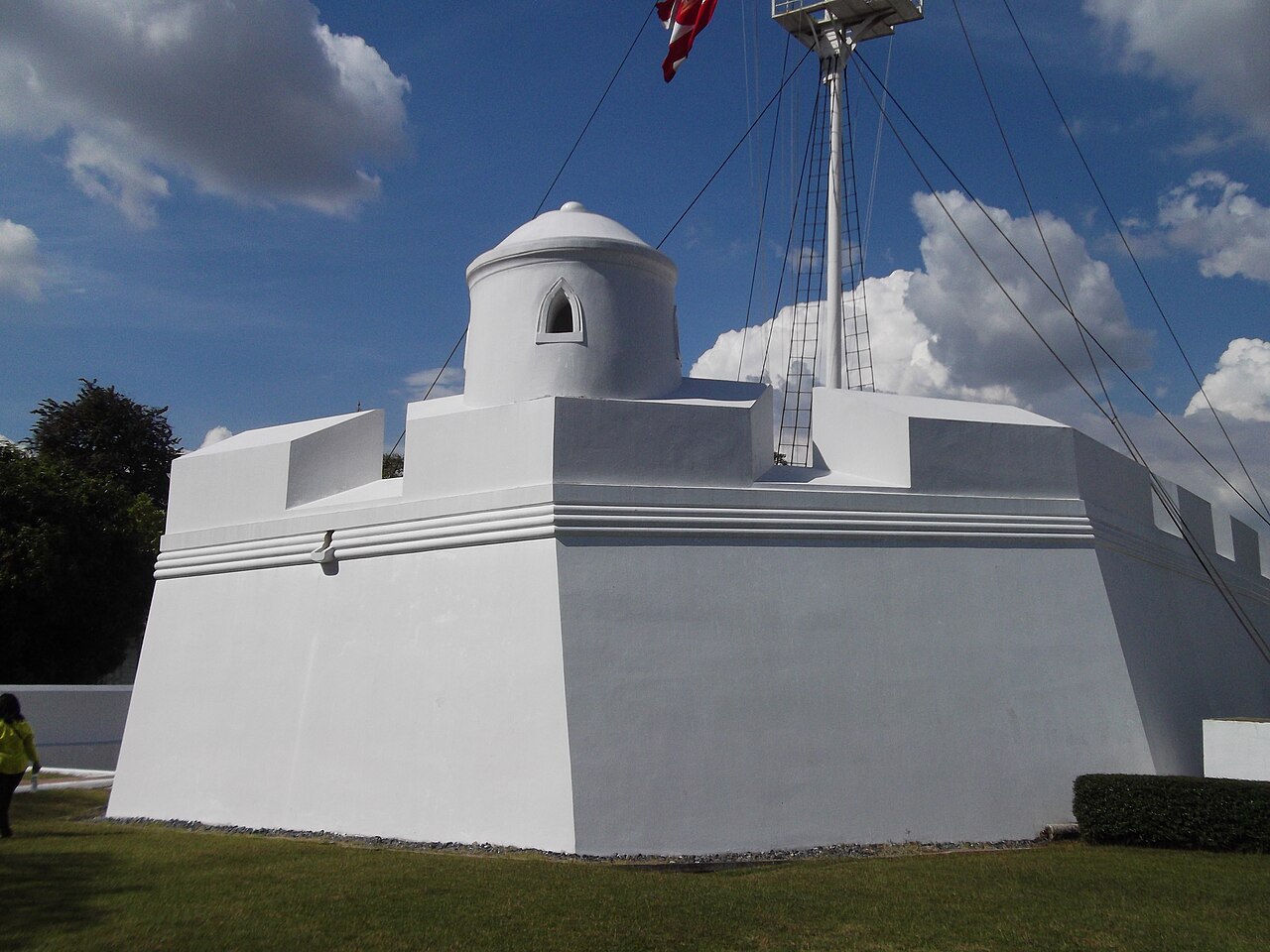
Wichai Prasit Fort ranks #7,406 of 9,040 worldwide in the atlas's castle fame ranking, and #16 of the 21 mapped in Thailand. 12 more atlas landmarks stand within 25 km. The nearest day-trip guide is Bangkok, 3 km away. See how Thailand compares in the castle statistics.
Wichai Prasit Fort is an old fortress on the Chao Phraya River, situated on the western bank of the Chao Phraya, to the north of the mouth of Khlong Bang Luang (Khlong Bangkok Yai). At present it lies within the area of the Royal Thai Navy Headquarters, the Old Palace, Arun Amarin Road, Wat Arun subdistrict, Bangkok Yai district, Bangkok.
Wichai Prasit Fort was originally a bastion fort standing at a corner of the city wall of Bangkok (Thonburi). It was built in the Ayutthaya period to protect the mouth of the river, which was an important trade route. It is thought that this fort was built before the reign of King Narai, possibly with the Portuguese helping to design it.
In the reign of King Narai, he ordered the fort of the city of Bangkok to be improved and rebuilt, possibly carried out on the advice of Chao Phraya Wichayen (Constantine Phaulkon). The design and supervision of the fort's construction were done by Monsieur de la Mare, a French engineer who played a role in the construction of several fortresses in the reign of King Narai, with Father Tommaso Valguarnera, an Italian Jesuit priest, as engineering adviser. La Mare planned to build star forts in the Western manner on both banks of the river, with a chain stretched across the river to prevent ships from entering and leaving, but only the fort on the eastern bank was completed, before the revolution at the end of King Narai's reign, and it was demolished in the Rattanakosin period (some sources say it was demolished in the reign of King Phetracha). Wichai Prasit Fort therefore still retains its original form.
Machine-translated from “ป้อมวิไชยประสิทธิ์” on the Thai Wikipedia, CC BY-SA 4.0.
View on the interactive castle map →