 Germany · 13th century
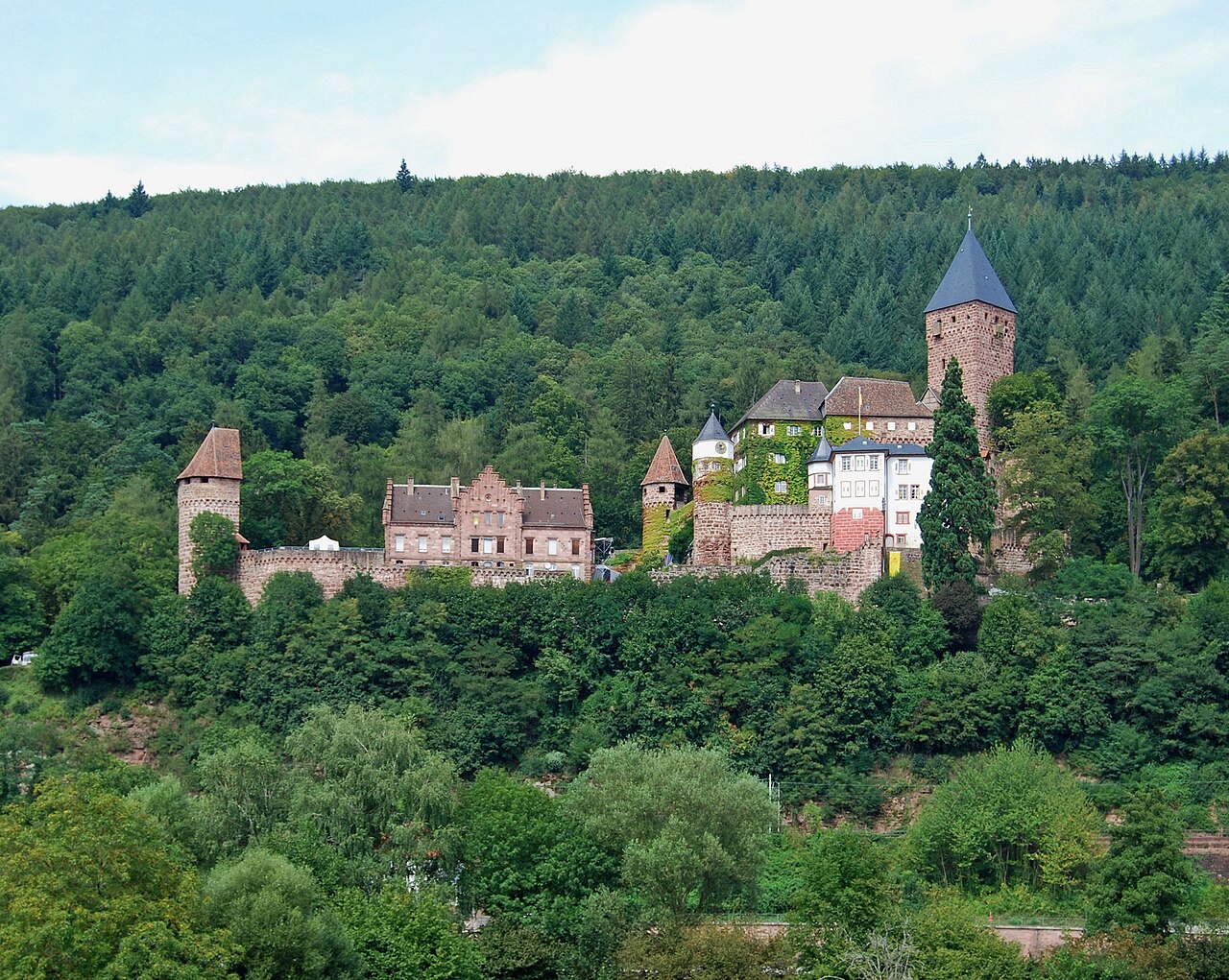
Zwingenberg Castle ranks #4,264 of 9,040 worldwide in the atlas's castle fame ranking, and #350 of the 714 mapped in Germany. Founded c. 1250, it is older than 67% of the atlas's dated landmarks, one of 1091 atlas entries founded in the 13th century. Its Wikipedia articles were opened 1,404 times in the last 60 days, more than 60% of the atlas. 6 more atlas landmarks stand within 25 km. The nearest day-trip guide is Heidelberg, 23 km away. See how Germany compares in the castle statistics.
Zwingenberg Castle (German: Burg Zwingenberg), also known as Zwingenberg or Schloss Zwingenberg, stands on the right bank of the River Neckar where it cuts through the Odenwald hills in central Germany. The castle is located in the municipality of Zwingenberg in the state of Baden-Württemberg.
The spur castle was built on a hill spur above the confluence of the Wolfschlucht gorge and the Neckar valley, approximately 50 metres above the river.
The castle was likely constructed in the 13th century by the Hohenstaufen ministerialis William of Wimpfen. The earliest known documentary reference dates to 1326.
A nephew of William of Wimpfen later adopted the name von Zwingenberg. Due to their activities as robber knights, the Zwingenberg family was expelled in 1363, and the castle was subsequently slighted by imperial order.
In 1403, the Lord of Hirschhorn received the castle as a fief and rebuilt it. After the extinction of the Hirschhorn line, ownership passed between the Electorate of Mainz, the Electorate of the Palatinate, and the Grand Duchy of Baden.
The castle is currently owned by Louis (Ludwig), Prince of Baden.
Above Zwingenberg Castle are the remains of Fürstenstein Castle.
Text adapted from “Zwingenberg Castle” on Wikipedia, CC BY-SA 4.0.
View on the interactive castle map →