Ruin
Pleissenburg
🇩🇪 Germany · 13th century
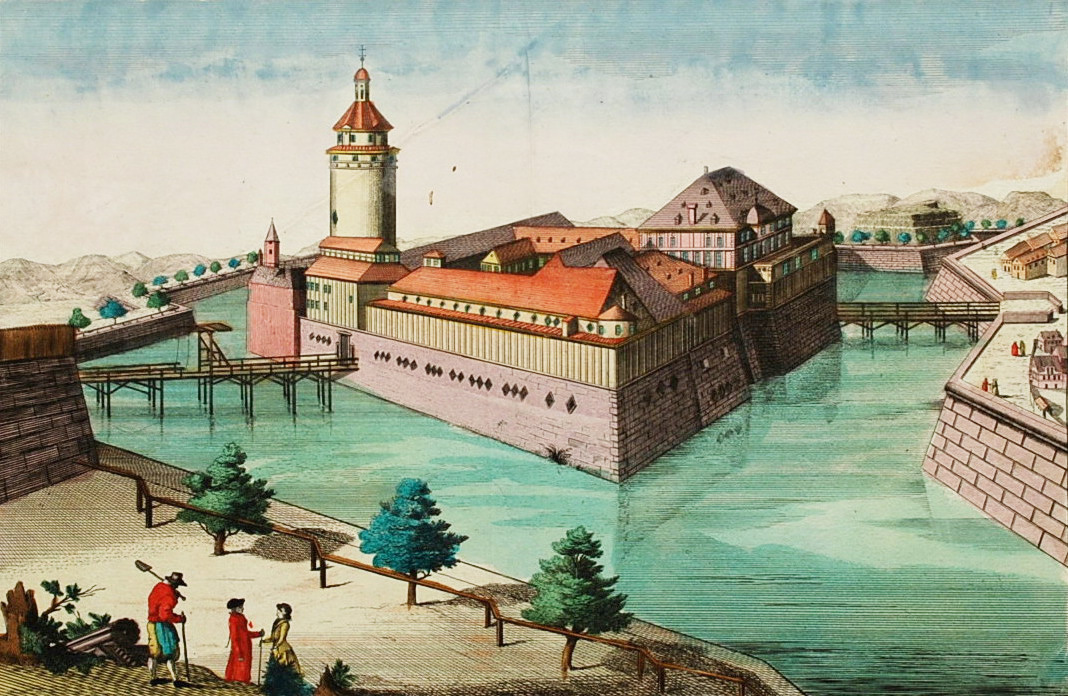
The Pleissenburg (German: Pleißenburg) was a historical building in the city of Leipzig in Saxony which is in modern-day Germany. It was built in the 13th century by Theodoric I, Margrave of Meissen and named after the Pleisse Mill Race (German: Pleißemühlgraben) which runs nearby and is often called for short Pleisse.
From 27 June to 16 July 1519, the debate in the form of theses and counter-theses between Martin Luther and Johann Eck, which became known as the Leipzig Debate, took place on the Pleissenburg. Martin Luther delivered the first Protestant sermon in Leipzig on Pentecost 1539 in the castle chapel.
After the severe destruction caused by the siege of the Schmalkaldic War, Maurice, Elector of Saxony (1521–1553) had the castle demolished in 1548 and rebuilt as a triangular fortress in 1549 under the direction of Hieronymus Lotter (1497–1580). The new Pleissenburg was attached to the city's fortification system and separated from the main walls by its own moat, so that it assumed the function of a citadel. It was equipped with casemates and a triangular bastion on the field side.
The fortress also housed the city's first post-Reformation Catholic church. In 1697 Elector Augustus II the Strong (1670–1733) converted to Catholicism. Therefore, the Catholics living in Leipzig asked for permission to found their own chapel. In 1710 the king instructed the commander of the Pleissenburg fortress to set up a room for masses there. At the same time the Jesuit priest Heinrich Eggerth was commissioned to care for the community. In the following years the Catholics of Leipzig were pastorated exclusively by the Jesuits and eventually three, then four dehonians lived here. They lived in a house in the city and were paid by the government.
In the Thirty Years' War, the attack of the Catholic League army under Johann Tserclaes, Count of Tilly on the Electorate of Saxony began with the capture of the Pleissenburg on 14 September 1631. The attack ended with the heavy defeat of Tilly's army at the Battle of Breitenfeld on 17 September against the Swedish-Saxon army of the Swedish king Gustavus Adolphus.
After the Thirty Years' War and the capture of Leipzig by the Swedes in September 1706, the Pleissenburg gradually lost its military importance. In 1764 it was deleted from the list of Saxon fortresses. It was still used as an administrative building and barracks.
Text adapted from “Pleissenburg” on Wikipedia, CC BY-SA 4.0.
Pleissenburg ranks #4,326 of 8,134 worldwide in the atlas's castle fame ranking, and #330 of the 505 mapped in Germany. Founded c. 1250, it is older than 69% of the atlas's dated landmarks — one of 861 atlas entries founded in the 13th century. Its Wikipedia articles were opened 1,361 times in the last 60 days, more than 57% of the atlas. See how Germany compares in the castle statistics.
View on the interactive castle map →Frequently asked questions
Where is Pleissenburg?
Pleissenburg stands in Germany, at 51.3362°, 12.3721°.
When was Pleissenburg built?
The atlas dates its founding to c. 1250. Earlier structures may have stood on the site; this is the earliest documented founding year.
How famous is Pleissenburg?
In this atlas's fame ranking: #4,326 of 8,134 worldwide, and #330 in Germany. Fame here combines how many Wikipedia language editions cover a landmark with how many people read them.
What is the nearest castle to Pleissenburg?
Moritzburg, about 33 km away.
More castles in Germany
- Wegelnburg Germany
- Burg Hülshoff Germany · 11th century
- Güssenburg Castle Germany · 14th century
- Augustusburg Hunting Lodge Germany · 16th century
More ruins
- Castle Roche Ireland · 13th century
- Castle Saunderson Ireland · 19th century
- Château d'Arques-la-Bataille France · 12th century
- Château de Clermont (Isère) France · 11th century