Fortaleza
Pir Huseyn Khanqah
🇦🇿 Azerbaiyán · siglo XIII
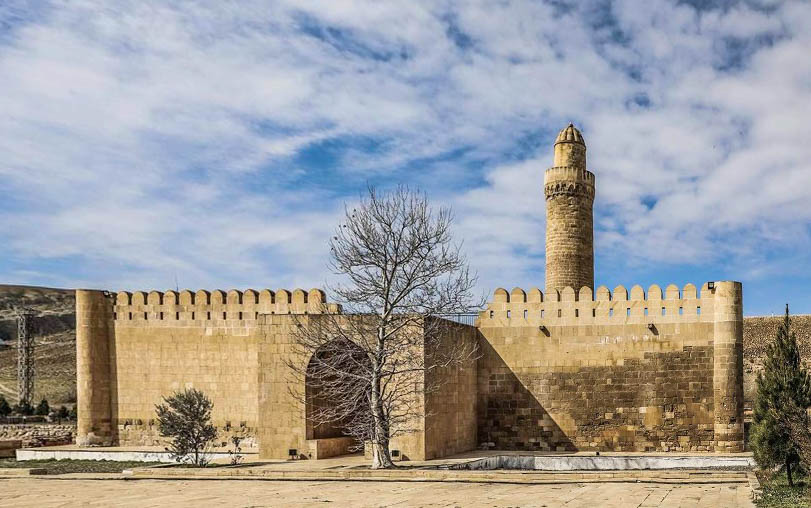
El khanqah y mausoleo de Pir Huseyn se halla en la orilla izquierda del río Pirsaat (Pirsaatçay), 126 kilómetros al suroeste de Bakú. La placa con la inscripción sobre el pórtico, leída por V. Kratchkovskaya en 1952, anuncia que el khanqah (monasterio derviche) fue construido por Sharaf al-Dawla wal-din Hasan durante el reinado del shirvanshah Afridhun Abul-Muzaffar Fariburz (Fariburz III, 1225-1255). El epígrafe da una fecha posterior: «Aquí yace el jeque, imán, místico… Al-Husain, hijo de Alí, conocido como Pir Husain Rawanan… Su tumba fue reconstruida por Umar, hijo de Muhammad al-Shirzadi de Qazvín, y completada en el año 684 [1280 e.c.]». Es probable que la tumba de Pir Husayn bin Ali, un jeque azerí de la secta qalandari que vivió en el siglo XI, existiera ya en el emplazamiento antes de que se construyera un khanqah formal a su alrededor en el siglo XIII.
Construido en piedra tallada, el complejo, de planta aproximadamente rectangular, se articulaba en torno a un patio abierto fortificado con murallas, de forma similar a un ribat. Las murallas almenadas estaban reforzadas con bastiones redondos en las esquinas y bastiones semicirculares en el centro de los muros sur, este y oeste. Una puerta monumental centrada en el muro oriental daba acceso al patio, rodeado al norte y al oeste por salas de diferentes tamaños, incluida una mezquita en el ala occidental y un único alminar cerca de la esquina noreste.
El khanqah de Pir Husayn era célebre por los azulejos vidriados que cubrían el interior de la tumba y el sarcófago del jeque, que habían desaparecido por completo hacia 1913. Hacia la década de 1940, V. Kratchkovskaya identificó más de cuatrocientos azulejos en forma de cruz y de estrella de la tumba en el Museo del Hermitage (San Petersburgo) y en el Museo Estatal de Georgia (Tiflis), incluidos azulejos del friso de inscripciones del mausoleo.
Traducción automática de «Pir Huseyn Khanqah» en la Wikipedia en inglés, CC BY-SA 4.0.
Pir Huseyn Khanqah ocupa el puesto 4426 de 8134 en el mundo en la clasificación de fama de este atlas y el n.º 22 de los 45 que el atlas cartografía en Azerbaiyán. Su fundación, hacia ca. 1300, es anterior a la del 63% de los monumentos datados del atlas — uno de los 861 monumentos del atlas fundados en el siglo XIII. La guía de excursión más cercana es Bakú, a 74 km. Compara el dato en las estadísticas de castillos.
Ver en el mapa interactivo de castillos →Preguntas frecuentes
¿Dónde está Pir Huseyn Khanqah?
La fortaleza se encuentra en Azerbaiyán, en las coordenadas 40.15359°, 49.00789°.
¿De qué año data Pir Huseyn Khanqah?
El atlas fija su fundación en ca. 1300. Pudieron existir construcciones anteriores en el mismo lugar; este es el año documentado más antiguo.
¿Qué puesto ocupa Pir Huseyn Khanqah en la clasificación por fama?
En la clasificación por fama de este atlas: n.º 4426 de 8134 en el mundo, y n.º 22 en Azerbaiyán. La fama combina en cuántas ediciones de Wikipedia aparece un monumento y cuánta gente las lee.
¿Qué castillo está más cerca de Pir Huseyn Khanqah?
Gulustan Castle, a unos 65 km.
Más castillos en Azerbaiyán
- Handaberd Azerbaiyán · siglo IX
- Hajigulular Palace Azerbaiyán · siglo XIX
- Melik Haykaz Palace Azerbaiyán · siglo XVIII
- Chirag Gala Azerbaiyán · siglo V
Más fortalezas
- Izzeddin Fortress Grecia · siglo XIX
- Castillo de la Inmaculada Concepción Nicaragua · siglo XVII
- Babruysk Fortress Bielorrusia · siglo XIX
- Fortaleza de Chakvinji Georgia