Vesting
Pir Huseyn Khanqah
🇦🇿 Azerbeidzjan · 13e eeuw
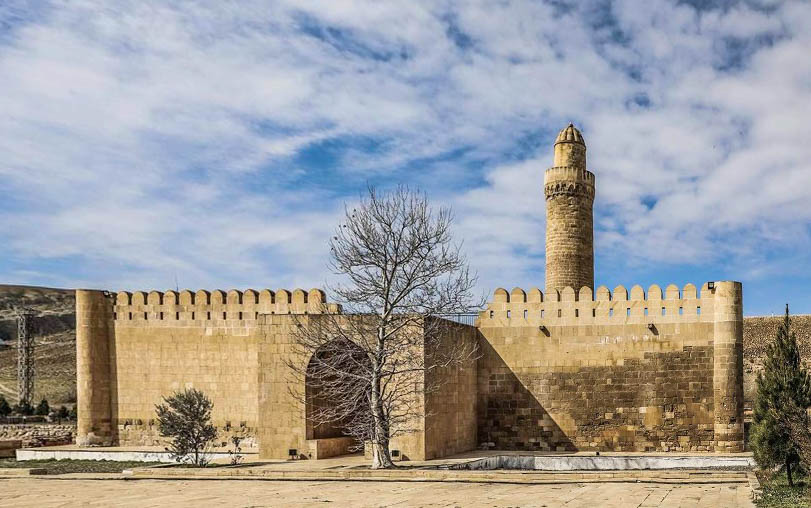
De Pir Huseyn-chanqah en het mausoleum liggen aan de linkeroever van de rivier de Pirsaat (Pirsaatçay), 126 kilometer ten zuidwesten van Bakoe. De inscriptieplaat boven het portaal, in 1952 gelezen door V. Kratsjkovskaja, meldt dat de chanqah (derwisjklooster) werd gebouwd door Sharaf al-Dawla wal-din Hasan tijdens het bewind van de shirvanshah Afridhun Aboe-l-Moezaffar Fariboerz (Fariboerz III, 1225-1255). De titel geeft een latere datum: "Hier rust de sjeik, imam, mysticus... Al-Husain, zoon van 'Ali, bekend als Pir Husain Rawanan... Zijn graf werd herbouwd door 'Umar, zoon van Muhammad al-Shirzadi uit Qazvin, en voltooid in het jaar 684 [1280 n.Chr.]." Het is waarschijnlijk dat het graf van Pir Husayn bin Ali, een Azerbeidzjaanse sjeik van de qalandari-sekte die in de 11e eeuw leefde, al op deze plek bestond voordat er in de 13e eeuw een formele chanqah omheen werd gebouwd.
Het uit gehouwen steen opgetrokken, min of meer rechthoekige complex was gecentreerd rond een open binnenplaats, versterkt met wallen, vergelijkbaar met een ribat. De kantelen van de wallen werden geschoord met ronde bastions op de hoeken en halfronde bastions in het midden van de zuid-, oost- en westmuur. Een monumentale poort in het midden van de oostmuur bood toegang tot de binnenplaats, die aan de noord- en westzijde was omringd door zalen van verschillende afmetingen, waaronder een moskee aan de westvleugel en een enkele minaret nabij de noordoostelijke hoek.
Machinaal vertaald uit “Pir Huseyn Khanqah” op de Engelstalige Wikipedia, CC BY-SA 4.0.
Pir Huseyn Khanqah staat op plaats 4.426 van 8.134 in de bekendheidsranglijst van deze atlas en op plaats 22 van de 45 die de atlas in Azerbeidzjan in kaart brengt. Gebouwd in ca. 1300, en daarmee ouder dan 63% van de gedateerde bouwwerken in de atlas — een van de 861 bouwwerken in de atlas die uit de 13e eeuw stammen. De dichtstbijzijnde dagtripgids is Bakoe, 74 km verderop. Zie hoe dat zich verhoudt in de kastelenstatistiek.
Bekijk op de interactieve kastelenkaart →Veelgestelde vragen
Waar ligt Pir Huseyn Khanqah?
Pir Huseyn Khanqah ligt in Azerbeidzjan, op 40.15359°, 49.00789°.
Wanneer werd Pir Huseyn Khanqah gebouwd?
De atlas dateert de stichting op ca. 1300. Er kunnen eerdere bouwwerken hebben gestaan; dit is het oudste gedocumenteerde bouwjaar.
Hoe bekend is Pir Huseyn Khanqah?
In de bekendheidsranglijst van deze atlas: plaats 4.426 van 8.134 wereldwijd, plaats 22 in Azerbeidzjan. Bekendheid combineert het aantal Wikipedia-taalversies met het aantal lezers.
Welk kasteel ligt het dichtst bij Pir Huseyn Khanqah?
Gulustan Castle, ongeveer 65 km verderop.
Meer kastelen in Azerbeidzjan
- Handaberd Azerbeidzjan · 9e eeuw
- Hajigulular Palace Azerbeidzjan · 19e eeuw
- Melik Haykaz Palace Azerbeidzjan · 18e eeuw
- Chirag Gala Azerbeidzjan · 5e eeuw
Meer vestingen
- Izzeddin Fortress Griekenland · 19e eeuw
- Fortress of the Immaculate Conception Nicaragua · 17e eeuw
- Babruysk Fortress Belarus · 19e eeuw
- Chakvinji Fortress Georgië