Forteresse
Pir Huseyn Khanqah
🇦🇿 Azerbaïdjan · XIIIe siècle
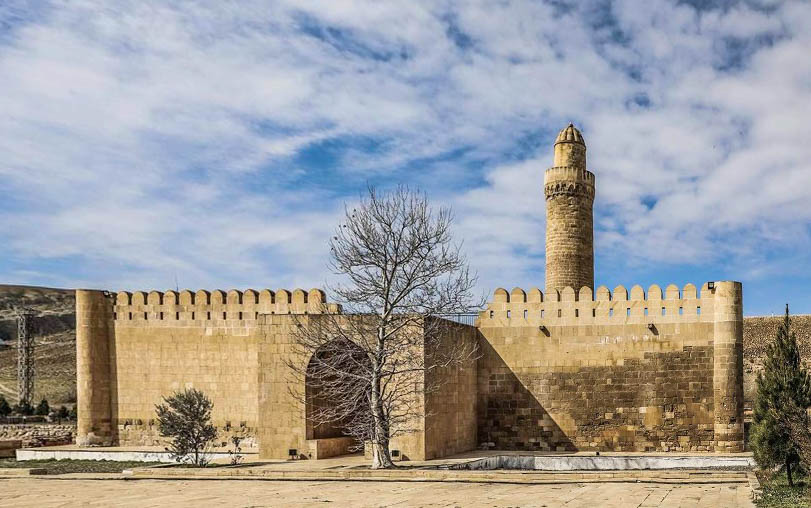
Le khanqah et mausolée de Pir Huseyn se dresse sur la rive gauche de la rivière Pirsaat (Pirsaatçay), à 126 kilomètres au sud-ouest de Bakou. L'inscription du portail, déchiffrée par V. Kratchkovskaya en 1952, indique que le khanqah (monastère de derviches) fut construit par Sharaf al-Dawla wal-din Hasan sous le règne du chirvanchah Afridhun Abul-Muzaffar Fariburz (Fariburz III, 1225-1255). Le titre donne une date ultérieure : « Ici repose le cheikh, imam, mystique... Al-Husain, fils de 'Ali, connu sous le nom de Pir Husain Rawanan... Sa tombe fut reconstruite par 'Umar, fils de Muhammad al-Shirzadi de Qazvin, et achevée en l'an 684 [1280 EC]. » Il est probable que la tombe de Pir Husayn bin Ali, un cheikh azéri de la secte qalandari ayant vécu au XIe siècle, existait sur ce site avant qu'un khanqah en bonne et due forme n'y fût construit autour d'elle au XIIIe siècle.
Bâti en pierre de taille, ce complexe de plan globalement rectangulaire était centré sur une cour ouverte fortifiée de remparts, à la manière d'un ribat. Les murs de rempart crénelés étaient renforcés par des bastions ronds aux angles et des bastions semi-circulaires au milieu des murs sud, est et ouest. Une porte monumentale, centrée sur le mur est, donnait accès à la cour, entourée au nord et à l'ouest de salles de tailles diverses, dont une mosquée dans l'aile ouest et un unique minaret près de l'angle nord-est.
Le khanqah de Pir Husayn était réputé pour les carreaux vernissés recouvrant l'intérieur de la tombe et le sarcophage du cheikh, qui avait entièrement disparu dès 1913. Dans les années 1940, plus de quatre cents carreaux cruciformes et étoilés de la tombe furent identifiés par V. Kratchkovskaya au musée de l'Ermitage (Saint-Pétersbourg) et au Musée d'État de Géorgie (Tbilissi), y compris des carreaux de la frise à inscription du mausolée.
Traduction automatique de « Pir Huseyn Khanqah » de la Wikipédia en anglais, CC BY-SA 4.0.
Pir Huseyn Khanqah occupe la 4 426e place sur 8 134 au classement de renommée de cet atlas et le 22e rang des 45 que l’atlas recense en Azerbaïdjan. Sa fondation, vers v. 1300, est antérieure à celle de 63 % des monuments datés de l’atlas — l’un des 861 monuments de l’atlas fondés au XIIIe siècle. Le guide d’excursion le plus proche est Bakou, à 74 km. Voyez comment l’Azerbaïdjan se compare dans les statistiques des châteaux.
Voir sur la carte interactive des châteaux →Questions fréquentes
Où se trouve Pir Huseyn Khanqah ?
Pir Huseyn Khanqah se trouve en Azerbaïdjan, aux coordonnées 40.15359°, 49.00789°.
De quand date Pir Huseyn Khanqah ?
L’atlas retient comme fondation v. 1300. Des constructions antérieures ont pu occuper le site ; c’est l’année de fondation documentée la plus ancienne.
Quelle est la renommée de Pir Huseyn Khanqah ?
Au classement de renommée de cet atlas : 4 426e place sur 8 134 dans le monde, 22e place en Azerbaïdjan. La renommée combine le nombre d’éditions de Wikipédia qui couvrent un monument et leur lectorat.
Quel château est le plus proche de Pir Huseyn Khanqah ?
Gulustan Castle, à environ 65 km.
D’autres châteaux en Azerbaïdjan
- Andaberd (citadelle) Azerbaïdjan · IXe siècle
- Hajigulular Palace Azerbaïdjan · XIXe siècle
- Melik Haykaz Palace Azerbaïdjan · XVIIIe siècle
- Chirag Gala Azerbaïdjan · Ve siècle
D’autres forteresses
- Forteresse d'Izzeddin Grèce · XIXe siècle
- Forteresse de l’Immaculée Conception Nicaragua · XVIIe siècle
- Babruysk Fortress Biélorussie · XIXe siècle
- Chakvinji Fortress Géorgie