 Spain · 10th century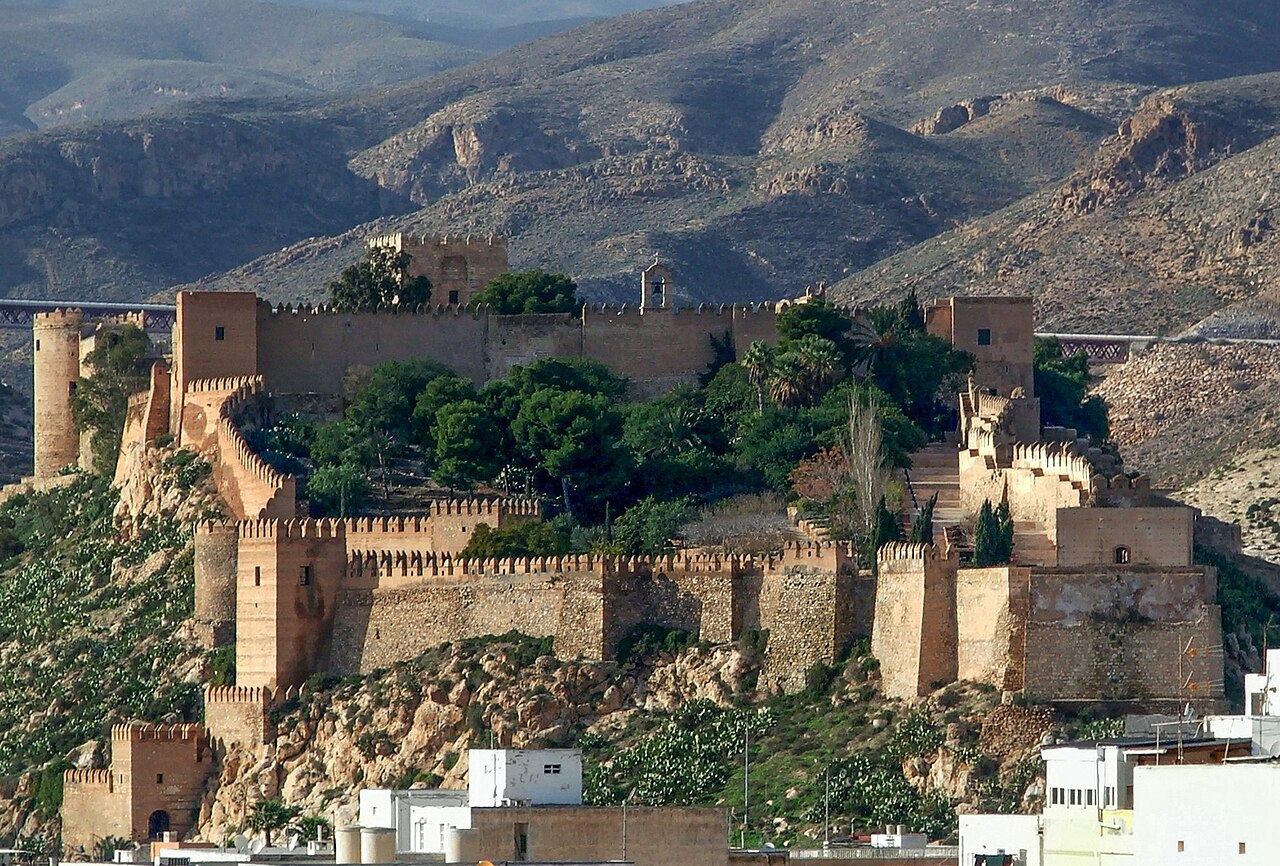
The Alcazaba of Almería is a fortified complex in Almería, southern Spain. The word alcazaba, from the Arabic word (القَصَبَة; al-qaṣabah), signifies a walled fortification in a city.
In 955, Almería was given the title of medina ("city") by the Caliph of Cordoba Abd ar-Rahman III, when the construction of the defensive citadel located in the upper sector of the city began. Provided not only with walls and towers but also with squares, houses, and a mosque, it was to be the seat of the local government, commanding the city and the nearby sea.
The complex was enlarged under caliph Al-Mansur and again under Khayran as-Saqlabi, the first king of the independent taifa of Almería.
Its purpose was to protect the area's largest city at the time, Pechina.
Most of the objects from the archaeological site at the Alcazaba are kept in the Museo de Almería, but some are in the Museo de la Alhambra.
The renowned Muslim scholar Abul Walid Al-Baji was reported to be buried within the grounds of the citadel according to the biographical work of Ibn Bashkawal writing around 50-60 years later.
The first line of walls is a wide enclosure corresponding to the first Muslim military camp, used as shelter for the population in case of siege. For this task it was provided with large cisterns.
The first enclosure is separated by the second one by the so-called Muro de la Vela ("Wall of the Sail"), taking its name from a bell that warned the population in case of events such as the arrival of a ship in the port, danger, fires etc. This wall was built by King Charles III of Spain.
In the second enclosure was the residence for the governors, their soldiers and their servants. It included also the mosque, baths, tanks, tents etc.
The third enclosure, the most external, is also the most modern in the complex. After the Christian reconquest of Almería, the Catholic monarchs Isabella I of Castile and Ferdinand II of Aragon had a castle built in the most elevated sector of the town, more apt to resist the new gunpowder artillery.
The Alcazaba has been used to film Conan the Barbarian, Indiana Jones and the Last Crusade, Never Say Never Again, and most recently Wonder Woman 1984. The syndicated TV series Queen of Swords used the inner courtyard and gardens.
Text adapted from “Alcazaba of Almería” on Wikipedia, CC BY-SA 4.0.
Alcazaba y Murallas del Cerro de San Cristóbal ranks #648 of 9,079 worldwide in the atlas's castle fame ranking, and #27 of the 607 mapped in Spain. Founded 955, it is older than 92% of the atlas's dated landmarks — one of 193 atlas entries founded in the 10th century. Its Wikipedia articles were opened 5,396 times in the last 60 days, more than 87% of the atlas. 3 more atlas landmarks stand within 25 km. It is one of the 124 landmarks on the atlas's regional map of Andalusia. See how Spain compares in the castle statistics.
View on the interactive castle map →