 Uzbekistan · 4th century BC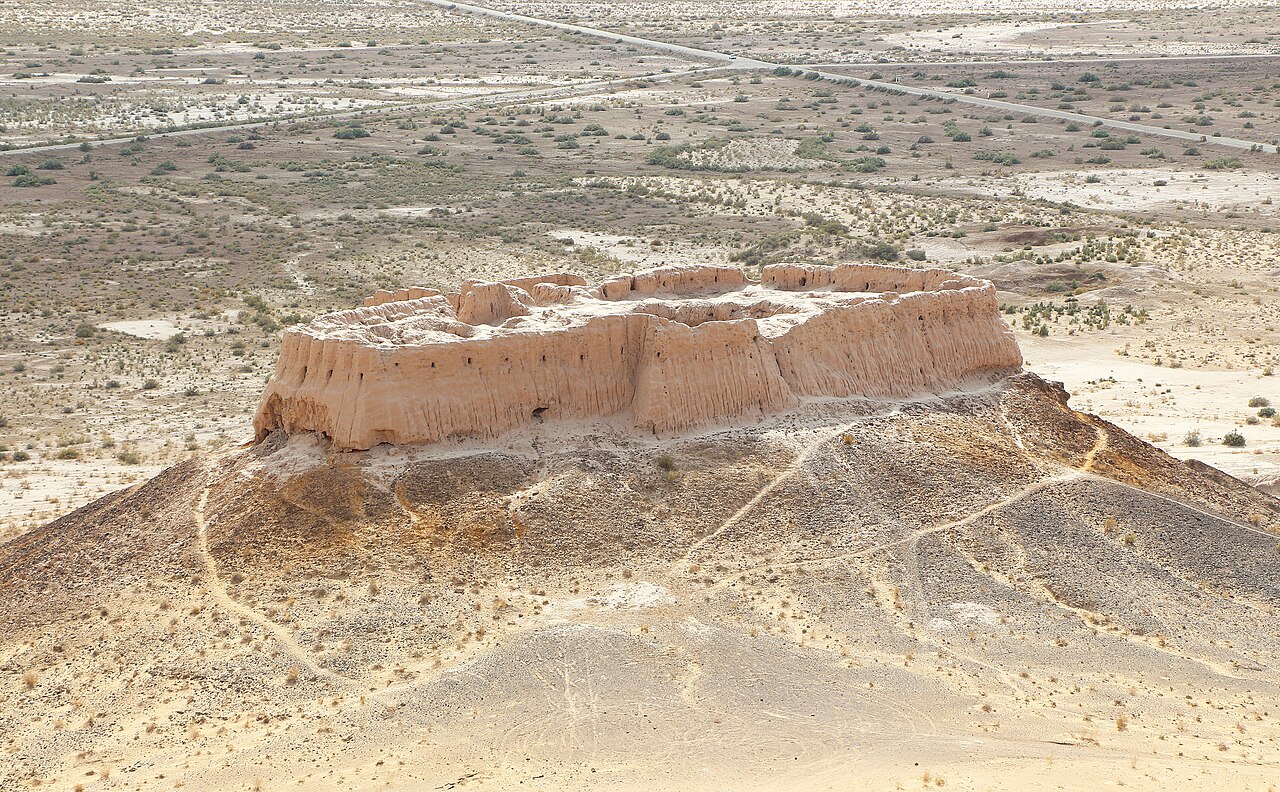
Ayaz-Kala is an archaeological site in Ellikqala District, Karakalpakstan, in northern Uzbekistan, built between the 4th century BCE and the 7th century CE. Situated on a hilltop overlooking the Kyzylkum Desert, the site encompasses the ruins of an ancient Khorezm fortress.
The site consists of three fortresses which were built from the 4th century BCE to the 7th century CE. The fortresses were part of a series of forts at the edge of the Kyzylkum Desert, which provided defence against raids by nomads and the Saka of the Syr Darya delta. Part of Ayaz Kala was built in the second century by the Kushan Empire. The now-ruined fortress is speculated to have been built as part of a chain of border fortresses guarding the borders of the Kyzylkum Desert. In addition to the eroded remains of defensive works, the remnants of several residential structures have been uncovered at site.
Ayaz Kala 1 is a fortress dating back to end of the 4th or beginning of the 3rd century BCE. In this time Khorezm had become independent from Persia. Ayaz Kala 1 was part of a chain of fortresses protecting the agricultural settlements from attacks by nomads. The fortress is situated on the top of a hill, approximately 100 m (330 ft) high, providing wide views over the surrounding plains. The fortress is rectangular in plan with sides 182 and 152 m (597 and 499 ft) long. The main axis is oriented from south to north.
At the southern end of the axis is a square gateway, which is a typical element of frontier fortresses of Khorezm. The enemies' approach lies parallel to the south east walls and invaders were vulnerable to attack from above. A massive gateway defended by two rectangular towers leads into a small rectangular chamber. This chamber was overlooked on all sides by high walls from which bowmen could shoot at the enemy in case the first gate was breached.
The enclosure of the fortress consists of an inner and outer wall with a vaulted corridor between them, about 2 m wide. The walls continue above the vaults, forming a protected rampart walk. The walls are up to 10 m (33 ft) high and at their base 2.2 to 2.4 m thick. The walls are reinforced in the 3rd century BCE by 45 watchtowers in half elliptical form, at a distance from each other of 11.5 m at the northern and of 14 m at the eastern and western sides.
Text adapted from “Ayaz-Kala” on Wikipedia, CC BY-SA 4.0.
Ayaz-Kala ranks #1,787 of 9,035 worldwide in the atlas's castle fame ranking, and #3 of the 12 mapped in Uzbekistan. Founded c. 350 BC, it is older than 99% of the atlas's dated landmarks, one of 15 atlas entries founded in the 4th century BC. Its Wikipedia articles were opened 1,972 times in the last 60 days, more than 69% of the atlas. 1 more atlas landmarks stand within 25 km. The nearest day-trip guide is Khiva, 89 km away. See how Uzbekistan compares in the castle statistics.
View on the interactive castle map →