 Uzbekistan · 19th century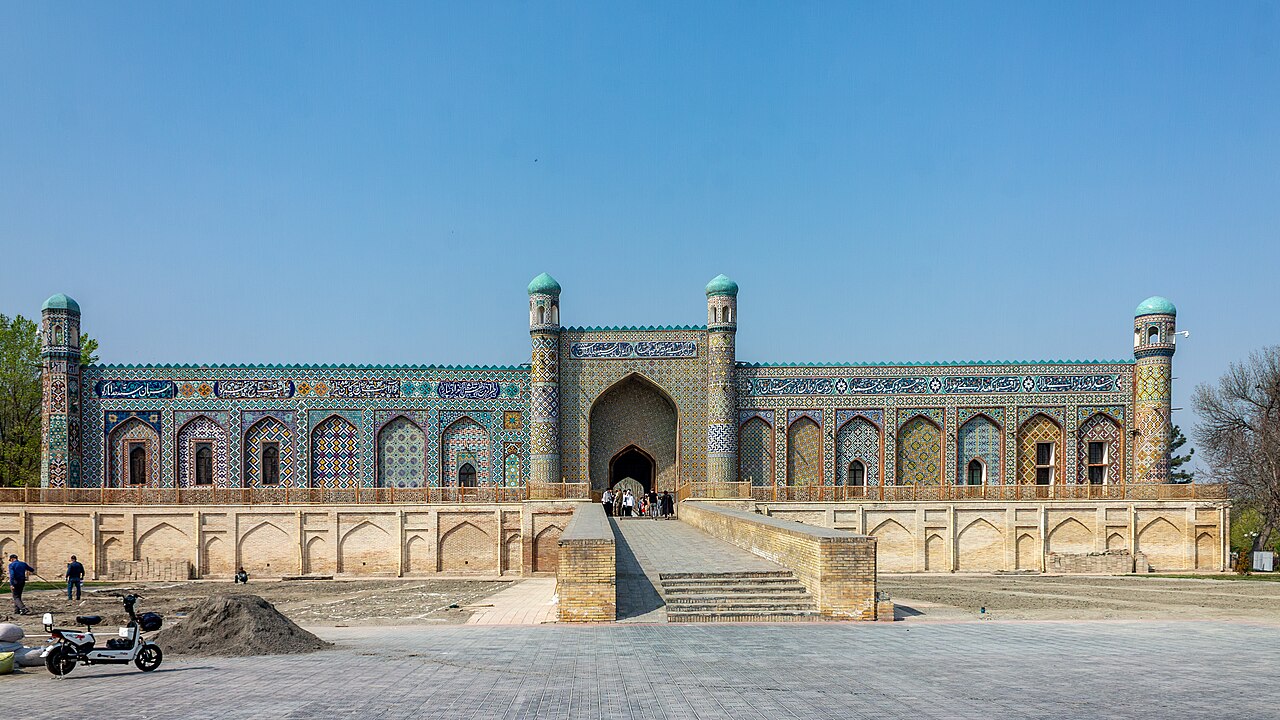
The Palace of Khudayar Khan, known as the Pearl of Kokand, was the palace of the last ruler of the Kokand Khanate, Khudayar Khan. It is the most visited tourism attraction in Uzbekistan’s Fergana Valley.
The Palace of Khudayar Khan, also known as Kokand Urda, was built in the early 1870s. It was the last in a series of seven palaces, each grander than the last, and it was intended to project the power of the khan. The architect was Mir Ubaydullo, and the palace is said to have been built by 80 master builders and 16,000 conscripted labourers. The American diplomat Eugene Schuyler described the palace as being "much larger and more magnificent than any other in Central Asia... glittering in all the brightness of its fresh tiles, blue, yellow and green."
During the Russian Conquest of Central Asia, Tsarist troops seized and liquidated the Khanate of Kokand, turning it into a vassal state. Khudayar Khan initially took a pro-Russian stance but was forced into exile, leaving his palace behind. The property was looted.
During the Bolshevik Revolution, Kokand and from 1917-18 had an anti-Bolshevik Provisional Government. When the Bolsheviks did take control of the city in 1918, they demolished the majority of the palace, including all of the harem, leaving just 19 original rooms out of nearly 120.
In 1938, under the leadership of architect Obid Zayniddinov, a renovation project was carried out in the Palace of Khudayar Khan; an architect Kadirjon Haydarov, carver S. Norkoziyev and other masters took part in the repair. As a result of the researches in 1974 (architectors N. Akromkhojayev, E. Nurullayev, etc.), the original state of the palace was determined.
In 1924, an exhibition of agricultural achievements was opened in the Palace of Khudoyorkhan. Since 1925, the Museum of Local History of the city of Kokhan has been operating in the palace.
The palace stands within landscaped gardens in the centre of Kokand. The total site is four hectares, and the original building was 138 m long and 68 m wide. The main entrance is 5 m above ground level and accessed via a ramp.
The entire facade is richly tiled, with a mixture of geometric patterns and inscriptions. Above the gateway, an Arabic inscription reads “High Palace of Seid Muhammad Khudayar Khan”.
Text adapted from “Palace of Khudáyár Khán” on Wikipedia, CC BY-SA 4.0.
Palace of Khudáyár Khán ranks #2,634 of 9,035 worldwide in the atlas's castle fame ranking, and #5 of the 12 mapped in Uzbekistan. Founded 1871, it is older than 6% of the atlas's dated landmarks, one of 705 atlas entries founded in the 19th century. Its Wikipedia articles were opened 1,515 times in the last 60 days, more than 62% of the atlas. See how Uzbekistan compares in the castle statistics.
View on the interactive castle map →