 England · 11th century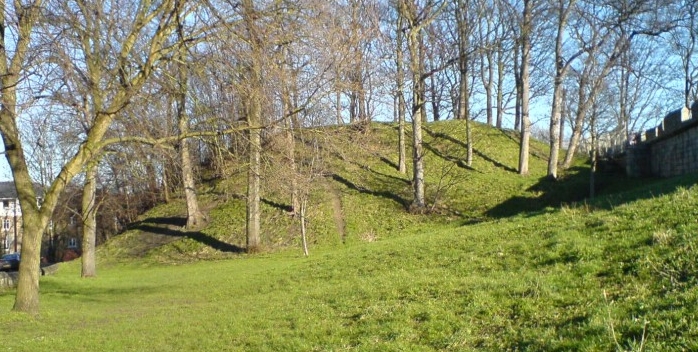
Baile Hill is a man-made earth mound in the Bishophill area of York, England. It is the only remaining feature of the fortification known as the Old Baile.
The origins of Baile Hill date back to 1068. Having seized York in that year, William the Conqueror built a castle on the south side of the city close to the River Ouse. Then, as a response to a rebellion the following year, a second castle was built on the opposite side of the river. There is no clear evidence which of these castles was built first, but it is generally thought to be the one which stood on the site of the later York Castle on the east side of the river, followed by the Old Baile on the west side.
Like its opposite counterpart, the Old Baile was a motte-and-bailey castle. The motte was approximately 40 feet (12 m) high and 180 feet (66 m) in diameter, and was surrounded by a large ditch. A flight of steps led to a wooden structure at the top which was surrounded by a fence, also made of wood. The bailey lay to the north-west of the motte and was rectangular. Around its perimeter was an earth rampart and an outer ditch.
The castle, it is believed, was not in regular use for long. By the 13th century it was in the hands of the Archbishop of York and in 1322 Archbishop Melton agreed to defend it in times of war. By c. 1340 part of the city wall had been built along the south-east and south-west sides of the Old Baile, incorporating the existing ramparts and ditch, however, these defences were rarely called into use. The only notable occasion was the siege of York in 1644 during the Civil War, when Baile Hill was used as a royalist gun emplacement. Apart from that, however, the Old Baile was used mainly for grazing and recreation activities, particularly archery during the medieval period.
Today, Baile Hill stands at the junction of Baile Hill Terrace and Cromwell Road.
Text adapted from “Baile Hill” on Wikipedia, CC BY-SA 4.0.
Baile Hill ranks #4,737 of 9,079 worldwide in the atlas's castle fame ranking, and #301 of the 360 mapped in England. Founded 1068, it is older than 88% of the atlas's dated landmarks — one of 436 atlas entries founded in the 11th century. 8 more atlas landmarks stand within 25 km. The nearest day-trip guide is Sheffield, 69 km away. See how England compares in the castle statistics.
View on the interactive castle map →