 England · 11th century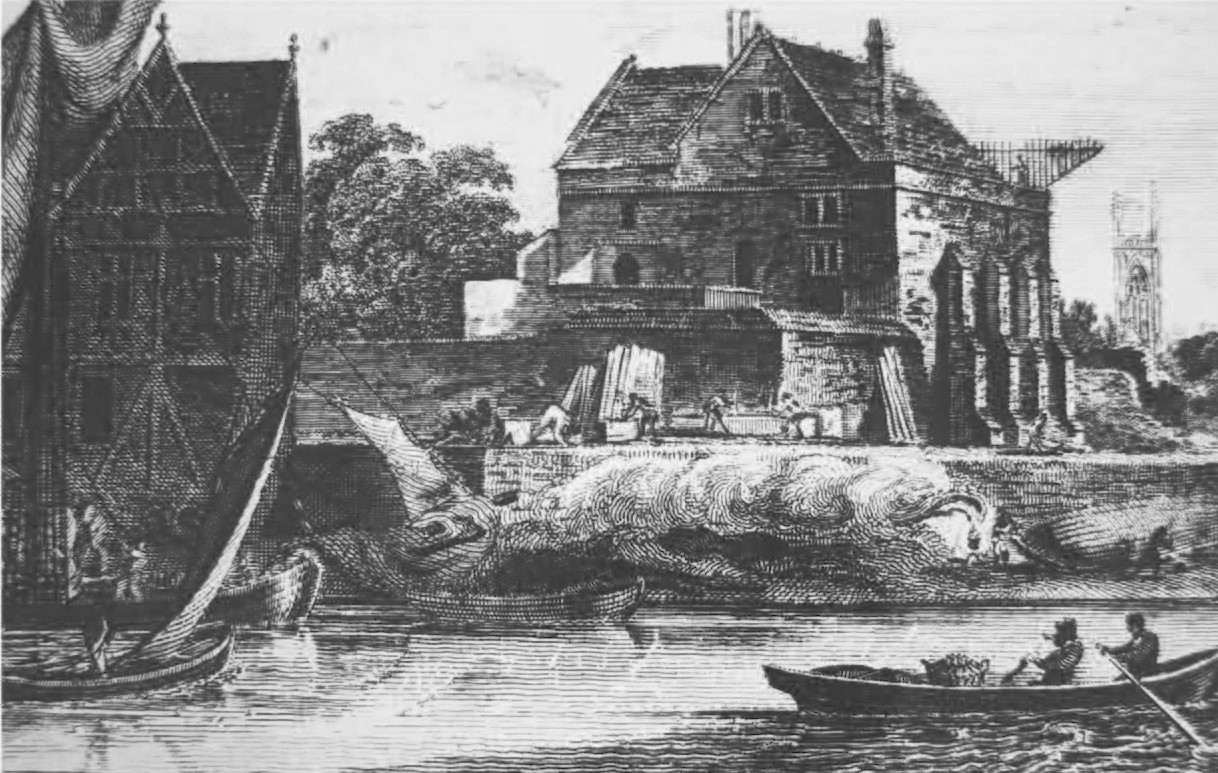
Gloucester Castle was a Norman-era royal castle situated in the city of Gloucester in Gloucestershire, England. It was demolished in 1787 and replaced by Gloucester Prison.
It was probably constructed by the Anglo-Norman Roger de Pitres, the first post-Norman Conquest Sheriff of Gloucestershire, as a simple motte and bailey castle during the reign of William the Conqueror (1066–1087), when sixteen houses were demolished to make way for it. It was enlarged by King William II (1087–1100) who demolished eight more houses. Walter of Gloucester, Sheriff of Gloucestershire, succeeded his father Roger de Pitres as Constable of the castle. Before 1113 Walter built a new castle west of Barbican hill on a former garden of Gloucester Abbey, overlooking the River Severn. Walter's son, and the next Constable of Gloucester Castle, was Miles FitzWalter of Gloucester, 1st Earl of Hereford (d.
1143) (alias Miles of Gloucester), Sheriff of Gloucestershire, a great magnate based in the west of England who became hereditary Constable of England. He was succeeded as Constable of Gloucester Castle by his eldest son Roger Fitzmiles, 2nd Earl of Hereford (d. 1155). Later it was retained by the Crown.
More improvements and some repairs were carried out by Henry III, these improvements included a bridge across the River Severn leading to a barbican in the outer wall. Henry III often used it as a residence, and it played an important role in the barons' war when it was besieged twice in 1264–1265. Part of the castle had been being used as a gaol by 1185 and it was probably then the official county gaol, as it certainly was by 1228, and Eleanor of Brittany, niece of King John and cousin of Henry III with a better claim to the throne according to primogeniture and thus becoming a state prisoner, had been briefly imprisoned there during the reign of John, from 1222 to 1223, and from 1237 to 1238, while in 1222 to accommodate her the castle temporarily moved all its prisoners elsewhere.
The defences were kept in full repair until the mid-15th century. It is likely that in the reign of Richard III, the castle ceased to be maintained as a fortress, continuing in use only as the county gaol.
Text adapted from “Gloucester Castle” on Wikipedia, CC BY-SA 4.0.
Gloucester Castle ranks #4,080 of 9,079 worldwide in the atlas's castle fame ranking, and #272 of the 360 mapped in England. Founded c. 1075, it is older than 87% of the atlas's dated landmarks — one of 436 atlas entries founded in the 11th century. Its Wikipedia articles were opened 1,114 times in the last 60 days, more than 53% of the atlas. 3 more atlas landmarks stand within 25 km. The nearest day-trip guide is Swindon, 47 km away. See how England compares in the castle statistics.
View on the interactive castle map →