 Slovakia · 13th century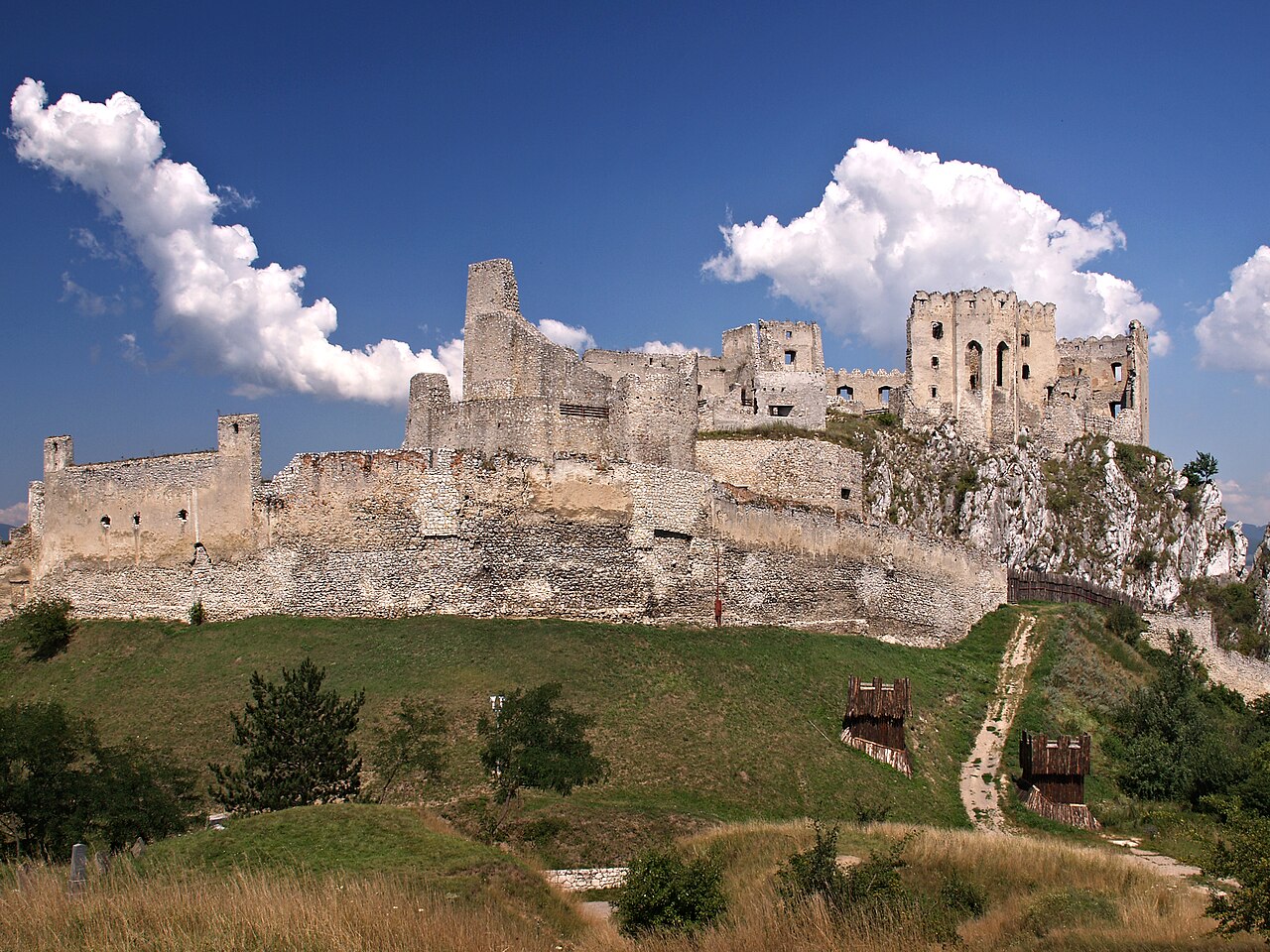
Beckov Castle (Slovak: Beckovský hrad/Beckov; Hungarian: Beckói vár) is a castle in ruins located above the former town of Beckov in Nové Mesto nad Váhom District, Trenčín Region, western Slovakia.
It is a national cultural monument and its present appearance is the result of renovations in the last quarter of the twentieth century and since 2002.
The original name of the castle was Blundix (Latin version). The name was derived from Slavic "Bludište" reflecting the difficult terrain in the area (blúdiť - to wander, in the modern Slovak language bludište/bludisko - a maze). Later, the name of the neighbouring village Beckov was adopted also as the name of the castle.
The Beckov Cliff is a klippe of the Hronic nappe well exposed by the Váh River. The castle is situated on the cliff near the river, and was used as a strategic outpost in Great Moravia. A stone castle was built there to protect the borders of the Kingdom of Hungary, probably in the middle of the 13th century. The castle became property of Matthew III Csák at the turn of the 13th and 14th centuries and was fortified under his rule. After his death in 1321, the castle was administered by castellans. Louis I of Hungary gave the castle to Miklós Bánffy in 1379 as a reward for his service in battles in the Balkans and Italy.
In 1388, the castle was given by Sigismund, King of Hungary to Stibor of Stiboricz of the Clan of Ostoja, a Lord of Polish origin. Stibor was one of king's most influential advisors and in control of significant part of Northern Hungary (today, Slovakia). Of 31 Castles that was in possession of Stibor, he chose Beckov as his home, giving the Castle special care. He rebuilt the castle into his family seat in the Gothic style. Artists from Venetia, Poland, Germany and Bohemia were working on to make Beckov an outstanding place. Stibor also built a chapel with splendid sculpture decorations and paintings including sculpture of Black Madonna which was considered as one of the most beautiful in Europe at that time. In entrance to the chapel, there was a family coat of arms made of stone.
Stibor also fortified the town below the castle and linked their walls together.
After Stibor's death in 1414, the castle was inherited by his son, Stibor Stiboric of Beckov. Because Stibor Stiboric of Beckov did not have a son, he bequeathed the property to his daughter Katarína (Katherine).
Text adapted from “Beckov Castle” on Wikipedia, CC BY-SA 4.0.
Beckov Castle ranks #1,068 of 9,079 worldwide in the atlas's castle fame ranking, and #11 of the 136 mapped in Slovakia. Founded c. 1300, it is older than 61% of the atlas's dated landmarks — one of 1080 atlas entries founded in the 13th century. Its Wikipedia articles were opened 4,306 times in the last 60 days, more than 84% of the atlas. 4 more atlas landmarks stand within 25 km. The nearest day-trip guide is Trenčín, 16 km away. See how Slovakia compares in the castle statistics.
View on the interactive castle map →