 India · 15th century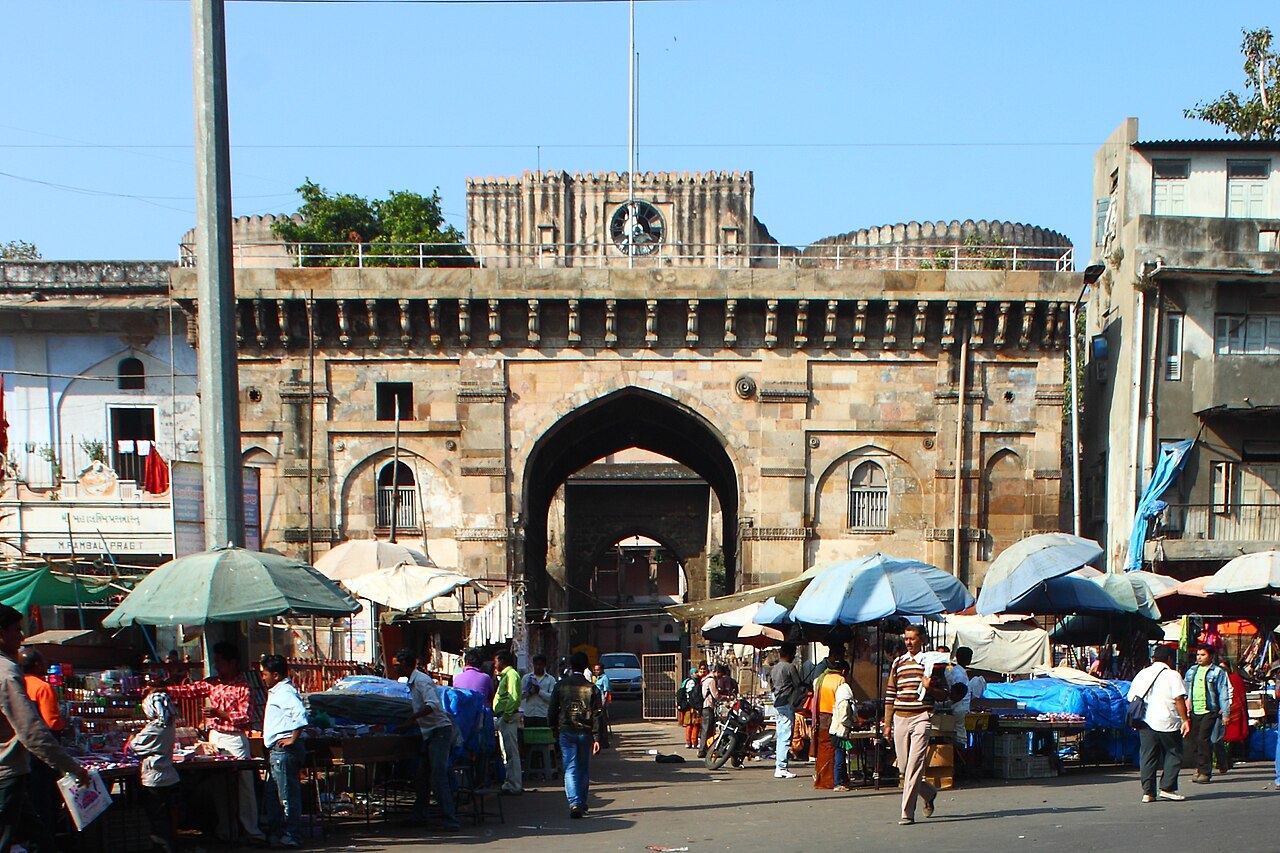
Bhadra Fort is situated in the walled city area of Ahmedabad, India. It was built by Ahmad Shah I in 1411. With its well-carved royal palaces, mosques, gates and open spaces, it was renovated in 2014 by the Amdavad Municipal Corporation (AMC) and the Archaeological Survey of India (ASI) as a cultural centre for the city.
It is believed the fort adopted the name Bhadra after a temple of Bhadra Kali, a form of Laxmi which was established during Maratha rule but a plaque near the fort tells a different story: "The Bhadra Gate - C.A.D. 1411 - The massive fortified gate was built in or about 1411 to serve as the principal eastern entrance of the palace erected here by Sultan Ahmad Shah I (1411-1442), the founder of Ahmedabad. The palace called the Bhadra after the ancient Rajput citadel of that name at Anhilwada-Patan (Baroda State), which the first three kings of the dynasty of Gujarat Sultans had held before Ahmedabad became the capital. Three inscribed slabs on the walls connecting this gateway with two ancillary gates behind are now almost completely defaced. One of these appears to show a date of the time of Jahangir (1605-1627). "
Ahmedabad was named after Ahmad Shah I of the Muzaffarid dynasty. He established Ahmedabad as the new capital of Gujarat Sultanate and built Bhadra Fort on the east bank of the Sabarmati River. It was also known as Arak Fort as described in Mirat-i-Ahmadi. The foundation stone of the fort was laid at Manek Burj in 1411. Square in form, enclosing an area of about forty-three acres, and containing 162 houses, the Bhadra fort had eight gates, three large, two in the east and one in the south-west corner; three middle-sized, two in the north and one in the south; and two small, in the west. The area within the fort had become occupied by urban developments by 1525.
So a second fortification was built later by Mahmud Begada, the grandson of Ahmed Shah, with an outer wall 10 km (6.2 mi) in circumference and consisting of 12 gates, 189 bastions and over 6,000 battlements as described in Mirat-i-Ahmadi. Almost 60 governors ruled Gujarat during the Mughal period including the future Mughal emperors Jahangir, Shah Jahan and Aurangzeb. A seraglio was built later in the 17th century by a Mughal governor, Azam Khan, known as Azam Khan Sarai. It was used as a Musafir khana (a resting place for travellers) during Mughal rule.
Text adapted from “Bhadra Fort” on Wikipedia, CC BY-SA 4.0.
Bhadra Fort ranks #2,923 of 9,035 worldwide in the atlas's castle fame ranking, and #116 of the 223 mapped in India. Founded 1411, it is older than 50% of the atlas's dated landmarks, one of 556 atlas entries founded in the 15th century. Its Wikipedia articles were opened 1,487 times in the last 60 days, more than 62% of the atlas. See how India compares in the castle statistics.
View on the interactive castle map →