 Canada · 19th century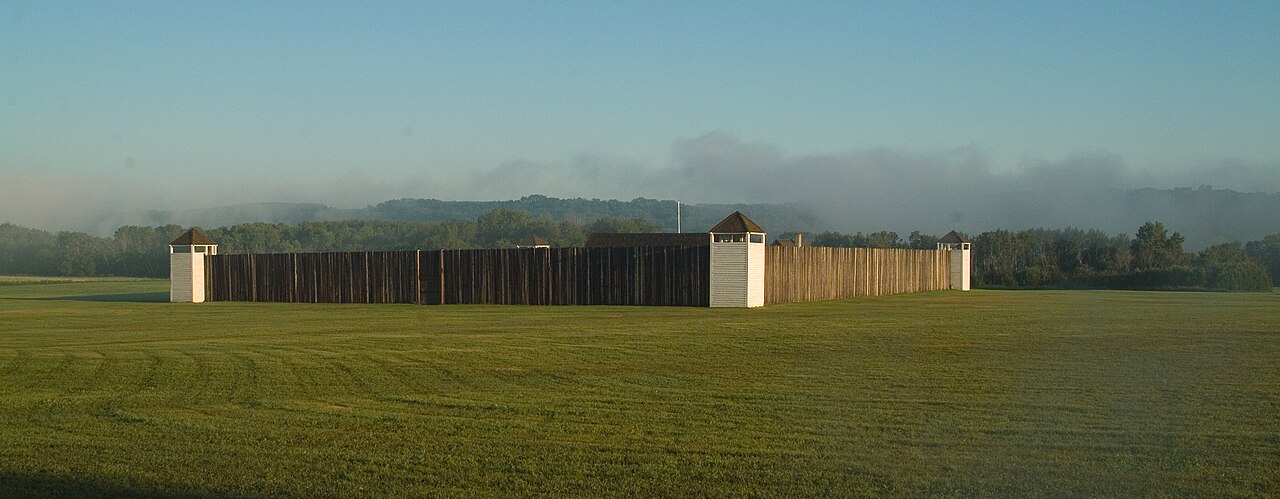
Fort Carlton was a Hudson's Bay Company fur trading post from 1795 until 1885. It was located along the North Saskatchewan River not far from Duck Lake, in what is now the Canadian province of Saskatchewan. The fort was rebuilt by the government of Saskatchewan as a feature of a provincial historic park and can be visited today. It is about 65 kilometres (40 mi) north of Saskatoon.
First called Carlton House, there were several historic Fort Carlton posts that operated in different periods and at three locations. Two posts were established in 1795 and 1805 respectively. A series of forts named Fort Carlton operated at a third location starting in 1810.
The first Fort Carlton (1795–1801) was built at a safer site near the old French post of Fort de la Corne in 1795 following the destruction of South Branch House. James Bird was in charge; James Sandison (Sanderson) was his assistant; and John Peter Pruden was an apprentice. From 1799 to 1801, Joseph Howse (Howes) was the writer in charge. The North West Company (NWC) had a nearby post called Fort St. Louis. It produced few furs and was closed in 1801.
The second Fort Carlton (1805–1810) was built on the South Saskatchewan River six miles upstream from the former South Branch House. Joseph Howse (Howes) was a trader. There was a nearby NWC post. In 1810 both companies abandoned the South Saskatchewan and moved to the third Fort Carlton.
The third Fort Carlton (1810–1885) was built on the south bank of the North Saskatchewan at the Great Crossing Place, a ford of that river. John Peter Pruden was master (1814–1815), master and trader (1815–1820), and chief trader (1821–1837) except for a brief furlough to London in 1824–1825. The area was prairie and not beaver country, but there were plentiful woods nearby and even a supply of limestone. The NWC had its Fort La Montée inside the same stockade as the HBC's Fort Carlton. In 1816 the Nor'Westers moved out and established a second Fort La Montée on the north bank 3 miles upstream. With the union in 1821 La Montée was abandoned and whatever could be salvaged was rafted down to Fort Carlton. In 1824 a group of First Nations people attacked Fort Carlton but were driven off. By 1835 the buildings were in disrepair and a new hexagonal fort was built 200 yards to the west.
Text adapted from “Fort Carlton” on Wikipedia, CC BY-SA 4.0.
Fort Carlton ranks #3,757 of 9,035 worldwide in the atlas's castle fame ranking, and #18 of the 26 mapped in Canada. Founded 1810, it is older than 11% of the atlas's dated landmarks, one of 705 atlas entries founded in the 19th century. See how Canada compares in the castle statistics.
View on the interactive castle map →