 Ireland · 15th century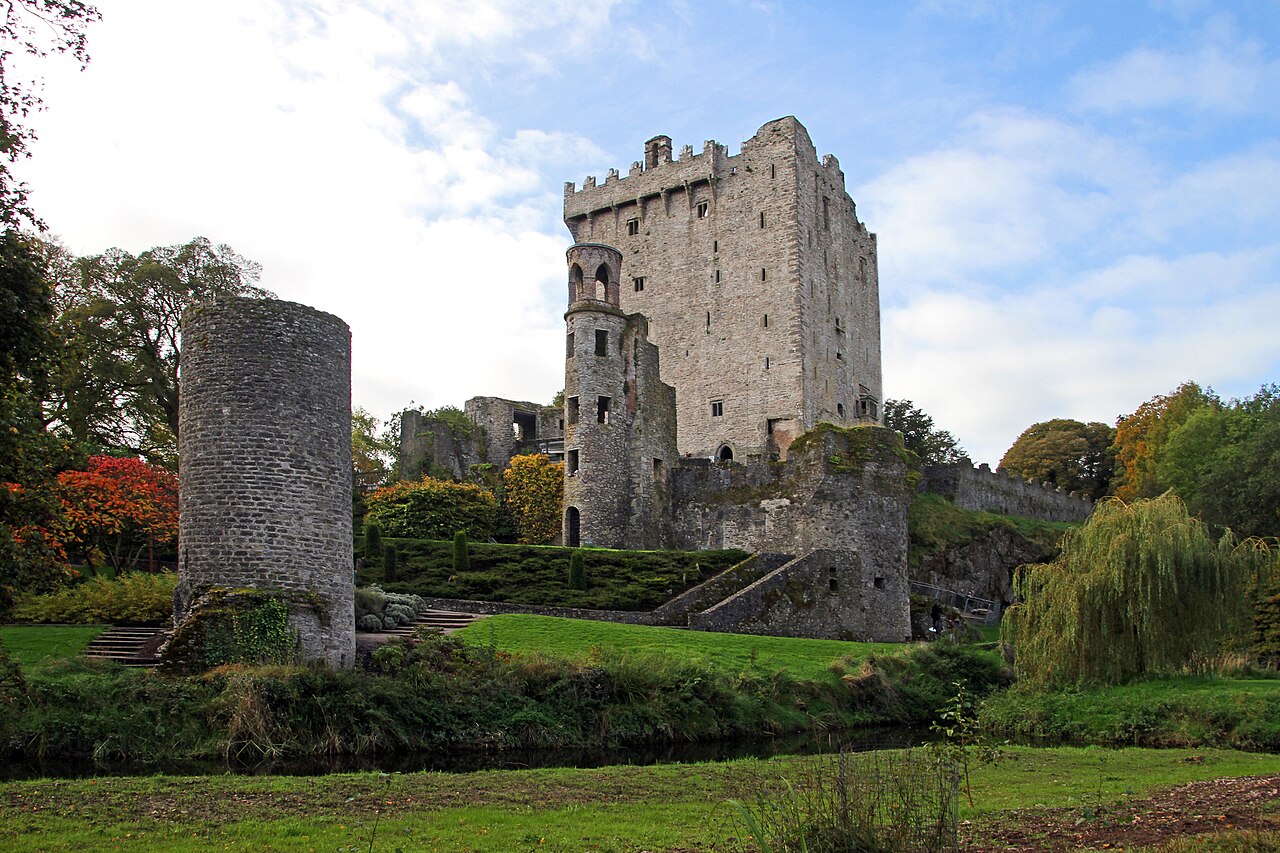
Blarney Castle (Irish: Caisleán na Blarnan) is a medieval stronghold in Blarney, a town in Cork, Ireland. Though earlier fortifications were built on the same spot, the current keep was built by the MacCarthy of Muskerry dynasty, a cadet branch of the Kings of Desmond, and dates from 1446. The Blarney Stone is among the machicolations of the castle.
The castle originally dates from before 1200, when a timber house was believed to have been built on the site, although no evidence remains of this. Around 1210 this was replaced by a stone fortification. It was destroyed in 1446 but subsequently rebuilt by Cormac Láidir MacCarthy, Lord of Muscry, who also built castles at Kilcrea and Carrignamuck.
The castle was besieged during the Irish Confederate Wars and was seized in 1646 by Parliamentarian forces under Lord Broghill. However, after the Restoration, the castle was restored to Donough MacCarty, who was made 1st Earl of Clancarty.
During the Williamite War in Ireland in the 1690s, the 4th Earl of Clancarty (also named Donough MacCarty) was captured, and his lands (including Blarney Castle) were confiscated by the Williamites.
The castle was sold and changed hands several times—Sir Richard Pyne, the Lord Chief Justice of Ireland, owned it briefly—before being purchased in the early 18th century by Sir James Jeffreys, governor of Cork City.
Members of the Jefferyes family later built a large house near the 15th-century keep. This house was destroyed by fire, and in 1874 a replacement mansion, known as Blarney House, was built overlooking the nearby lake. The house was built in a Scottish baronial style by John Lanyon of Lanyon, Lynn and Lanyon architects.
In the mid-19th century, the Jefferyes and Colthurst families were joined by marriage, and the Colthurst family still occupies the demesne. In May 2008, the present estate owner, Sir Charles St John Colthurst, Baronet, succeeded in a court action to eject a man who had lived on his land for 44 years. The man's great-grandfather had been the first to occupy the estate cottage.
Blarney Castle is now a partial ruin with some accessible rooms and battlements. At the top of the castle lies the Stone of Eloquence, better known as the Blarney Stone. Tourists visiting the castle may hang upside-down over a sheer drop to kiss the stone, which is said to give the gift of eloquence.
Text adapted from “Blarney Castle” on Wikipedia, CC BY-SA 4.0.
Blarney Castle ranks #364 of 9,079 worldwide in the atlas's castle fame ranking, and #4 of the 178 mapped in Ireland. Founded 1446, it is older than 49% of the atlas's dated landmarks — one of 554 atlas entries founded in the 15th century. Its Wikipedia articles were opened 14,745 times in the last 60 days, more than 96% of the atlas. 8 more atlas landmarks stand within 25 km. The nearest day-trip guide is Cork, 7 km away. See how Ireland compares in the castle statistics.
View on the interactive castle map →