 Sweden · 13th century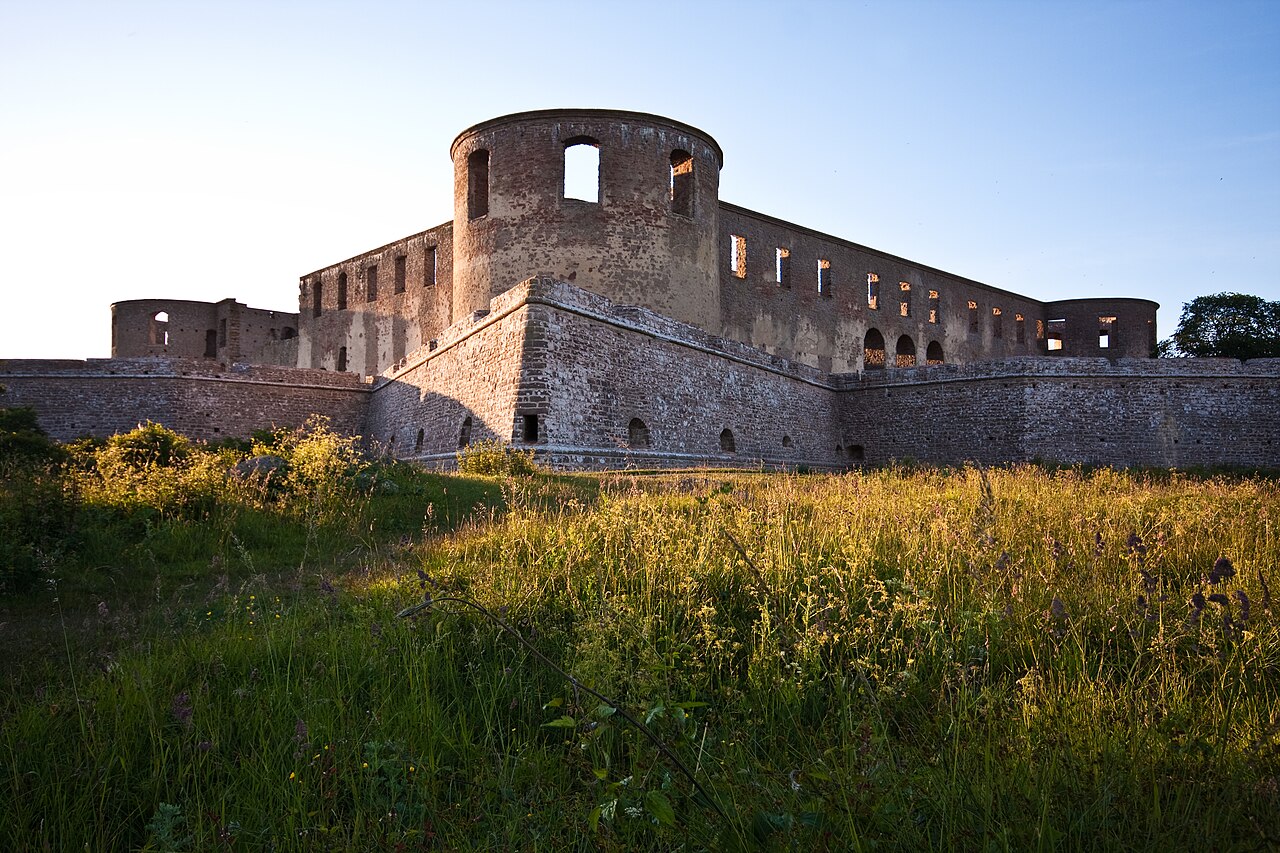
Borgholm Castle (Swedish: Borgholms slott) in Borgholm, Sweden, is today only a ruin of the fortress that was first built in the second half of the 13th century and rebuilt many times in later centuries. It is linked to Halltorp estate, to the south. The castle was destroyed in a fire on 14 October 1806.
The construction of the original fortress was probably ordered by King Canute I, although this is not totally certain. He reigned 1167–1195 and had fortresses built on the Swedish east coast as defence against enemies from the other side of the Baltic Sea. During the 13th to 15th centuries, additions and changes were made. For example, new towers were built, and a new and thicker wall was constructed. The fortress was damaged on a number of occasions during these centuries, including in 1361, when King Valdemar IV (Atterdag) of Denmark attacked Borgholm.
During the Kalmar Union, many castles and fortresses in Sweden were damaged as a result of the ongoing conflicts between Danes and Swedes. When Gustav Eriksson became Swedish king and the union was dissolved, he, together with the sons that followed him on the throne, invested huge sums of money in repairing these buildings. It was Gustav's son John III (r. 1568–1592) who ordered the reconstruction of Borgholm into a renaissance castle. During his reign, the Pahr brothers (four engineers and architects from Milan) led a significant rebuilding that took place from 1572. The castle acquired a Gothic character and became exemplary of the Italianate bastion style.
Some decades later, Sweden and Denmark fought each other in the Kalmar War. Borgholm Castle first, in 1611, surrendered to the Danish side, but was reconquered by the Swedish side later the same year. The following year, after a siege of two weeks, the commander of the Swedish defence, Peter Michelsen Hammarskiöld, had to surrender. In accordance with the treaty that followed the war, the Treaty of Knäred, Borgholm was handed back to the Swedish.
The castle was in a bad shape after the war and it took until 1654 before a restoration and reconstruction would begin. This time, the castle was to be turned into a baroque palace. Charles X Gustav was the king who ordered this, and Nicodemus Tessin the Elder was the architect engaged to fulfill the king's wishes.
Text adapted from “Borgholm Castle” on Wikipedia, CC BY-SA 4.0.
Borgholm Castle ranks #504 of 9,079 worldwide in the atlas's castle fame ranking, and #7 of the 209 mapped in Sweden. Founded c. 1275, it is older than 65% of the atlas's dated landmarks — one of 1080 atlas entries founded in the 13th century. Its Wikipedia articles were opened 11,904 times in the last 60 days, more than 95% of the atlas. 4 more atlas landmarks stand within 25 km. See how Sweden compares in the castle statistics.
View on the interactive castle map →