 Sweden · 17th century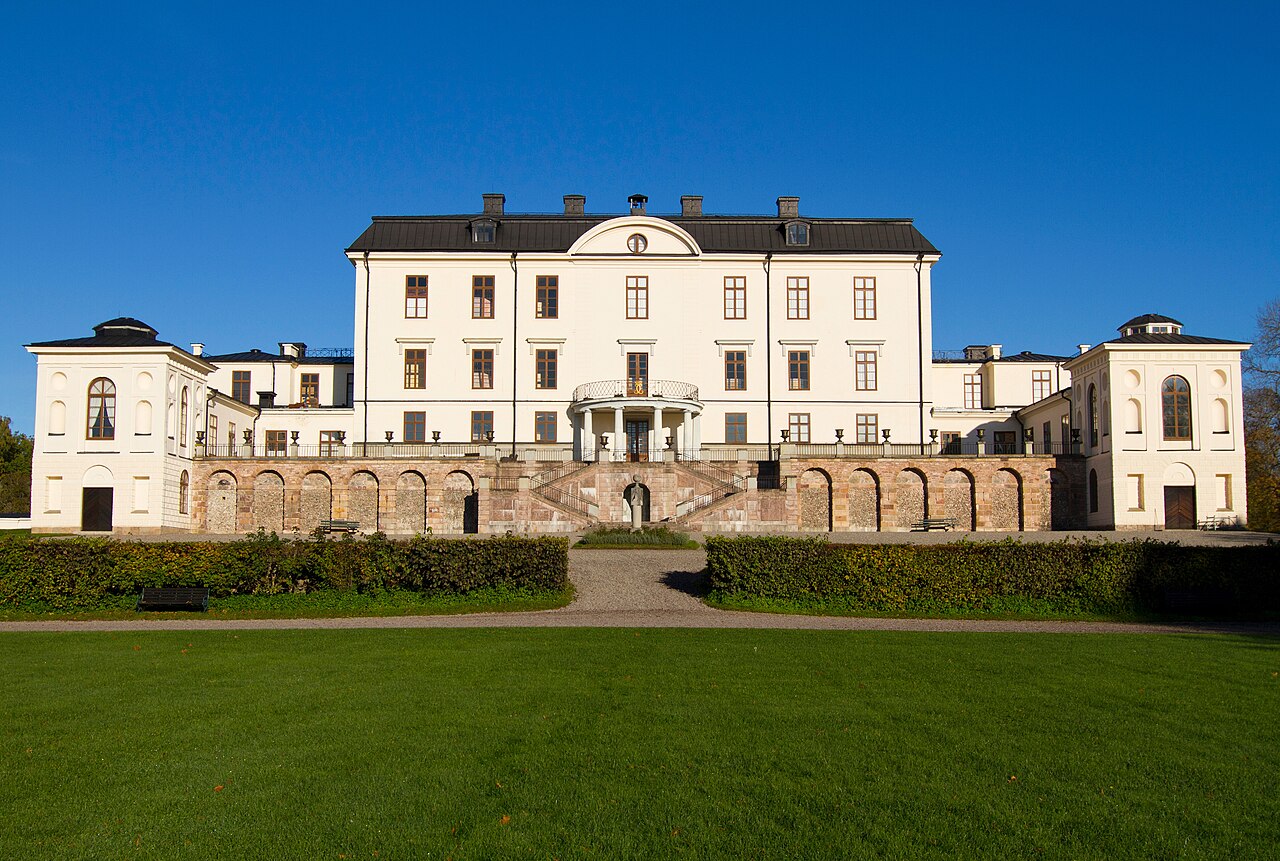
Rosersberg Palace (Swedish: Rosersbergs slott) is one of the royal palaces of Sweden. Situated on the shores of Lake Mälaren, on the outskirts of Stockholm, it was built in the 1630s by the Oxenstierna family and became a royal palace in 1762, when the state gave it to Duke Charles (later Charles XIII), the younger brother of Gustav III.
Gabriel Bengtsson Oxenstierna named the palace after his mother, who came from the prestigious Tre Rosor ("Three Roses") family. Construction of the building in the typical Renaissance style of the time started in 1634 and was completed in 1638.
In the late 17th century, the Renaissance style was out of fashion and Oxenstierna's son, Bengt Oxenstierna, had it radically modernised in the then current Baroque style under the architect Nicodemus Tessin the Younger. The gables of the main building were demolished and the building was given a new roof. New wings and a colonnaded gallery were added.
In 1747, Rosersberg was acquired by Baron Erland Carlsson Broman, and was again modernized with the assistance of the architect Jean Eric Rehn. Broman died in 1757, and the palace was acquired by the state, and given to Duke Charles.
Charles took up residence in the palace and continued with Rehn's plans for modernizing it. It was renovated in the late Gustavian style but was lacking many of the more capricious aspects of the style, replacing them with a more serious and romantic tone which is referred to as the Charles XIII Empire style. As part of the modernisation a series of new interiors were created, the most notable of which are the Orange and Red drawing rooms, and the Hogland Room.
It was a favourite among the palaces for Charles XIV John and Queen Desideria, the first of the Bernadotte line, who spent their summers relaxing at Rosersberg and were the last royals to use the palace as a residence. Charles John's bedchamber is regarded as one of the most important examples of an early 19th-century Swedish interior. Nowadays, the rooms and collections are preserved very much as they were during the period 1795–1825.
After the death of Desideria in 1860, the palace was given to Swedish infantry. In 1874 the Swedish Infantry Gunnery School moved into the castle's ground floor and wings. In the spring of 1961, the Infantry Gunnery School was relocated to Linköping Garrison.
Text adapted from “Rosersberg Palace” on Wikipedia, CC BY-SA 4.0.
Rosersberg Palace ranks #1,568 of 9,079 worldwide in the atlas's castle fame ranking, and #36 of the 209 mapped in Sweden. Founded 1638, it is older than 28% of the atlas's dated landmarks — one of 721 atlas entries founded in the 17th century. Its Wikipedia articles were opened 2,128 times in the last 60 days, more than 71% of the atlas. 14 more atlas landmarks stand within 25 km. The nearest day-trip guide is Stockholm, 30 km away. See how Sweden compares in the castle statistics.
View on the interactive castle map →