Ruin
Borsh Fortress
🇦🇱 Albania
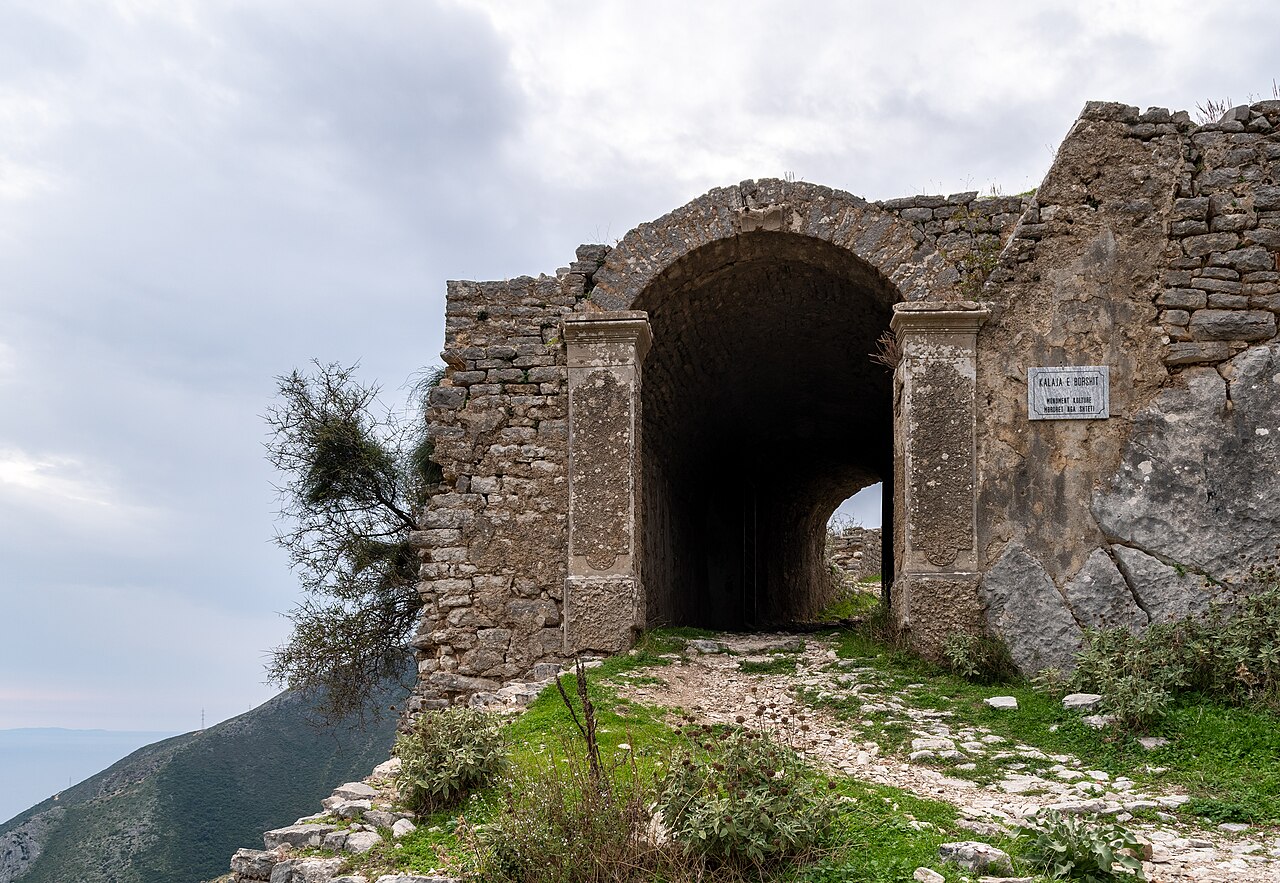
Borsh Castle (Albanian: Kalaja e Borshit) also known as Sopot Castle (Albanian: Kalaja e Sopotit) from the hill it is located, is a historic castle near the village Borsh, Albania, near the coast of the Ionian Sea. The only standing building inside the castle is the 17th-century Hajji Bendo Mosque from Ottoman times which got ruined in the 20th century.
The earliest finds date to the end of the Bronze Age, when early fortifications were built along the coast. Their purpose probably was to defend against Dorian attacks in the 12th century BC. Later in the second half of the 4th century BC the site evolved into a small hill town. The castle's fortifications follow the trace of an acropolis, with four subsequent phases of reconstruction, ranging from the early Byzantine period to the late Middle Ages. At the end of the 1st century BC the settlement was abandoned for more than 1100 years. Since then the history of the place has been closely linked with that of Himara. The name "Sopot" is of Slavic origin. In medieval Greek documents, the castle is named Sopoton or Sopotos, while its harbour is mentioned in Greek portolans with the name Gazopolis.
The site is first mentioned in the early 13th century, when archbishop Demetrios Chomatenos wrote of the "archonship of Sopotos", part of the region of Vagenetia. In 1258, the Despot of Epirus Michael II Komnenos Doukas gave the castle along with Buthrotum and the island of Corfu as dowry for his daughter Helena to Manfred, King of Sicily. It came back under Epirote control soon thereafter, before being once again ceded by Nikephoros I Komnenos Doukas to Charles I of Anjou in 1279. The area returned again to Epirote hands in the subsequent decades, but in the Epirote rebellion against Palaiologan Byzantine rule in 1338–39, it remained loyal to Emperor Andronikos III Palaiologos.
Following the Ottoman conquest, a cadaster from 1431 lists Sopot with 60 households, and as capital of a nahiye. In 1456, troops of King Alfonso V of Aragon were operating in the area of Sobato against the Ottomans. In 1470 it was under Venetian control, under the jurisdiction of the governor of Corfu; at the end of the Ottoman–Venetian War of 1463–1479, the Ottomans laid claim to it and apparently received it. In 1481 Albanians led by Gjon Kastrioti II invaded Southern Albania from Italy and captured the castle, but retreated in 1484.
Text adapted from “Borsh Castle” on Wikipedia, CC BY-SA 4.0.
Borsh Fortress ranks #4,580 of 8,134 worldwide in the atlas's castle fame ranking, and #21 of the 27 mapped in Albania. 2 more atlas landmarks stand within 25 km. The nearest day-trip guide is Vlorë, 53 km away. See how Albania compares in the castle statistics.
View on the interactive castle map →Frequently asked questions
Where is Borsh Fortress?
Borsh Fortress stands in Albania, at 40.07028°, 19.85556°.
How famous is Borsh Fortress?
In this atlas's fame ranking: #4,580 of 8,134 worldwide, and #21 in Albania. Fame here combines how many Wikipedia language editions cover a landmark with how many people read them.
What is the nearest castle to Borsh Fortress?
Porto Palermo Fortress, about 6 km away.
More castles in Albania
- Dagnum Albania
- Tomornitsa Albania
- Royal Palace of Durrës Albania
- Venetian Fortress of Butrint Albania
More ruins
- Karksi Castle Estonia · 13th century
- Lielvārde Castle Latvia · 13th century
- Rauna Castle Latvia
- Cloughoughter Castle Ireland · 13th century