 Germany · 12th century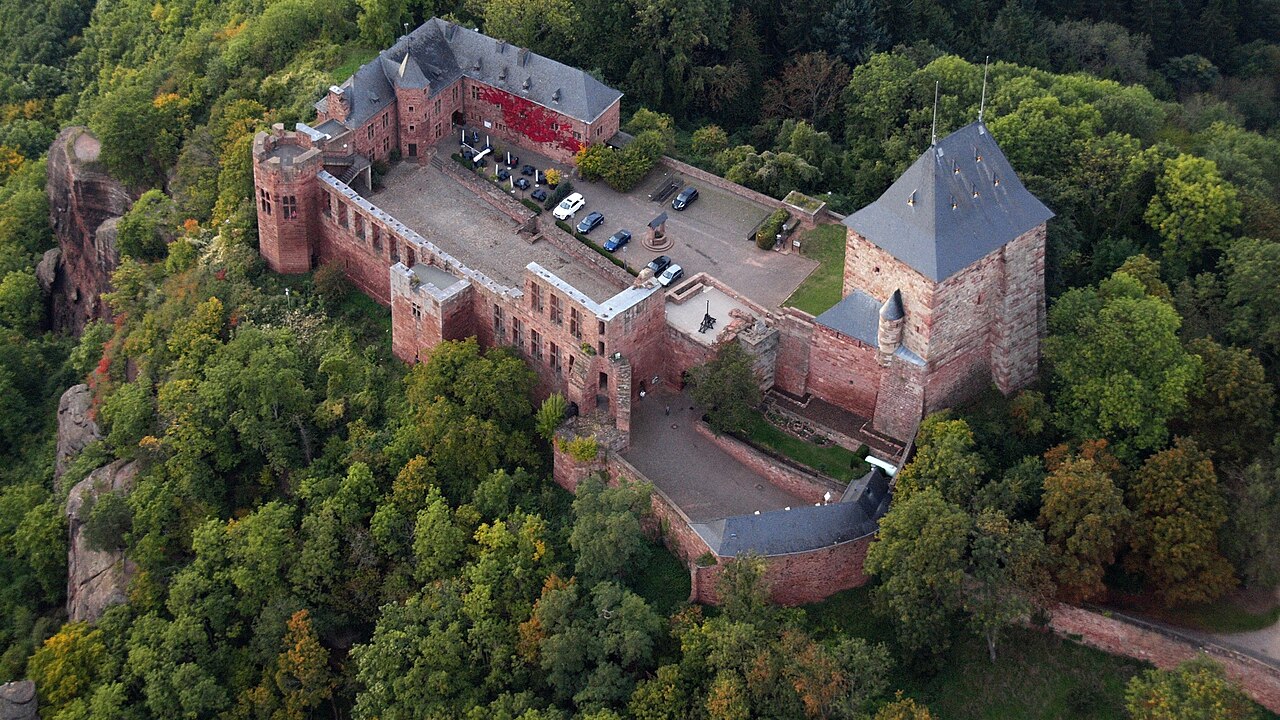
The ruins of Nideggen Castle (German: Burg Nideggen) are a symbol of the town of Nideggen in Germany and are owned by the county of Düren. The rectangular hill castle was the seat of the powerful counts and dukes of Jülich and had a reputation in the Middle Ages of being impregnable.
Nideggen Castle was built by the counts of Jülich in the strategically important border area of the then Herrschaft ("Lordship") of Monschau. It was intended to protect the inherited territory of the counts against the interests of the archbishops of Cologne.
The foundation stone for the castle was laid in 1177 by William II on the construction of the bergfried, which was erected within sight of the imperial castle of Berenstein. It was located about three kilometres to the west and was built around 1090. After its almost complete destruction around 1200, it served as a quarry for the extension of Nideggen's castle tower. The yellowish ashlar blocks of the Berensteins differ markedly from the red-coloured sandstone blocks forming the lower half of the tower, which were broken at Nideggen.
Construction work was continued by William III. Like his ancestors, his successor was also at odds with the Electorate of Cologne. In 1242, after a successful battle, William IV left the then Archbishop, Conrad of Hochstaden for nine months in the dungeon of the keep. But he was not the only one who got to know the walls of that dark prison. A few years earlier (around 1214), Duke Louis of Bavaria had to "make his quarters there". Conrad's successor to the throne of the Archbishopric of Cologne, Engelbert II of Falkenburg, was also held captive there by the Jülich counts for more than three years in the period from 1267 to 1271.
Under Gerhard of Jülich, the settlement of Nydeckin was founded near the Burgflecken. Gerhard granted Nideggen town rights in 1313.
William V, later Duke William I started to extend the castle in 1340, the palas at Nideggen being one of the largest castle halls built in the Rhineland. In the late Middle Ages, only the Emperor's hall of Aachen Town Hall and the Gürzenich in Cologne approached similar dimensions. William I was also the one who made Nideggen Castle his family seat in 1356.
After the death of Rainhald of Jülich, the castle went to the family of the dukes of Berg, whose heads from then on called themselves the Dukes of Jülich and Berg.
Text adapted from “Nideggen Castle” on Wikipedia, CC BY-SA 4.0.
Burg Nideggen ranks #3,359 of 9,035 worldwide in the atlas's castle fame ranking, and #274 of the 709 mapped in Germany. Founded 1177, it is older than 78% of the atlas's dated landmarks, one of 763 atlas entries founded in the 12th century. Its Wikipedia articles were opened 1,878 times in the last 60 days, more than 68% of the atlas. 4 more atlas landmarks stand within 25 km. The nearest day-trip guide is Aachen, 29 km away. See how Germany compares in the castle statistics.
View on the interactive castle map →