Castle
Burg Wernerseck
🇩🇪 Germany · 15th century
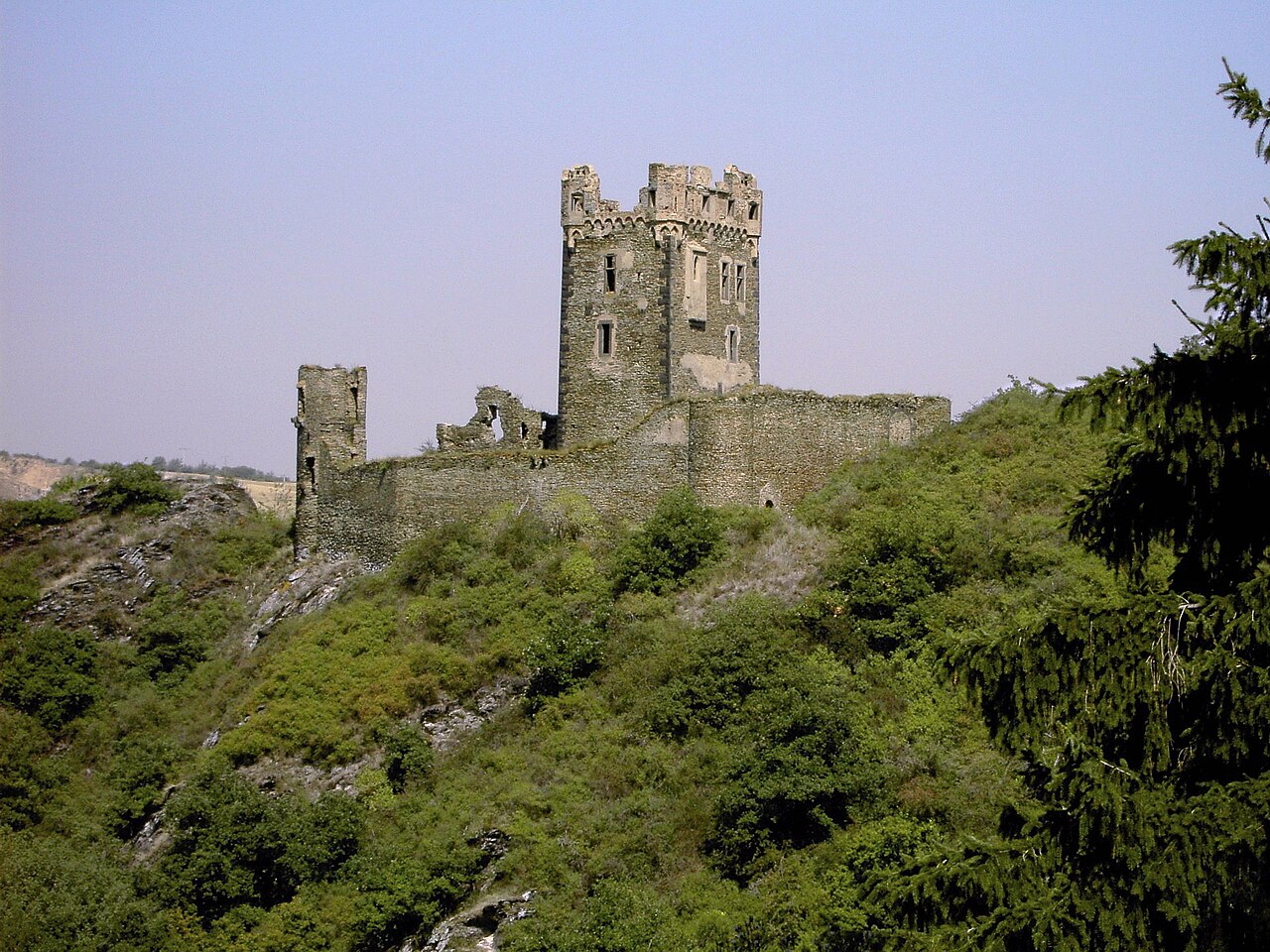
Wernerseck Castle (German: Burg Wernerseck), also called the Kelterhausburg, is a late medieval hill castle in the municipality of Ochtendung in the county of Mayen-Koblenz in the German state of Rhineland-Palatinate. It owes its name to its founder and lord of the castle, the Archbishop of Trier, Werner of Falkenstein (1388–1418). "Wernerseck" means "Werner's corner".
The ruins of the hill castle are situated above the River Nette at the foot of the Eifel mountains in the immediate vicinity of the Plaidt junction on the A 61 motorway. In the eastern part of the hill spur, on the narrowest part of which the castle was built, there was a Roman fortification in the Late Antiquity. The origin of this defensive position, which was probably conceived as a refuge fort, has been dated by coin finds to the first half of the 4th century. On the basis of pottery finds, it is assumed that the fort was used until the early 5th century. Similar sites from the Late Antiquity along the Nette are found at Welling, Ruitsch and on the Katzenberg near Mayen.
The Trier prince-elector and archbishop, Werner of Falkenstein, began building the castle in late 1401 as part of his expansion policy in the Pellenz area. Thus, the site was not in the district of Ochtendung, which belonged to Electoral Trier, but in the feudal area of the counts of Virneburg. The castle was intended to act as a border fortress, guarding it against the principality of the Archbishop of Cologne. However, the castle never fulfilled this purpose, as the borders were realigned whilst it was being built. Later the castle was used as an administrative centre. Conrad Colbe of Boppard was probably appointed as the first Amtmann (bailiff) in 1412.
From the 16th century onwards, the castle was enfeoffed to the lords of Eltz, who owned it until the 19th century. From 1966 to 1969 there was a falconry at the castle. A preservation society has set itself the task of securing and renovating the dilapidated castle and, between summer 2006 and November 2007, the tower house was renovated.
The pentagonal castle has round towers at three corners, whilst another corner forms the gate system. Its occupants lived in the 22-metre-high, four-storey, donjon (keep or tower house), which also had the normal function of a bergfried (fighting tower). It also contained the castle chapel. Access was via an elevated entrance.
Text adapted from “Wernerseck Castle” on Wikipedia, CC BY-SA 4.0.
Burg Wernerseck ranks #6,061 of 8,134 worldwide in the atlas's castle fame ranking, and #463 of the 505 mapped in Germany. Founded 1402, it is older than 52% of the atlas's dated landmarks — one of 455 atlas entries founded in the 15th century. 22 more atlas landmarks stand within 25 km. The nearest day-trip guide is Koblenz, 16 km away. It is one of the 43 landmarks on the atlas's regional map of the Moselle. It is stop 17 of 27 on the Moselle castle route, Trier to Koblenz. See how Germany compares in the castle statistics.
View on the interactive castle map →Frequently asked questions
Where is Burg Wernerseck?
Burg Wernerseck stands in Germany, at 50.3724°, 7.37808°.
When was Burg Wernerseck built?
The atlas dates its founding to 1402. Earlier structures may have stood on the site; this is the earliest documented founding year.
How famous is Burg Wernerseck?
In this atlas's fame ranking: #6,061 of 8,134 worldwide, and #463 in Germany. Fame here combines how many Wikipedia language editions cover a landmark with how many people read them.
What is the nearest castle to Burg Wernerseck?
Niederburg, Kobern, about 9 km away.
More castles in Germany
- Altrathen Castle Germany · 13th century
- Stettenfels Castle Germany · 10th century
- Grevenburg Germany · 14th century
- Burg Bodenstein Germany
More castles
- Katzenstein Castle Germany · 11th century
- Wiesenburg Castle Germany · 12th century
- Burg Eltville Germany · 14th century
- Ehrenburg (Plaue) Germany · 14th century