 Scotland · 13th century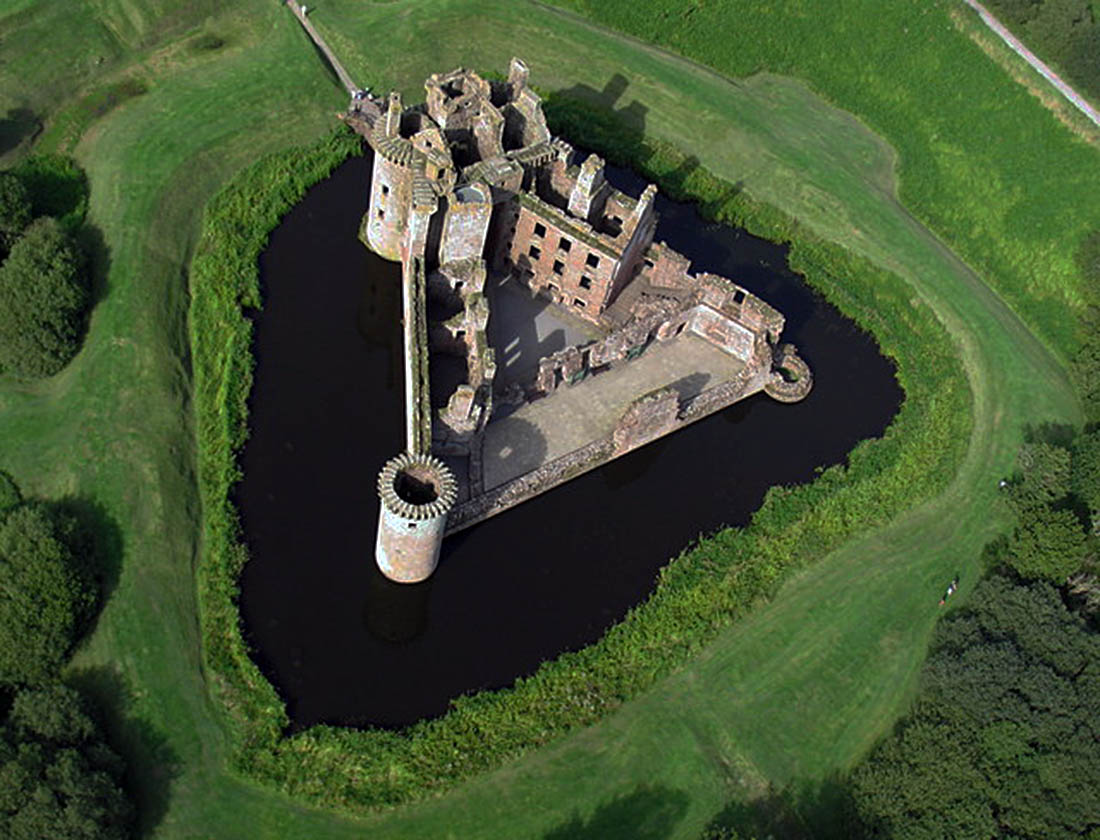
Caerlaverock Castle is a moated triangular castle first built in the 13th century. It is located on the southern coast of Scotland, eleven kilometres (seven miles) south of Dumfries, on the edge of the Caerlaverock National Nature Reserve. Caerlaverock was a stronghold of the Maxwell family from the 13th century until the 17th century, when the castle was abandoned. It was besieged by the English during the Wars of Scottish Independence, and underwent several partial demolitions and reconstructions over the 14th and 15th centuries. In the 17th century, the Maxwells were created Earls of Nithsdale, and built a new lodging within the walls, described as among "the most ambitious early classical domestic architecture in Scotland".
In 1640 the castle was besieged for the last time by the Protestant Covenanters army, and was subsequently abandoned. Although demolished and rebuilt several times, the castle retains the distinctive triangular plan first laid out in the 13th century. Caerlaverock Castle was built to control trade in early times.
The castle, which is protected as a scheduled monument, is in the care of Historic Environment Scotland, and is a popular tourist attraction.
Text adapted from “Caerlaverock Castle” on Wikipedia, CC BY-SA 4.0.
Caerlaverock Castle ranks #492 of 9,079 worldwide in the atlas's castle fame ranking, and #14 of the 226 mapped in Scotland. Founded c. 1300, it is older than 61% of the atlas's dated landmarks — one of 1080 atlas entries founded in the 13th century. Its Wikipedia articles were opened 12,382 times in the last 60 days, more than 95% of the atlas. 2 more atlas landmarks stand within 25 km. See how Scotland compares in the castle statistics.
View on the interactive castle map →