 England · 13th century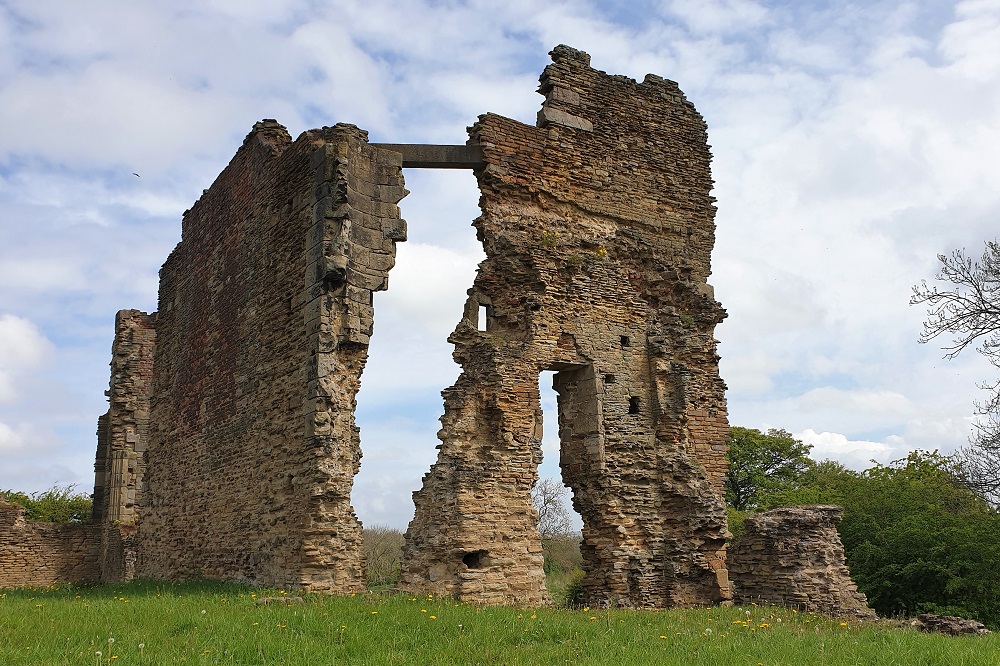
Codnor Castle is a ruined 13th-century castle in Derbyshire, England. The land around Codnor came under the jurisdiction of William Peverel after the Norman Conquest. The building is registered as a Scheduled Ancient Monument a Grade II Listed Building and is officially a Building at Risk.
The castle is a stone keep and bailey fortress, and was established by William Peverel. The present fragmentary remains represent a three-storey keep and a strong curtain wall and ditch, flanked by round towers. The outer bailey is on a lower level, and was constructed at a later period. The castle overlooks the Erewash valley and the counties of Derbyshire and Nottinghamshire. It originally had a deep moat, and on its eastern side, there was once a considerable abundance of trees, which have now been cut down. On the west side, there was a courtyard that was strongly fortified by huge round towers, which had battlements. In other parts of the ruins, there is evidence that the outer walls had arrow-loops included to allow bowmen to use them if necessary.
By 1211, it was owned by Henry de Grey, a descendant of the Norman knight Anchetil de Greye. Henry's descendants include the long line of Lords Grey of Codnor, the Lords Grey of Ruthyn, Wilton and Rotherfield, Lady Jane Grey and the Earls of Stamford, and the extinct families of the Dukes of Suffolk and Kent. His son Richard settled in Codnor and was a loyal Baron to Henry III. Along with his brother John, they served the King in the Holy Land. John Grey distinguished himself in the Scottish wars, and found himself in great favour with Edward III. Together with William D'Eincourt, the Lord Grey commanded all the knights of Derbyshire and Nottinghamshire in case of an invasion. Henry, the last of the family, died during the reign of Henry VII without a legitimate heir. He left part of his lands to his illegitimate sons, Henry and Richard, and part to his widow, Katherine Stourton.
The remainder went to his aunt Elizabeth Grey, who in 1429 married Sir John Zouche, the youngest son of the fourth Baron Zouche of Harringworth. Sir John Zouche of Codnor was three times High Sheriff of Derbyshire. The castle remained in the hands of the Zouche family for two hundred years until they sold up and emigrated to Virginia in 1634.
Text adapted from “Codnor Castle” on Wikipedia, CC BY-SA 4.0.
Codnor Castle ranks #2,139 of 9,079 worldwide in the atlas's castle fame ranking, and #145 of the 360 mapped in England. Founded c. 1250, it is older than 67% of the atlas's dated landmarks — one of 1080 atlas entries founded in the 13th century. Its Wikipedia articles were opened 1,141 times in the last 60 days, more than 54% of the atlas. 5 more atlas landmarks stand within 25 km. The nearest day-trip guide is Sheffield, 38 km away. See how England compares in the castle statistics.
View on the interactive castle map →